Hotel FF&E stands for Furniture, Fixtures, and Equipment. It includes the furniture, decorative fixtures, and equipment used to make hotel guestrooms and public areas functional, comfortable, and guest-ready.
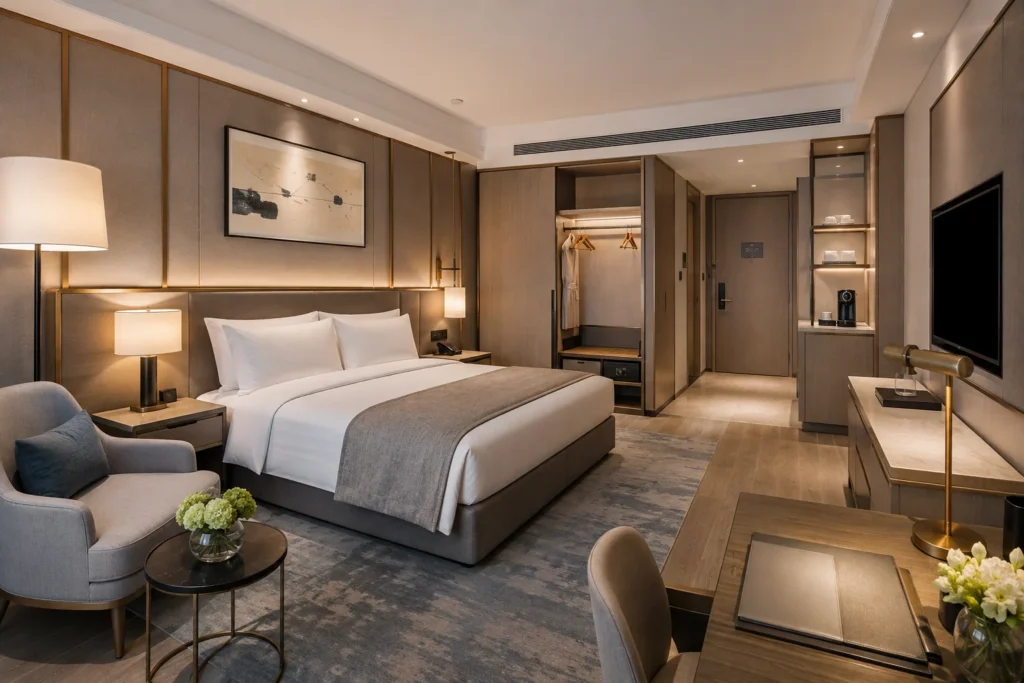
Common hotel FF&E examples include beds, headboards, desks, chairs, decorative lighting, mirrors, TVs, minibars, and safes.
However, not every item fits neatly into one category. Built-in wardrobes, bathroom vanities, headboard walls, and millwork may fall under FF&E, fixed furniture, or interior fit-out. The exact scope depends on the project specifications and responsibility matrix.
This guide explains what hotel FF&E includes, where project scope boundaries can become unclear, and how FF&E differs from OS&E, fixed furniture, and hotel fit-out.
What Does FF&E Stand For in Hotels?
FF&E stands for Furniture, Fixtures, and Equipment.
In hotel projects, the term covers many products used to furnish, equip, and complete guestrooms and public spaces.
The exact scope can vary by project. However, FF&E usually includes three broad categories:
Items used for sleeping, sitting, working, dining, or storage.
Examples: Beds, desks, sofas, wardrobes, and tables.
Decorative or semi-fixed elements included in the project scope.
Examples: Mirrors, decorative lighting, wall accessories, and decorative panels.
Functional equipment used by hotel guests or staff.
Examples: TVs, safes, minibars, and selected guestroom appliances.
Furniture
Furniture often represents a major part of a hotel FF&E package.
Typical hotel furniture includes:
- Beds and bed bases
- Headboards
- Nightstands
- Desks
- Chairs
- Sofas
- Coffee tables
- Dining tables
- Wardrobes
- Luggage benches
- Reception furniture
These pieces support sleeping, working, dining, storage, and relaxation across guestrooms and public areas. Because hotel furniture faces heavier use than most residential furniture, projects often require commercial-grade construction, durable finishes, reliable hardware, and consistent production quality.
Many hotels also use custom hotel furniture to fit room dimensions, brand standards, and specific design requirements.
Fixtures
Fixtures are one of the less clearly defined categories within hotel FF&E.
Depending on the project scope, they may include:
- Decorative lighting
- Mirrors
- Selected wall-mounted accessories
- Decorative panels
- Window treatments
Not every fixed item is automatically part of FF&E. A decorative wall light may sit within the FF&E package, while an integrated lighting system may fall under electrical or fit-out work.
The final classification should follow the project specifications, BOQ, and responsibility matrix.
Equipment
Equipment includes functional products used across hotel guestrooms and public areas.
Common hotel FF&E equipment includes:
- Televisions
- Minibars
- Safes
- Selected guestroom appliances
- Guest-facing electronic equipment
The exact list varies by hotel concept, brand standards, and project scope. The approved FF&E schedule and specifications should always take priority over a generic checklist.
What Is Included in Hotel FF&E?
There is no single hotel FF&E list that fits every property. A business hotel, luxury resort, and boutique hotel will each require a different mix of furniture, fixtures, and equipment.
Still, most hotel FF&E packages cover the same core areas.
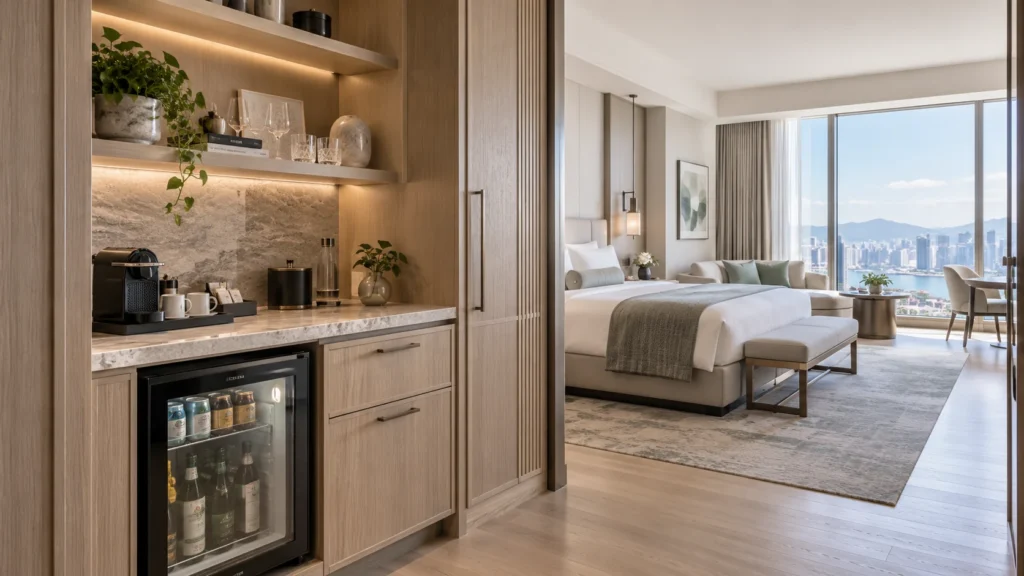
Guestroom FF&E
Guestrooms usually contain the most repeated FF&E items in a hotel project.
Because these items may repeat across hundreds of rooms, dimensions, materials, finishes, and hardware must remain consistent. See our hotel room furniture packages guide for a closer look.
Suite FF&E
Suites usually combine standard guestroom FF&E with additional living and dining furniture.
Suites often use more customized finishes and statement pieces to reinforce the hotel's design identity.
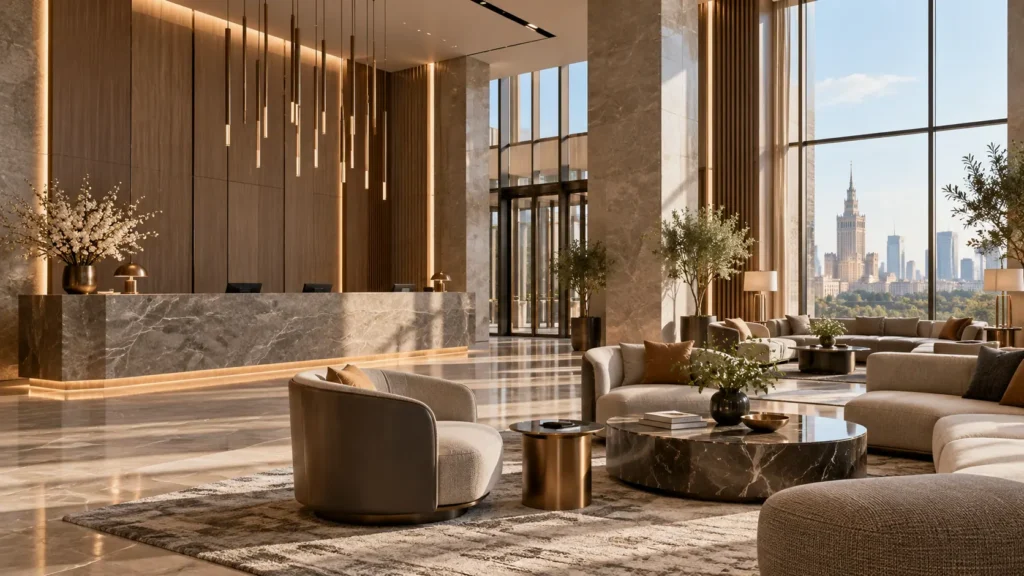
Lobby & Reception FF&E
Lobby FF&E must create a strong first impression while handling constant guest traffic.
These pieces need to balance visual impact, comfort, durability, and easy maintenance.
Restaurant & Bar FF&E
Hotel restaurants and bars often combine loose furniture with fixed installations and custom millwork.
Fixed bars, buffet counters, and service stations may fall under a separate millwork or fit-out package. Learn more about hotel restaurant furniture .
Meeting & Event Space FF&E
Meeting and event spaces need furniture that can adapt to different layouts and functions.
Flexibility matters because one room may serve as a boardroom, training space, meeting room, or private event venue.
Outdoor & Leisure FF&E
Outdoor hotel FF&E must perform in conditions that are much tougher than indoor environments.
Materials should be selected for exposure to sunlight, moisture, salt air, temperature changes, and frequent commercial use.
Three Common Hotel FF&E Scope Boundaries
Hotel FF&E often overlaps with other project scopes. The most common confusion involves building systems, interior fit-out, and OS&E.
Understanding these boundaries helps project teams define responsibilities before sourcing, production, and installation begin.
Building & MEP Systems
Structural walls, major HVAC systems, elevators, permanent plumbing, and main electrical infrastructure normally sit outside hotel FF&E.
Interior Fit-Out & Fixed Works
Built-in joinery, bathroom vanities, wall systems, and custom millwork may fall under FF&E, fit-out, or a separate trade package.
OS&E
Linens, towels, tableware, glassware, utensils, and housekeeping supplies support daily hotel operations rather than furnishing the space.
Some items still sit between these scopes. Built-in wardrobes, bathroom vanities, decorative lighting, and custom millwork are common examples.
The next section explains when these items may—or may not—be included in the hotel FF&E scope.
Which Hotel Items May or May Not Be Included in FF&E?
Hotel FF&E does not always fit into clear-cut categories. Some built-in or integrated items may fall under FF&E in one project, but under millwork, joinery, electrical, or fit-out in another.
The final classification usually depends on the project drawings, specifications, BOQ, contract packages, and responsibility matrix. The examples below show some of the most common gray areas.

Are Built-In Wardrobes Considered FF&E?
A freestanding wardrobe is clearly furniture. A built-in wardrobe may instead fall under FF&E, fixed furniture, joinery, architectural millwork, or interior fit-out.
The difference often comes down to site coordination. Built-in wardrobes may interact with walls, ceilings, flooring, lighting, and electrical points.
Who measures, manufactures, delivers, and installs the wardrobe can also affect how the scope is defined.
Are Headboard Wall Systems Considered FF&E?
A loose upholstered headboard normally fits within FF&E. A full headboard wall is more complex.
It may combine upholstered panels, timber finishes, metal trims, bedside units, electrical cutouts, and integrated lighting.
Depending on the project, the complete system may sit under FF&E, fixed furniture, millwork, or hotel fit-out.
Is a Bathroom Vanity Considered FF&E?
A hotel bathroom vanity can combine cabinetry, stone, basins, mirrors, lighting, and plumbing interfaces.
One supplier may manufacture the cabinet, another may provide the stone top, while a plumbing contractor completes the final connections.
For that reason, vanities may fall under FF&E, joinery, millwork, or interior fit-out. See our hotel bathroom vanity manufacturing guide for more detail.
Is Decorative Lighting Part of FF&E?
Decorative lighting is commonly included in hotel FF&E. Typical examples include table lamps, floor lamps, pendants, and decorative wall lights.
Integrated lighting can cross into electrical or fit-out work. An illuminated headboard wall, for example, may involve wiring, drivers, controls, and site installation.
The project team should define who supplies, connects, installs, and tests each lighting element.
Are Millwork and Wall Panels Considered FF&E?
Millwork and wall panels may be included in a broader FF&E package, but they are often treated as a separate millwork or fit-out scope.
Typical examples include:
- Wall panels
- Fixed TV walls
- Built-in cabinets
- Reception desks
- Bar fronts
- Decorative joinery
These elements usually require closer coordination with site dimensions, finishes, electrical points, and surrounding construction.
Do not classify an item by its name alone. Follow the approved drawings, specifications, BOQ, contract packages, and responsibility matrix.
Hotel FF&E vs OS&E: What's the Difference?
The main difference between FF&E and OS&E is how the items are used in a hotel.
FF&E stands for Furniture, Fixtures, and Equipment. It covers longer-life furnishings and equipment that help create functional guest and public spaces.
OS&E stands for Operating Supplies and Equipment. It includes many items needed for daily hotel operations and guest service.
Common hotel OS&E examples include:
- Linens and towels
- Glassware and tableware
- Cutlery
- Kitchen smallwares
- Housekeeping supplies
- Guest amenities
A simple way to remember the difference is:
FF&E helps furnish and equip the hotel. OS&E helps operate it every day.
Hotel FF&E vs Fit-Out: Where Does Fixed Furniture Fit?
Hotel FF&E and hotel fit-out are closely related, but they do not describe the same project scope.
Loose FF&E is usually easy to identify. Fixed furniture may fall within either the FF&E or fit-out scope, while fit-out covers a broader part of the completed interior.

What Is Loose FF&E?
Loose FF&E includes furniture and equipment that can usually be moved or replaced without major building work.
Common examples include:
- Chairs
- Sofas
- Coffee tables
- Side tables
- Loose desks
- Freestanding furniture
These items are typically delivered as finished products and placed in position during installation.
What Is Fixed Hotel Furniture?
Fixed hotel furniture is attached to, or closely integrated with, the room.
Typical examples include:
- Built-in wardrobes
- Fixed desks
- Headboard walls
- TV wall units
- Bathroom vanities
- Built-in shelving
Unlike loose FF&E, these items usually require closer site coordination. Dimensions must match actual room conditions, while walls, floors, ceilings, electrical points, and plumbing may affect installation.
Depending on the project, fixed furniture may sit within the FF&E package or under a separate millwork, joinery, or fit-out scope.
What Is Hotel Fit-Out?
Hotel fit-out covers a broader scope than FF&E alone.
It brings together the fixed elements, finishes, furniture, millwork, services coordination, and installation needed to complete an interior space.
Depending on the contract, a hotel fit-out package may include:
- Interior finishes
- Fixed furniture
- Architectural millwork
- Doors and wall systems
- Selected FF&E
- Site coordination
- Installation
For a deeper look at the full process, see our hotel fit out guide.
A simple way to understand the relationship is:
Loose FF&E furnishes the space. Fixed furniture integrates with the space. Fit-out brings the complete interior together.
Why Does Hotel FF&E Matter?
Hotel FF&E shapes more than the look of a hotel. It affects how guests use the space, how staff maintain it, and how well the property performs over time.
Guest Comfort & Experience
Guests experience FF&E through everyday use. The bedside table needs to be within reach, the desk chair should match the desk height, and luggage storage should not block circulation.
Small design decisions can make a guestroom noticeably easier and more comfortable to use.
Brand Identity
Furniture, materials, finishes, and detailing help turn a hotel concept into a physical experience. A luxury resort should feel different from an airport business hotel.
Consistent FF&E helps connect guestrooms and public areas to the same visual identity.
Hotel Operations & Maintenance
Hotel furniture also needs to work for housekeeping and maintenance teams. Surfaces should be easy to clean, while hardware and damaged components should be practical to access and replace.
A product that looks good but is difficult to maintain can quickly become an operational burden.
Durability & Lifecycle Value
Hotel furniture faces repeated daily use. Edges get knocked, drawers are opened constantly, upholstery is cleaned often, and hardware wears over time.
The lowest purchase price is not always the lowest cost over the product's full life.
How Is Hotel Furniture Different from Residential Furniture?
Furniture is a major part of hotel FF&E, but hotel furniture faces very different demands from furniture used at home.
It must handle heavier use, frequent cleaning, and consistent performance across many rooms.
Built for Heavier Use
Hotel furniture is used by different guests every day.
Drawers, hinges, glides, upholstery, edges, and finishes all face repeated wear. Products therefore need to withstand more frequent use than furniture in most homes.
Commercial-Grade Performance
Hotel furniture often requires stronger construction, durable finishes, and hardware suited to commercial use.
SATRA highlights strength, stability, surface durability, upholstery performance, and safety when evaluating furniture for non-domestic environments.
The exact requirements depend on the project, local regulations, and hotel brand standards.
Maintenance and Repairability
Good hotel furniture should be easy to clean, maintain, and repair.
Can housekeeping reach the surfaces easily? Can maintenance replace a hinge or damaged panel without removing the whole unit?
These practical details can reduce downtime and make long-term maintenance much easier.
Repeatability at Scale
A custom cabinet for one home is a single product. Hundreds of hotel cabinets are a production system.
Dimensions, finishes, drilling positions, hardware, and packaging all need to remain consistent across the project.
Before full production, hotel furniture projects typically use shop drawings, material samples, prototypes, mock-up rooms, and quality control (QC) to verify consistency and reduce production risks.
Who Is Responsible for Hotel FF&E?
Hotel FF&E is rarely managed by a single party. Responsibility is usually shared across the owner, design team, operator, procurement team, manufacturers, and site contractors.
Each stakeholder handles a different part of the process.
| Stakeholder | Typical FF&E Responsibility |
|---|---|
| Owner / Developer | Approves the scope, budget, and major project decisions. |
| Hotel Brand / Operator | Defines brand standards and operational requirements. |
| Interior Designer | Develops the FF&E design, selections, and specifications. |
| Architect / Consultant | Coordinates drawings, interfaces, and technical requirements. |
| Procurement Team | Manages sourcing, tendering, orders, and supplier coordination. |
| Manufacturer | Develops shop drawings and samples, then manufactures approved items. |
| Logistics Team | Coordinates freight, delivery, storage, and site sequencing. |
| Installer / Contractor | Handles installation, site coordination, and handover. |
Clear responsibilities become especially important when one item crosses several trades.
A bathroom vanity, for example, may involve cabinetry, stone, plumbing, lighting, and installation. If supply and installation responsibilities are not defined early, gaps can appear during site execution.
A clear responsibility matrix helps identify who specifies, supplies, approves, installs, and signs off each FF&E item before work begins.
What Is a Hotel FF&E Schedule?
A hotel FF&E schedule is a working document that lists the furniture, fixtures, and equipment required for a project.
It gives designers, procurement teams, manufacturers, and contractors a shared reference for what is specified, where it is used, and how much is required.
A typical FF&E schedule may include:
- Item code
- Product description
- Room or area
- Quantity
- Dimensions
- Materials
- Finish
- Specification reference
- Approval status
As the project moves into procurement, the schedule may also track supplier information, lead times, order status, and delivery dates.
This level of control matters in hotels because one specification change may affect dozens or hundreds of guestrooms.
A well-managed FF&E schedule helps keep design, purchasing, production, and site teams working from the same approved information.
How Does Hotel FF&E Move From Design to Installation?
Hotel FF&E moves through several stages before it reaches the guestroom or public area.
Each stage confirms a different part of the project, from design intent to final installation.

The design team defines the look, function, materials, finishes, and overall room concept.
Furniture layouts are also coordinated with circulation, lighting, power points, and other interior elements.
Each item is documented with details such as quantity, dimensions, materials, finishes, and performance requirements.
This information becomes the reference for sourcing, pricing, engineering, and production.
Manufacturers translate the approved design into buildable details.
Shop drawings confirm dimensions, construction, materials, hardware, fixing methods, and interfaces with the site.
Samples help confirm colors, finishes, fabrics, hardware, and material quality before mass production.
More complex custom pieces may also require a prototype for further review.
A mock-up room brings multiple FF&E items together in one real space.
It allows the project team to check proportions, clearances, finishes, lighting interfaces, and installation details.
Once drawings, samples, and mock-ups are approved, production can begin.
Consistency becomes critical when the same furniture is repeated across dozens or hundreds of guestrooms.
QC checks may cover dimensions, construction, finishes, hardware, quantities, labeling, and packaging.
Problems are much easier to correct before products leave the factory.
Finished FF&E is packed, shipped, delivered, and installed according to the project sequence.
Site access, room readiness, storage, and installation coordination all affect the final handover.
VOLANT supports this process through engineering, custom furniture manufacturing, QC, delivery, and installation support. For a closer look at shop drawings, samples, prototypes, mock-up rooms, and production, see our custom hotel furniture guide .
What Should You Consider When Selecting Hotel FF&E?
Selecting hotel FF&E is not only about appearance. Each item also needs to work for guests, hotel staff, and the project team.
Focus on these seven factors:
Dimensions should support real guest behavior, including seating, storage, circulation, and reach.
Materials, finishes, hardware, and construction should suit frequent commercial hotel use.
Choose finishes and components that are practical to clean, repair, and replace.
FF&E should support the hotel's design language and brand standards without sacrificing function.
Dimensions, finishes, hardware, and workmanship should remain consistent across repeated rooms.
Products may need to meet fire, accessibility, performance, and brand-specific requirements.
Designs should be practical to engineer, manufacture, deliver, and install before mass production begins.
Best practice: Select hotel FF&E by balancing design, function, durability, maintenance, compliance, and execution—not appearance alone.
How Is Hotel FF&E Procured?
Hotel FF&E procurement turns approved designs and specifications into products that are manufactured, delivered, and installed on site.
A typical process moves through:
Scope
Specifications
Supplier Sourcing
Approvals
Manufacturing
QC
Logistics
Installation
The exact workflow varies by project, but the goal is the same: keep design intent, budget, quality, lead times, and site delivery aligned.
For a step-by-step breakdown of budgeting, RFP preparation, supplier sourcing, bid comparison, samples, mock-up rooms, logistics, installation, and handover, see our Hotel FF&E Procurement Guide.

Final Thoughts on Hotel FF&E
A clear hotel FF&E scope helps keep design, manufacturing, fit-out, and installation aligned from the start.
VOLANT supports hotel projects with engineering, custom furniture and millwork manufacturing, QC, delivery, and installation support. This helps reduce coordination gaps between design intent, production, and site execution.
Planning a hotel FF&E or fit-out project? Contact VOLANT to discuss your project scope, furniture requirements, and delivery plan.
FAQs
What does FF&E stand for in hotels?
FF&E stands for Furniture, Fixtures, and Equipment. It includes the furniture, decorative fixtures, and equipment used to furnish and equip hotel guestrooms and public spaces.
What is included in hotel FF&E?
Hotel FF&E commonly includes beds, headboards, wardrobes, desks, chairs, sofas, tables, decorative lighting, mirrors, TVs, minibars, and safes. The exact list depends on the hotel design and project scope.
What is the difference between FF&E and OS&E?
FF&E covers longer-life furniture, fixtures, and equipment used to furnish hotel spaces. OS&E covers operating items such as linens, towels, tableware, housekeeping supplies, and guest amenities.
Is built-in furniture considered FF&E?
Sometimes. Built-in wardrobes, headboard walls, vanities, and similar items may fall under FF&E, fixed furniture, millwork, or fit-out. The project specifications and responsibility matrix should define the final scope.
Is decorative lighting part of hotel FF&E?
Usually. Table lamps, floor lamps, pendants, and decorative wall lights are commonly included in hotel FF&E. Integrated lighting may instead fall under electrical or fit-out work.
Is a bathroom vanity considered FF&E?
It depends on the project. A bathroom vanity may be classified under FF&E, joinery, millwork, or interior fit-out, especially when cabinetry, stone, plumbing, and installation involve different trades.
What is a hotel FF&E schedule?
A hotel FF&E schedule is a working document that records the furniture, fixtures, and equipment required for the project. It may include item codes, locations, quantities, dimensions, materials, finishes, specifications, and approval status.
What is the difference between hotel FF&E and fit-out?
FF&E focuses on the furniture, fixtures, and equipment used within the hotel. Fit-out is broader and may include fixed furniture, millwork, finishes, wall systems, site coordination, and installation.