Choosing acoustic doors for hotels involves more than selecting a thick door. The right solution depends on the required sound insulation, door construction, seals, and installation quality.
This guide explains STC and Rw ratings, compares options for different hotel spaces, and shows how to evaluate acoustic door assemblies. You’ll also learn what to check in test reports and specifications before placing an order.
Quick answer: Start with your project’s acoustic requirements, then verify the tested door assembly, including its frame, seals, and hardware. The rating alone cannot guarantee the same performance on site.
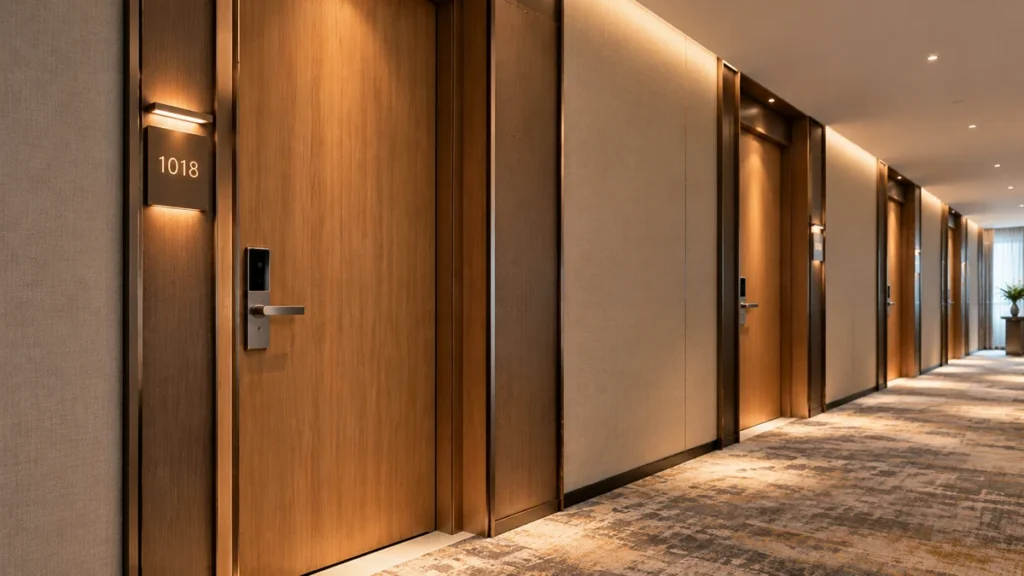
What Are Acoustic Doors for Hotels?
Acoustic doors for hotels are designed to reduce sound transmission between spaces. They help limit hallway conversations, television noise, and sounds from adjacent rooms.
Unlike standard interior doors, acoustic door assemblies are designed to meet specific sound-insulation targets. Their performance depends on the door construction, frame, seals, and installation quality.
Although “soundproof hotel door” is common in product marketing, no door should be assumed to block all sound. Check documented test results rather than relying on product descriptions alone. The Steel Door Institute’s acoustic door guide provides further technical guidance.
STC vs. Rw: Understanding Acoustic Door Ratings
STC and Rw are single-number ratings used to describe airborne sound insulation. Both help compare acoustic performance, but they follow different rating systems.
What Is an STC Rating?
STC (Sound Transmission Class) is commonly used in the United States to rate the airborne sound insulation of building elements, including door assemblies.
The rating is derived from sound transmission loss measurements across specified frequencies. A higher STC rating generally indicates better sound insulation under comparable laboratory conditions.
Two ASTM standards play different roles in this process:
- ASTM E90: Measures airborne sound transmission loss under laboratory conditions. View the test method.
- ASTM E413: Defines the classification procedure used to determine STC ratings from sound transmission loss data. View the classification standard.
What Is an Rw Rating?
Rw (Weighted Sound Reduction Index) is commonly used in markets following the ISO acoustic rating framework.
Laboratory measurements of airborne sound insulation can be conducted in accordance with ISO 10140-2:2021, while ISO 717-1:2020 defines the procedure for deriving single-number ratings from those measurements.
Are STC and Rw Ratings Interchangeable?
No. STC and Rw use different rating procedures and frequency ranges. Their numerical values may be similar for some constructions, but they should not be treated as equivalent.
When comparing acoustic hotel doors from different suppliers, check the applicable test standard and supporting report. Do not compare rating numbers alone.
How Should You Choose an Acoustic Rating for Hotel Doors?
The right STC or Rw rating depends on the hotel’s layout, noise sources, and acoustic requirements. Different spaces may need different levels of sound insulation.
| Hotel Door Location | Key Acoustic Considerations |
|---|---|
| Guestroom entrance | Corridor noise, guest privacy, and gaps around the closed door |
| Connecting rooms | Sound transmission between adjoining rooms and the tested door configuration |
| Suites and premium rooms | Privacy expectations, perimeter seals, and specified acoustic targets |
| Meeting and conference rooms | Speech privacy, room use, and project acoustic requirements |
| Service or plant rooms | Equipment noise, operating conditions, and ventilation requirements |
For example, a guestroom facing a busy corridor may need different acoustic treatment from one opening onto a quiet interior space.
Before choosing a rating: Check the project’s acoustic specification and verify the supporting test report. The required performance should reflect the intended use and surrounding construction, not the hotel’s star classification alone.
What Makes a Complete Acoustic Door Assembly?
An acoustic door is a complete system, not just a heavy door leaf. The frame, seals, hardware, and installation all influence sound insulation.

Door Leaf and Core
The door core, thickness, mass, and construction affect sound transmission. Material specifications alone cannot establish the door's acoustic rating. Check the test report for the complete assembly.

Door Frame
The frame must match the specified door and sealing system. Poor alignment can leave gaps and prevent seals from making consistent contact when the door closes.

Perimeter Acoustic Seals
Perimeter seals run along the top and sides of the door frame. Their position, profile, and compression help close gaps when the door is shut.

Door Bottom Seals and Thresholds
An automatic drop seal can help close the gap beneath a door. The floor surface, threshold, and operating clearances must suit the selected system.
Hinges, locks, glazing, and other hardware may also affect the tested configuration. Changes to these components should be checked against the supporting documentation.
Buyer tip: Request acoustic test evidence for the complete door assembly, not just the door leaf. Confirm that the tested configuration matches the product you intend to order. The Steel Door Institute’s acoustic door guidance provides further technical information.
How Do Acoustic Door Seals Improve Sound Control?
Even a well-built door can lose acoustic performance if gaps remain around its edges. Acoustic door seals help reduce sound transmission by closing these gaps when the door is shut.
Perimeter Acoustic Seals
Perimeter acoustic seals run along the top and sides of the door frame. They compress against the closed door to help limit sound leakage.
Correct positioning and compression are essential. If a seal makes uneven contact, gaps may remain and reduce the assembly’s acoustic performance.
Automatic Drop Seals and Door Bottom Gaps

An automatic drop seal lowers when the door closes and retracts when it opens. It helps close the gap beneath the door without requiring a permanently raised threshold in every application.
The floor surface and operating clearances must suit the selected system. Uneven floors or incorrect adjustment can prevent consistent contact.
Why Seal Compatibility Matters
Adding more seals does not automatically improve sound insulation. The seals must work with the door leaf, frame, hardware, and installation details as a complete system.
Before ordering or replacing acoustic door seals, check that:
- The seal type and position match the specified door assembly.
- The door closes and latches correctly without excessive resistance.
- The bottom gap, floor surface, and threshold suit the selected seal.
- The supporting test documentation covers the proposed configuration.
Important
Acoustic seals are not automatically approved for fire or smoke control. If the project requires these functions, verify the relevant product documentation and confirm that the seals are permitted in the approved door assembly.
Why Can On-Site Sound Insulation Differ from Laboratory Ratings?
Laboratory ratings measure performance under controlled conditions. A completed hotel room introduces additional variables that can affect sound insulation.
The ISO 10140-2:2021 standard specifies laboratory methods for measuring airborne sound insulation in building elements. Laboratory results cannot be applied directly to field conditions without accounting for factors such as flanking transmission, boundary conditions, and total loss factor.
Common causes of poor on-site performance include:
- Gaps around the door: Unsealed openings can allow sound to pass through.
- Poor frame installation: Misalignment can prevent seals from making consistent contact.
- Weak surrounding construction: Sound can travel through adjacent walls, ceilings, or other building elements.
- Unsealed service penetrations: Gaps around pipes, ducts, and cables can create additional sound paths.
- Incorrect door adjustment: Uneven closing or latching can leave gaps around the door.

Think of the door as one part of a larger sound-control system. Even a well-tested acoustic door may underperform if sound bypasses it through surrounding construction.
For projects with demanding acoustic targets, coordinate door specifications with the architect and acoustic consultant. Consider on-site acoustic testing when required by the project specification.
Can Acoustic Hotel Doors Also Be Fire-Rated?
Yes. A door assembly can meet both acoustic and fire-protection requirements, but each performance must be verified separately.
Fire Performance
- Required rating: Confirm the fire-resistance rating required by the project and applicable regulations.
- Certification: Check the relevant certification or listing and its scope of application.
- Approved assembly: Verify that the door leaf, frame, glazing, seals, and hardware match the approved configuration.
- Component changes: Confirm that proposed substitutions are permitted before ordering.
Acoustic Performance
- Target rating: Confirm the specified STC or Rw requirement for the project.
- Test evidence: Check the test standard, laboratory report, and reported rating.
- Tested configuration: Verify that the report covers the proposed door leaf, frame, seals, glazing, and hardware, as applicable.
- Installation: Confirm that the specified installation details are consistent with the tested assembly.
Neither rating proves the other. Before ordering, verify that all components match the documented configuration. For more guidance, see our guide to fire-rated doors for hotels.
Acoustic Hotel Door Specification Checklist
A clear acoustic door specification helps suppliers quote comparable products and reduces costly changes during production and installation.
Use this checklist when preparing a door schedule or request for quotation (RFQ).
| Specification Field | What to Confirm |
|---|---|
| Door Identification | Door number, room type, and opening location. |
| Acoustic Target | Required STC or Rw rating and applicable test standard. |
| Tested Assembly | Door leaf, frame, seals, hardware, and glazing, where applicable. |
| Seals and Threshold | Perimeter seals, bottom seal, threshold, and required clearances. |
| Dimensions and Finish | Door size, thickness, finish, and glazing requirements. |
| Hardware | Lockset, hinges, closer, latching requirements, and hardware templates. |
| Fire Performance | Required fire rating and supporting certification or listing, where applicable. |
| Supporting Documents | Acoustic test reports, product identification, and installation instructions. |
| Installation and Inspection | Wall interface, door gaps, adjustment, and inspection requirements. |
Before approving a quotation, ask the supplier to identify any differences between the proposed product and the tested assembly. Confirm that the supporting documentation covers the specified configuration.
For custom hotel doors, coordinate acoustic requirements with door dimensions, finishes, and hardware templates before factory machining begins.
Common Mistakes When Specifying Acoustic Hotel Doors
Avoid these common mistakes during design, purchasing, and installation.
1. Choosing by Rating Alone
A rating should be assessed alongside the test report and the specific door assembly to which it applies. Verify the tested door assembly and confirm that it matches the proposed configuration.
2. Treating STC and Rw as Equivalent
STC and Rw follow different rating systems. Check the applicable test standard before comparing ratings from different suppliers.
3. Ignoring the Bottom Gap
An unsuitable bottom seal or excessive floor clearance can undermine sound control. Check the threshold, floor surface, and seal adjustment.
4. Mixing Unverified Components
Changing the frame, seals, glazing, or hardware may affect documented performance. Confirm compatibility before approving substitutions.
5. Assuming Fire and Acoustic Ratings Are Interchangeable
Fire resistance and sound insulation are separate performance requirements. Verify the relevant evidence for each when both are required.
6. Changing Specifications Too Late
Late changes can delay production and complicate installation. Finalize acoustic targets, dimensions, finishes, and hardware before factory machining begins.
Conclusion: Specify the Complete Acoustic Door System
Choosing acoustic doors for hotels starts with a clear STC or Rw target. The door leaf, frame, seals, hardware, and installation must work together to achieve the specified performance.
Before ordering, verify the test documentation and confirm that the proposed configuration meets your project requirements.
Planning a Hotel Door Project?
VOLANT provides custom hotel door and window solutions, including guestroom doors, connecting doors, and customized door systems. Discuss your project's acoustic requirements with the team and request relevant performance documentation before finalizing your specification.
FAQs
What STC Rating Should a Hotel Guestroom Door Have?
There is no universal STC rating for hotel guestroom doors. The target depends on project requirements, noise levels, and surrounding construction.
Are STC and Rw Ratings Interchangeable?
No. STC and Rw use different rating systems and frequency ranges. Check the applicable test standard when comparing acoustic hotel doors.
Can Acoustic Hotel Doors Make a Room Completely Soundproof?
No. Acoustic hotel doors reduce sound transmission, but noise can still travel through gaps, walls, ceilings, and service openings.
Do Acoustic Door Seals Improve Sound Insulation?
Yes. Properly fitted perimeter seals and automatic drop seals help reduce sound leakage through door gaps. Overall performance depends on the complete door assembly.
Can Acoustic Hotel Doors Also Be Fire-Rated?
Yes. A door assembly can meet both requirements, but fire resistance and acoustic performance must be verified separately through appropriate documentation.
Why Can Acoustic Doors Perform Differently On Site Than in a Laboratory?
Gaps, poor frame alignment, incorrect adjustments, and surrounding construction can reduce on-site sound insulation compared with laboratory results.
What Documents Should I Request When Buying Acoustic Hotel Doors?
Request the acoustic test report, applicable standard, product identification, and installation instructions. Confirm that the tested assembly matches the proposed door configuration.