Contract grade furniture vs. residential furniture is an important consideration when furnishing a hotel. Although both may look similar, they are designed for different usage conditions and performance requirements.
Hotel furniture must do more than look good. It needs to withstand frequent use, maintain guest comfort, and support efficient maintenance over time. So, does every hotel need contract grade furniture? Not necessarily.
The right choice depends on the furniture type, usage frequency, project specifications, and expected service life. This guide explores the key differences, advantages, and limitations of both options. It also explains how hotel buyers can select furniture that meets their operational needs and long-term investment goals.
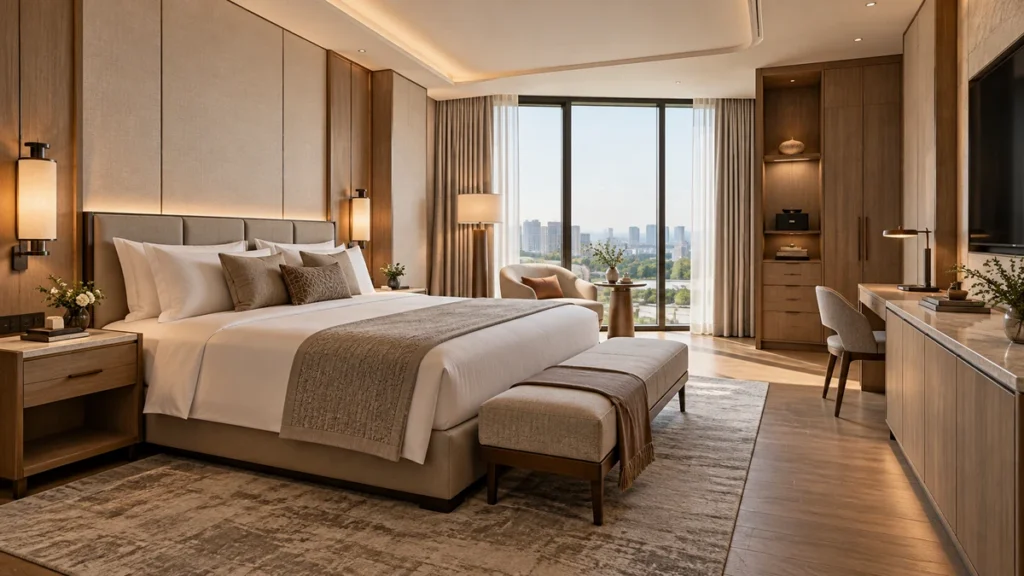
What Is Contract Grade Furniture?
Contract grade furniture is designed for commercial environments with frequent use and demanding operating conditions. Common applications include hotels, restaurants, offices, and public spaces.
Unlike residential furniture, contract furniture must meet the performance requirements of its intended environment. These may include structural strength, material durability, safety, and ease of maintenance.
However, contract grade is not a universal certification. Furniture suitability depends on its construction, specifications, applicable testing standards, and intended use.
For hotels, key requirements include:
- Frequent Use: Withstand repeated use by different guests.
- Structural Durability: Maintain stability during daily operations.
- Material Performance: Resist everyday wear, scratches, and stains.
- Easy Maintenance: Support regular cleaning.
- Consistent Quality: Maintain uniform finishes and construction across multiple rooms.
These factors make contract grade furniture an important consideration for hospitality projects.
Contract Grade vs. Residential Furniture: 8 Key Differences
Although contract grade and residential furniture may look similar, they are designed for different usage conditions. For hotels, the main differences involve construction, materials, durability, safety, and long-term costs.
| Comparison Factor | Residential Furniture | Contract Grade Furniture |
|---|---|---|
| Frame Construction | Designed for typical household use | Specified for repeated commercial use |
| Materials & Finishes | Standard residential materials | Application-specific performance materials |
| Upholstery | Residential fabric options | Commercial performance fabrics |
| Safety & Compliance | Applicable residential requirements | Applicable commercial and project requirements |
| Maintenance | Routine household maintenance | Frequent commercial cleaning and maintenance |
| Customization | Standard sizes and finishes are common | Project-specific dimensions and finishes |
| Warranty | Usually covers residential use | Commercial-use coverage, where specified |
| Cost & Lifecycle Value | Often lower initial cost | May offer better long-term value |
These are general differences. Actual performance depends on product specifications, construction, and intended use.
Frame Construction and Structural Durability
Frame construction determines how well furniture handles repeated use and daily movement. Residential frames may suit household environments, but hotels require careful structural evaluation.
Key factors include:
- Frame material and thickness.
- Joint construction and reinforcement.
- Fastener quality and connection methods.
- Load capacity and structural stability.
Plywood, MDF, particleboard, and solid wood each have different properties. No material guarantees durability on its own. The right choice depends on furniture design, expected loads, environmental conditions, and manufacturing quality.
For hotel casegoods, structural integrity matters as much as appearance.

Materials, Finishes, and Hardware
Material selection affects furniture appearance, durability, and maintenance. Common panel substrates and surface finishes used in commercial furniture include:
Panel Substrates
- Plywood: Suitable for various structural applications.
- MDF: Provides a consistent surface for machining and finishing.
- Particleboard: Commonly used in engineered furniture panels.
Surface Materials and Finishes
- Wood Veneer: Creates a natural wood appearance.
- Melamine-Faced Panels: Offer practical, easy-to-maintain surfaces.
- Lacquer Coatings: Provide different gloss levels and surface finishes.
Hardware matters too. Hinges, drawer slides, connectors, and mounting systems affect everyday functionality.
Hotel buyers should evaluate material specifications, edge banding, finish resistance, and hardware quality together. A beautiful cabinet is not necessarily a durable cabinet.
Upholstery, Foam Density, and Fabric Durability
Hotel upholstery faces frequent contact, cleaning, and friction. Contract grade upholstery should therefore match the intended application.
Important considerations include:
- Fabric abrasion resistance.
- Colorfastness and light resistance.
- Resistance to approved cleaning products.
- Foam density and resilience.
- Seam construction and stitching quality.
Fabric abrasion is commonly measured using the Wyzenbeek test (ASTM D4157) and Martindale test (ASTM D4966). Wyzenbeek measures double rubs, while Martindale measures abrasion cycles using a figure-eight motion. See the ACT Textile Glossary for details.
However, results from these methods are not directly comparable and cannot independently predict fabric lifespan. Other factors, including cleaning, maintenance, and usage, also affect durability. See ACT’s abrasion guidance for more information.

Safety, Performance Standards, and Regulatory Requirements
Safety and compliance are essential when selecting commercial furniture. However, different standards address different products and performance requirements.
01. ANSI/BIFMA Standards
BIFMA develops voluntary standards for furniture safety, durability, and performance. Standards are organized by product category, so hotel buyers should identify the applicable requirements for each furniture type and intended use.
Request product-specific test reports and confirm that the tested model and configuration meet the applicable BIFMA standard.
02. Upholstered Furniture Requirements
In the United States, 16 CFR Part 1640 incorporates California TB 117-2013 smolder-resistance requirements for covered indoor upholstered seating furniture. Confirm whether each product falls within the regulation's scope or is exempt.
Confirm that the product is covered by the regulation and request applicable compliance documentation from the supplier.
03. Composite Wood Emissions
In the United States, EPA TSCA Title VI sets formaldehyde emission limits for regulated composite wood products, including hardwood plywood, medium-density fiberboard (MDF, including thin-MDF), and particleboard.
Request material compliance documentation and verify that regulated composite wood components meet applicable emission limits.
Maintenance, Repairability, and Replacement
Hotel furniture requires more frequent cleaning than typical residential furniture. This places additional demands on finishes, upholstery, hardware, and structural connections.
A practical maintenance strategy should consider:
- Resistance to approved cleaning products.
- Accessibility of replaceable components.
- Availability of matching materials and finishes.
- Ease of surface repairs.
- Availability of replacement hardware.
For large hotel projects, repairability can reduce unnecessary replacement costs. Modular designs also make future maintenance easier.
Customization and Brand Consistency
Hotels often follow specific interior design concepts and brand standards. Standard residential furniture may offer limited dimensions, finishes, and configurations.
Custom contract furniture provides greater flexibility. Hotel buyers can specify:
- Custom dimensions and layouts.
- Project-specific materials and finishes.
- Integrated storage and functional components.
- Matching designs across different room types.
For large hotel projects, consistency matters as much as individual product quality. A hotel with 200 guestrooms needs a coordinated furniture system, not simply 200 attractive furniture pieces.
Warranty and Commercial-Use Coverage
A residential furniture warranty does not automatically cover commercial use. Some manufacturers exclude hotels and other high-traffic environments from standard residential warranties.
Before purchasing, review:
- Commercial-use eligibility.
- Structural warranty coverage.
- Hardware and finish coverage.
- Upholstery exclusions.
- Repair and replacement conditions.
Always request written warranty terms to avoid unexpected costs after installation.
Initial Cost vs. Long-Term Value
Contract grade furniture may require a higher initial investment. However, purchase price alone does not determine overall value.
Frequent repairs, premature replacement, and room downtime can increase the total cost of residential furniture in demanding environments.
Hotel owners should compare the total cost of ownership (TCO), including all major expenses throughout the furniture’s service life:
TCO = Purchase + Shipping + Installation + Maintenance + Repair + Replacement + Operational Disruption
For a hotel with 150 guestrooms, even small per-room cost differences can add up.
The best purchasing decision balances initial investment, expected performance, maintenance requirements, and replacement planning.
Hotel Furniture Requirements by Application
Different hotel furniture types face different usage conditions. Their materials, construction, and performance requirements should reflect their intended applications.
Guestroom Furniture and Casegoods

Hotel guestrooms require both movable furniture and fixed casegoods or millwork, all of which must balance functionality, appearance, and durability under daily use.
Common products include:
- Headboard wall systems
- Wardrobes and storage cabinets
- TV cabinets and minibar units
- Nightstands and desks
- Bathroom vanities
- Integrated wall panels
Accurate dimensions, suitable materials, reliable hardware, and consistent finishes are essential. For large hotel projects, standardized specifications help maintain quality across multiple guestrooms.
Lobby and Public Area Furniture

Hotel lobby furniture typically experiences more frequent use than guestroom furniture. Reception desks, lounge seating, public storage, and decorative millwork must withstand continuous guest interaction.
Key requirements include:
- Structural stability
- Surface durability and cleanability
- Upholstery performance
- Consistent appearance
- Easy maintenance
These areas also shape guests’ first impressions. Furniture must combine durability with the hotel’s overall design identity.
Restaurant and Bar Furniture

Hotel restaurant and bar furniture faces frequent use, movement, and cleaning. Dining chairs, bar stools, tables, and banquettes should meet the demands of busy hospitality environments.
Buyers should consider:
- Frame strength and stability
- Seating comfort and support
- Fabric and surface durability
- Cleaning requirements
- Table and seating dimensions
The right specifications depend on the restaurant’s operating style, expected traffic, and interior design.
Can Hotels Use Residential Furniture?
Yes. Hotels can use residential furniture in selected applications, but suitability depends on the intended use and operating conditions.
Residential furniture may work well in low-traffic areas, decorative spaces, and some boutique hotels. However, high-traffic areas generally require furniture with proven commercial performance.
Consider the following examples:
| Hotel Application | Residential Furniture Suitability |
|---|---|
| High-Traffic Lobby | Generally unsuitable without proven commercial performance |
| Guestroom Accent Furniture | May be suitable after evaluation |
| Boutique Hotel Decorative Areas | Depends on usage and project requirements |
| Guestroom Casegoods | Commercial-grade construction is generally preferable |
| Luxury Suite Furniture | Depends on brand standards and product specifications |
A residential chair may perform well in a quiet guestroom but wear out faster in a busy hotel lounge.
Before choosing residential furniture, evaluate its construction, materials, expected usage, maintenance requirements, warranty coverage, and applicable safety standards.
The goal is not to choose the most expensive furniture. It’s to select furniture that meets the hotel’s actual operating needs.
How to Choose Contract Grade Furniture for Hotel Projects
Choosing the right contract furniture supplier involves more than comparing prices. Hotel buyers should evaluate product quality, manufacturing capabilities, and project support before making a decision.
Use these four steps to assess potential suppliers.
Define Hotel Project Requirements
Start by identifying the project's specific needs. Clear requirements help suppliers provide accurate quotations and suitable furniture solutions.
- Hotel category and brand standards.
- Number of guestrooms and room types.
- Furniture quantities and configurations.
- Expected usage conditions.
- Project budget and delivery schedule.
Prepare a clear project brief covering room quantities, brand standards, furniture requirements, and delivery milestones. Share the same brief with every supplier for accurate comparisons.
Review Materials and Technical Specifications
Request detailed product specifications before approving production. Material selection and construction directly affect furniture performance and service life.
- Board and frame materials.
- Surface finishes and edge treatments.
- Hardware specifications.
- Upholstery and foam details.
- Relevant test reports and certifications.
Request written specifications and supporting reports for the exact products being quoted. Verify that materials, finishes, and hardware match approved project requirements.
Evaluate Manufacturing and Quality Control
A reliable hotel furniture manufacturer should demonstrate consistent production capabilities. Review the factory's equipment, engineering processes, and quality control procedures.
- Technical drawings and approved material specifications.
- Pre-production samples for finish, dimensions, and construction review.
- Mock-up room coordination to verify product fit and design details.
- In-process quality inspections during manufacturing.
- Final product inspection records before shipment.
If possible, visit the factory to review machinery, production workflows, material handling, and inspection procedures. This helps verify the manufacturer's actual production capabilities.
Check Delivery, Installation, and After-Sales Support
Manufacturing quality alone doesn't guarantee a successful hotel project. Furniture must arrive in good condition and meet approved site requirements.
- Packaging and transportation procedures.
- Room-based component identification.
- Installation planning and coordination.
- Replacement parts availability.
- Warranty and after-sales support.
Confirm packaging, shipping schedules, room identification, installation responsibilities, warranty terms, and replacement-part support before finalizing the supplier agreement.
How Advanced Manufacturing Improves Hotel Furniture Quality
Modern hotel furniture manufacturing involves more than cutting boards and assembling cabinets. Digital engineering, precision machinery, and standardized quality control help manufacturers manage complex projects and maintain consistent results.

Digital Engineering and Precision Manufacturing
Digital engineering connects approved designs with manufacturing processes. CAD drawings and production software translate design details into precise production instructions.
- CAD drawings for accurate design specifications.
- Production software for manufacturing instructions.
- CNC cutting for precise panel dimensions.
- CNC drilling and machining for consistent component processing.

Material Processing and Surface Finishing
Material preparation affects production efficiency, appearance, and finished product quality.
- Automated Cutting: Improves material preparation and reduces waste.
- CNC Nesting: Optimizes panel layouts and material utilization.
- Edge Banding: Protects exposed panel edges and improves appearance.
- Surface Finishing: Helps achieve consistent surface quality and protection.

Quality Control and Pre-Assembly
Quality control should take place throughout production, not only before shipment. A structured inspection process includes:
- Raw material inspection.
- Component dimension checks.
- Machining and edge inspection.
- Surface finish evaluation.
- Pre-assembly verification.
- Final product inspection.

Consistency Across Large Hotel Projects
Large hospitality projects require repeatable manufacturing quality. For example, wardrobes across 200 guestrooms should follow the same approved dimensions, materials, and finish specifications.
- Consistent material batches.
- Standardized production specifications.
- Uniform surface finishes.
- Clear component identification.
- Coordinated quality inspections.
- Organized project delivery schedules.
How VOLANT Applies Advanced Manufacturing
At VOLANT, we combine digital engineering, precision manufacturing, and integrated quality control to deliver customized hotel furniture solutions.
Our capabilities cover three key areas:
- Engineering & Precision Manufacturing: CAD-based engineering, CNC machining, and automated production support complex designs and precise manufacturing.
- Material Processing & Finishing: Laser edge banding, custom wood processing, surface finishing, and specialized material fabrication support diverse hotel furniture requirements.
- Quality Control & Project Delivery: Pre-assembly, production inspections, and coordinated delivery help maintain product consistency across large hotel projects.
Ready to Build Your Hotel Furniture Project?
Explore our manufacturing capabilities or discuss your project requirements with our team.
Is Contract Grade Furniture Worth the Investment?
For many hotel projects, contract grade furniture is worth the investment. However, the decision depends on actual usage, project requirements, and expected service life.
A low-traffic boutique hotel may not need the same specifications as a large resort. Similarly, a decorative guestroom chair has different requirements from a high-traffic lobby sofa.
Before purchasing, evaluate the total cost of ownership (TCO), including:
- Initial Purchase Price: The upfront cost of furniture.
- Shipping and Installation: Transportation, handling, and installation expenses.
- Maintenance: Expected cleaning and maintenance frequency.
- Repair and Replacement: Expected costs of repairing furniture and replacing components or entire furniture units over the evaluation period.
- Operational Disruption: Lost revenue or other operating costs caused by room downtime or interruptions while furniture is being repaired or replaced.
The most expensive option is not always the best investment. Choose furniture that balances durability, functionality, appearance, and long-term value, using contract-grade specifications where the expected usage and project requirements justify them.
Conclusion: Choosing the Right Furniture for Your Hotel
Contract grade furniture is not automatically the best choice for every hotel. The right solution depends on usage conditions, product specifications, durability, maintenance requirements, and total cost of ownership.
By matching furniture specifications to actual operating needs, hotel buyers can balance product performance, guest comfort, design consistency, and long-term value.
If you need custom hotel furniture solutions tailored to your project, contact VOLANT to discuss your requirements.
FAQs
What Does Contract Grade Furniture Mean?
Contract grade furniture is designed for commercial environments with frequent use. Its suitability depends on construction, materials, performance testing, and intended application.
Which Hotel Areas Need Contract Grade Furniture Most?
High-traffic areas such as hotel lobbies, restaurants, and public lounges generally require commercial-grade furniture. Guestroom furniture depends on individual usage conditions.
What Standards Should Hotel Furniture Meet?
Requirements depend on product type and project location. Relevant standards may include ANSI/BIFMA, applicable CPSC regulations, and EPA TSCA Title VI requirements.
What Is the Difference Between Wyzenbeek and Martindale Tests?
Wyzenbeek measures fabric abrasion in double rubs, while Martindale measures abrasion cycles. Their results are not directly comparable, and neither independently predicts fabric lifespan.
Is Contract Grade Furniture Worth the Investment?
It can be, particularly in high-traffic hotel environments, but the decision depends on the furniture’s intended use, product specifications, durability, maintenance costs, repair frequency, and replacement requirements.
How Long Does Contract Grade Furniture Last in Hotels?
There is no fixed lifespan. Furniture longevity depends on construction quality, materials, usage frequency, cleaning methods, and maintenance.
Does a Residential Furniture Warranty Cover Hotel Use?
Not necessarily. Many residential warranties exclude commercial use, so hotel buyers should confirm coverage and exclusions in writing before purchasing.
What Should Hotel Buyers Look for in a Furniture Manufacturer?
Evaluate engineering capabilities, material specifications, production equipment, quality control, pre-production samples, delivery capabilities, and after-sales support.