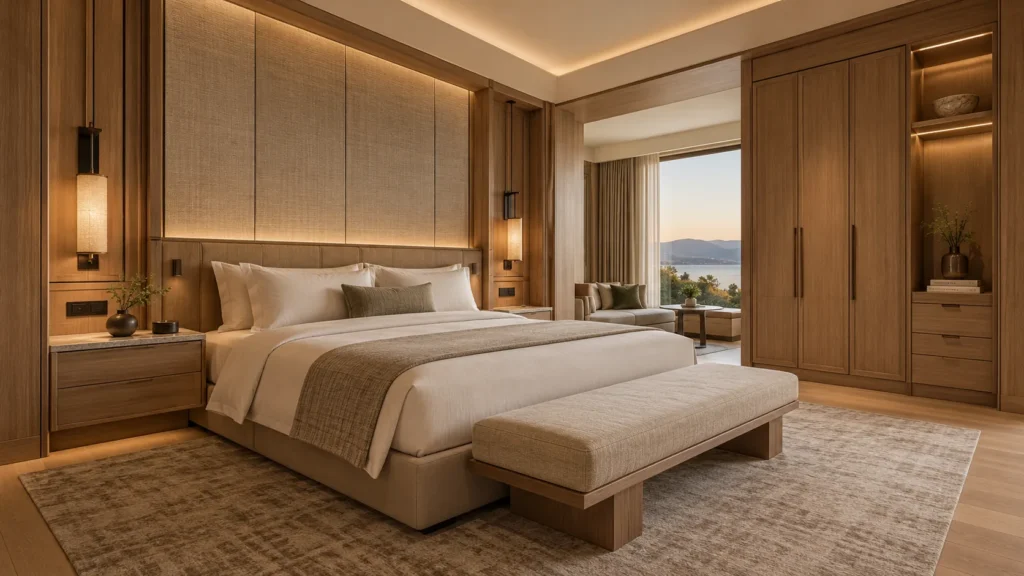
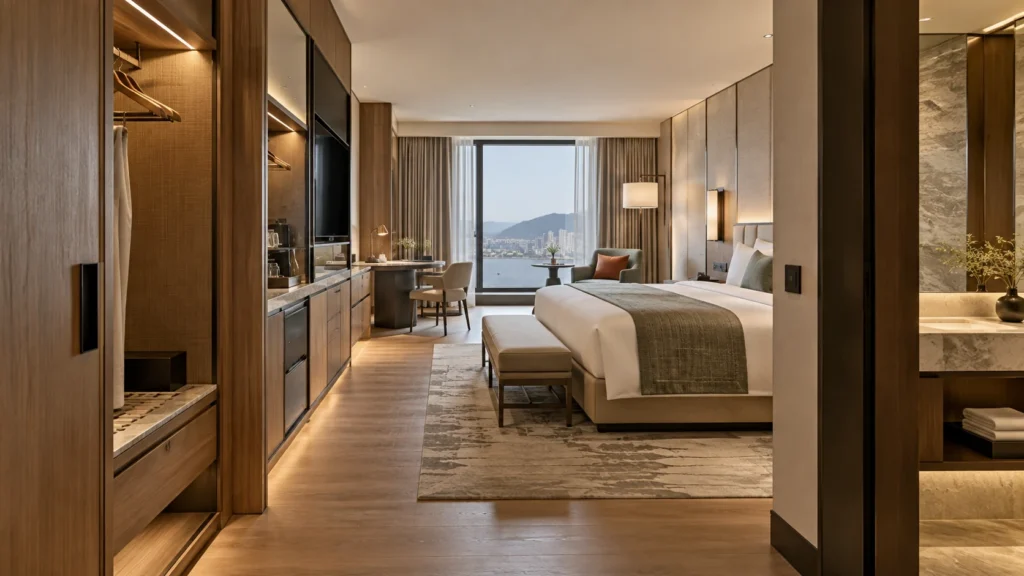
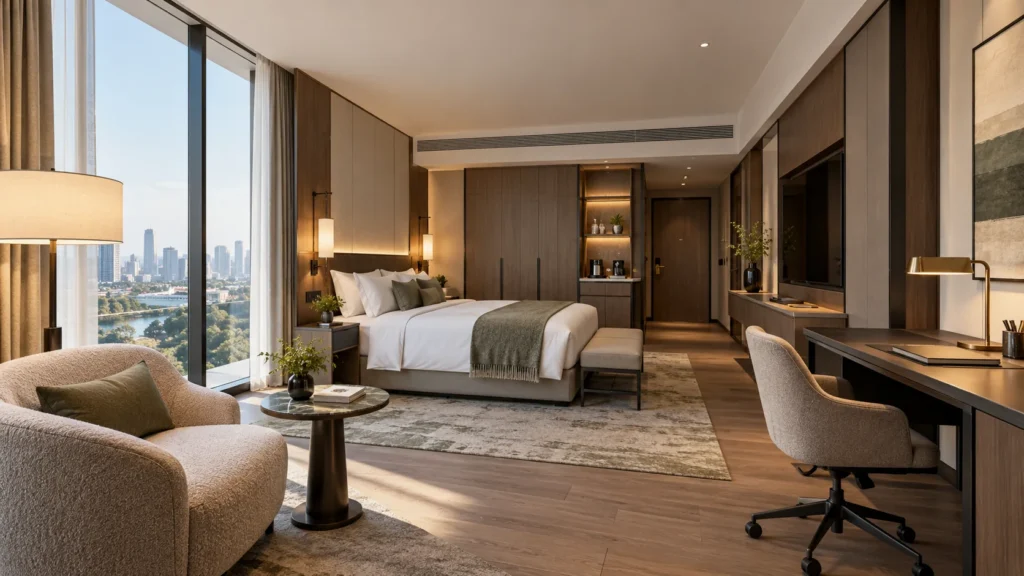
Hotel casegoods are durable, hard-surface furniture used in hotel guestrooms and hospitality spaces. They include nightstands, wardrobes, desks, dressers, TV cabinets, and storage units. Built for commercial use, these pieces must withstand daily wear, frequent cleaning, and repeated guest use.
But what makes hotel casegoods suitable for a particular project? Beyond appearance, the right choice depends on materials, construction quality, room layout, and long-term maintenance needs.
Whether you’re furnishing a new hotel or renovating existing guestrooms, this guide covers hotel casegoods types, materials, specifications, costs, and procurement. You’ll learn how to choose furniture that balances durability, design consistency, and budget while avoiding common purchasing mistakes.
What Are Hotel Casegoods?
Hotel casegoods refer to rigid, primarily non-upholstered furniture designed for storage, work, and everyday use in hospitality environments. Typically made from wood, engineered panels, or metal, these pieces combine functionality, durability, and consistent design across guestrooms.
What Does Casegoods Mean in the Hotel Industry?
In hotel projects, casegoods commonly include wardrobes, desks, dressers, nightstands, and storage cabinets. Based on their design and installation, they generally take three forms:

Freestanding Casegoods
Movable furniture, such as nightstands, dressers, and desks.

Built-in Casegoods
Cabinets and storage units fitted into walls or specific room layouts.

Modular Casegoods
Furniture systems using standardized components adaptable to different room configurations.
These categories can overlap. For example, a modular wardrobe can also be built-in. The final classification depends on the project’s design, specifications, and installation requirements.
Why Are Hotel Casegoods Important?
Hotel casegoods do more than complete a guestroom’s appearance. They influence how guests use the space and how efficiently hotels operate. A poorly designed cabinet or unreliable drawer can create problems across hundreds of rooms.
Well-designed hotel casegoods offer five key benefits:
-
Improve Guest Comfort
Provide convenient storage, accessible surfaces, and practical features for everyday use.
-
Maximize Room Space
Make efficient use of available space without compromising comfort or movement.
-
Maintain Brand Consistency
Create a cohesive look through coordinated materials, finishes, and furniture designs.
-
Support Long-Term Durability
Withstand frequent use through suitable materials, sturdy construction, and reliable hardware.
-
Simplify Maintenance
Make cleaning, repairs, and component replacement easier for hotel staff.
For hotel owners and procurement teams, choosing the right casegoods means balancing guest satisfaction, operational efficiency, and long-term value.
What Are the Different Types of Hotel Casegoods?
Hotel casegoods come in different forms, depending on room layouts, guest needs, and hotel design standards. From bedside tables to built-in storage, each type serves a specific purpose.
Here are the most common types of hotel casegoods used in guestrooms and hospitality spaces.

Hotel Headboards and Nightstands
Nightstands keep essentials close to the bed. Headboard systems can integrate lighting, charging outlets, and decorative panels.
Key considerations: Bed alignment, electrical access, cable management, and secure installation.

Hotel Wardrobes and Closets
Wardrobes organize clothing and luggage. Built-in, freestanding, and sliding-door designs suit different room layouts.
Key considerations: Storage capacity, door clearance, hardware durability, and internal layout.

Hotel Desks, Dressers, and Storage Cabinets
Desks provide practical work surfaces, while dressers and cabinets organize personal items. Drawers and cable access support daily use.
Key considerations: Surface durability, drawer hardware, legroom, and convenient power access.

Hotel TV Cabinets and Minibar Units
TV cabinets organize media equipment and concealed wiring. Minibar units accommodate refrigerators, beverages, and guest accessories.
Key considerations: Equipment dimensions, ventilation, cable routing, and maintenance access.

Hotel Luggage Benches and Luggage Racks
Luggage benches make unpacking easier. Durable surfaces and stable construction help withstand repeated contact with heavy suitcases.
Key considerations: Load capacity, impact resistance, structural stability, and floor space.

Bathroom Vanities and Built-In Casework
Bathroom vanities combine storage, countertops, and plumbing access. Moisture protection matters, especially around joints and edges.
Key considerations: Moisture resistance, sealed edges, and convenient plumbing access.
Hotel Casegoods vs. FF&E, Millwork, and Loose Furniture
Casegoods, millwork, FF&E, and loose furniture often appear in the same hotel project. However, these terms describe different aspects of furniture and interior work.
Understanding the differences helps prevent scope gaps, unclear quotations, and installation disputes.
What Is the Difference Between Casegoods and Millwork?
Casegoods describe primarily rigid furniture, such as desks, dressers, and wardrobes.
Millwork refers to fabricated architectural elements, including built-in cabinetry and wall panels.
A freestanding dresser is typically casegoods. A built-in wardrobe may qualify as both casegoods and millwork.
The final classification depends on the project’s drawings, specifications, and scope of work.
Are Hotel Casegoods Part of FF&E?
Yes. Many hotel casegoods fall under FF&E (Furniture, Fixtures, and Equipment).
However, permanently installed cabinetry may be included in separate millwork or construction packages.
Your BOQ and contract should clearly define these responsibilities.
For more details, see our hotel FF&E guide.
Casegoods vs. Upholstered and Loose Furniture
Casegoods typically feature rigid surfaces and structural components. Upholstered furniture includes padded pieces, such as sofas and lounge chairs.
Loose furniture refers to movable items that are not permanently installed.
These categories can overlap. For example, a freestanding dresser is both casegoods and loose furniture.
| Category | Typical Examples | Key Difference |
|---|---|---|
| Casegoods | Wardrobes, desks, dressers | Primarily rigid furniture |
| Millwork | Built-in cabinets, wall panels | Architectural fabrication |
| FF&E | Furniture, fixtures, equipment | Broad procurement category |
| Loose Furniture | Chairs, movable desks, dressers | Not permanently installed |
| Upholstered Furniture | Sofas, lounge chairs | Primarily padded furniture |
What Materials Are Used in Hotel Casegoods?
Choosing the right hotel casegoods materials affects durability, appearance, and long-term maintenance. But which materials work best?
Start with three key elements: the structural core, surface finish, and edge treatment. Hardware and construction details also influence performance.
Each component serves a different purpose. The best choice depends on how and where the furniture will be used.

Core Materials: Plywood, MDF, Particleboard, and Solid Wood
The core material forms the furniture’s structure. Common options include:
Made from bonded wood layers, plywood suits cabinet structures, shelves, and components requiring reliable fastening. Check panel grade, thickness, and moisture resistance.
MDF provides a smooth, uniform surface for painted doors and decorative panels. Proper edge sealing and hardware installation are essential.
A cost-effective option for standardized cabinet construction. Select appropriate grades and verify moisture resistance, fastening strength, and edge protection.
Often used for furniture frames, decorative details, and premium components. It offers natural texture but requires consideration of humidity-related movement.
Surface Finishes: HPL, Melamine, Veneer, and Lacquer
Surface finishes influence appearance, cleaning, and resistance to everyday wear.
Suitable for frequently used desks, countertops, and cabinet surfaces. Properly specified HPL offers practical abrasion and stain resistance.
Provide decorative, easy-to-clean surfaces for standardized cabinetry. Performance depends on the panel grade and surface specification.
Delivers authentic wood grain for luxury hotel casegoods. Consistent color, grain direction, and protective coatings are important.
Create smooth painted or transparent surfaces. The coating system should match the substrate and expected cleaning conditions.
Edge Banding, Joinery, and Hardware
Even premium materials can fail when edges, joints, or hardware are poorly specified.
When evaluating hotel casegoods, check:
- Edge banding: ABS, PVC, or wood veneer edges suited to the application.
- Edge sealing: Compatible adhesives and protection against moisture penetration.
- Joinery: Secure connections, suitable fasteners, and stable cabinet construction.
- Hardware: Reliable hinges, drawer slides, handles, and replaceable components.
- Small details matter. A poorly sealed cabinet edge can eventually lead to swelling and costly repairs.
Metal, Glass, Stone, and Solid Surface Components
Custom hotel casegoods may also combine wood-based panels with other materials.
Metal provides structural support or decorative accents. Glass works for cabinet doors and shelves. Stone and solid-surface materials are common countertop choices.
Each material requires suitable support, fixing methods, cleaning procedures, and transportation protection.
Which Material Is Best for Different Hotel Casegoods?
There is no single best material for every hotel.
A busy guestroom desk faces different demands than a decorative headboard or bathroom vanity.
The table below shows practical material combinations for common applications.
| Furniture Type | Suggested Material Approach | Key Considerations |
|---|---|---|
| Nightstands | HPL tops with suitable engineered-panel cabinets | Scratches, spills, edge protection |
| Wardrobe Doors | Veneer or HPL over an appropriate panel substrate | Door stability, finish consistency |
| Writing Desks | HPL over a suitable structural panel | Surface wear, cleaning, edge durability |
| Minibar Cabinets | Protected panel construction with suitable finishes | Moisture, ventilation, service access |
| Bathroom Vanities | Moisture-appropriate cabinetry with solid-surface or stone tops | Sealed joints, plumbing, humidity |
These are illustrative material approaches. Final specifications depend on project requirements, product grades, and approved construction details.
For example, an HPL-finished desk may suit a busy business hotel. A veneer-finished cabinet may better match a luxury property’s design.
The goal isn’t to choose one premium material. It’s to select a complete construction system that balances durability, appearance, maintenance, and cost.
Hotel Casegoods Specifications: What Should You Include?
A detailed hotel casegoods specification translates design intent into clear manufacturing, installation, and inspection requirements.
Without consistent specifications, suppliers may interpret the same drawing differently, leading to pricing discrepancies, production errors, and installation delays.
Each furniture item should have an identifiable item code and an approved specification covering the following areas.
Dimensions, Layouts, and Installation Clearances
Accurate dimensions are essential, but the furniture must also function within the available space.
For each item, specify:
- Overall width, depth, and height.
- Relevant wall, floor, and site conditions.
- Door and drawer opening clearances.
- Installation, maintenance, and service access.
- Required site measurements and dimensional tolerances.
For example, a wardrobe must fit the designated space while allowing doors to open fully and guests to access the storage comfortably.
Substrate, Finish, and Edge Specifications
Define the complete material construction rather than using general descriptions.
Include:
- Substrate type and panel thickness.
- Surface finish, color, and approved finish code.
- Edge banding material, thickness, and treatment.
- Visible wood grain direction and matching requirements.
- Approved samples and acceptable appearance variations.
Avoid vague terms such as “high-quality wood finish.” Clear material specifications help manufacturers quote and produce furniture consistently.
Hardware, Construction, and Load Requirements
Hardware and joinery affect how hotel casegoods perform under repeated daily use.
Specify:
- Hinge, drawer slide, handle, and lock requirements.
- Shelf and drawer load capacities.
- Cabinet joinery and structural connections.
- Wall fixing and anti-tip provisions where required.
- Hardware accessibility and replacement options.
Where practical, identify approved hardware models or measurable performance requirements.
Electrical, Lighting, and MEP Coordination
Hotel casegoods often incorporate electrical, mechanical, and plumbing interfaces.
Shop drawings should identify outlet positions, cable routes, integrated lighting connections, minibar ventilation, and plumbing access where applicable.
The project team should also confirm who is responsible for electrical connections, service openings, and coordination with surrounding construction.
Resolve these interfaces before mass production to reduce expensive site modifications.
Durability, Safety, and Environmental Requirements
Hotel casegoods specifications should reflect the furniture’s intended use, destination market, and applicable project requirements.
Key considerations include surface wear, moisture resistance, hardware performance, structural stability, and safety.
For U.S. projects, the EPA’s TSCA Title VI formaldehyde emission standards regulate certain composite wood products, including hardwood plywood, MDF, and particleboard, as well as applicable finished goods containing them.
For architectural wood casework, ANSI/AWI 0641-2019 establishes requirements within its defined scope. These requirements do not automatically apply to all freestanding hotel furniture or installation work.
Accessible guestrooms may also need to meet the ADA requirements for transient lodging guest rooms, including applicable provisions for clearances, storage access, and fixtures.
Always confirm the applicable standards, testing, and compliance documentation for the specific project and destination market.
Shop Drawings, Samples, and Mock-Up Approval
Before releasing hotel casegoods for production, confirm the following approval requirements:
- Shop drawings: Final dimensions, construction, and installation details.
- Material samples: Approved substrates, finishes, and edge treatments.
- Hardware schedule: Confirmed components and performance requirements.
- Mock-up or prototype: A representative sample where the project requires one.
- Production approval: Documented sign-off and revision control.
Approved documents should provide a consistent reference for manufacturing and quality inspection.
| Specification | Example |
|---|---|
| Item Code | CG-01 |
| Furniture Item | Guestroom Wardrobe |
| Dimensions | 1200 × 600 × 2200 mm |
| Substrate | Project-approved engineered wood panels |
| Finish | HPL, approved color and finish code |
| Edge Treatment | Matching edge banding with sealed edges |
| Hardware | Approved hinges and handles |
| Installation | Fixing details per approved shop drawings |
| Approvals | Shop drawings, finish samples, mock-up if required |
| Inspection | Dimensions, appearance, hardware, and operation |
Note: This specification sheet is illustrative. The dimensions and construction details are not universal hotel standards and must be confirmed against project requirements.
A well-prepared specification helps manufacturers produce consistent furniture across guestrooms while giving buyers clear criteria for approval and inspection.
What Makes Hotel Casegoods Durable?
Durable hotel casegoods must withstand frequent guest use, regular cleaning, and occasional impact or moisture exposure.
Long-term performance depends on more than appearance. Material construction, edge protection, hardware, joinery, and installation all play important roles.

Hotel Casegoods vs. Residential Furniture Durability
Compared with typical residential use, hotel furniture often faces more frequent guest turnover, luggage contact, and housekeeping activities.
These conditions place additional demands on surfaces, doors, drawers, and fittings.
However, a “commercial-grade” label alone does not guarantee durability. Ask manufacturers for relevant material specifications, hardware performance information, and evidence that the furniture meets your project’s requirements.
Common Hotel Casegoods Quality Problems
Common issues to watch for include:
- Peeling or poorly bonded edge banding.
- Scratched, chipped, or damaged surfaces.
- Misaligned wardrobe doors and uneven gaps.
- Loose handles, hinges, and fittings.
- Drawer slides that stick or fail.
- Swelling around moisture-exposed edges and joints.
Many of these problems originate from inadequate edge protection, unsuitable hardware, poor assembly, or installation issues rather than the main structural panels alone.
How to Evaluate Hotel Casegoods Quality
Inspect the complete furniture assembly, not just individual material samples.
Visual inspection: Check surface finishes, edge sealing, visible joints, and finish consistency.
Functional inspection: Open and close doors and drawers, check hardware operation, and verify furniture stability.
Production consistency: Compare dimensions, finishes, and workmanship against approved shop drawings and reference samples.
For larger hotel projects, agree on inspection criteria before mass production and verify that delivered items match the approved standard.
How to Choose Hotel Casegoods for Different Hotel Types
The right hotel casegoods depend on guest expectations, room layouts, operating requirements, and maintenance needs.
Different hotel types often prioritize different furniture features.
Economy and Select-Service Hotels
Prioritize efficient room layouts, durable finishes, and easy-to-replace hardware.
Standardized casegoods can simplify bulk purchasing, installation, and ongoing maintenance while helping control project costs.
Business and Extended-Stay Hotels
Focus on functional writing desks, convenient power access, organized storage, and practical minibar arrangements.
Extended-stay guestrooms may also require additional wardrobe space, drawers, and storage for everyday belongings.
Luxury Hotels, Boutique Hotels, and Resorts
Custom hotel casegoods can support distinctive interiors, premium finishes, and integrated architectural details.
Pay particular attention to veneer matching, finish consistency, hardware quality, and coordination across different furniture pieces.
Standard vs. Custom Hotel Casegoods: Which Should You Choose?
Standard, custom, and modular hotel casegoods offer different levels of design flexibility, manufacturing repeatability, and project coordination.
The right approach depends on room layouts, design requirements, order quantities, and delivery priorities. Some projects benefit from combining these options.
Standard Hotel Casegoods
Standard casegoods use established dimensions, configurations, and available finishes.
They can simplify product selection, quotation, and repeat purchasing, especially when guestroom layouts are consistent.
However, fixed sizes and limited customization options may not suit unusual room dimensions or specific brand requirements.
Custom Hotel Casegoods
Custom hotel casegoods are manufactured to meet project-specific drawings and specifications.
Dimensions, materials, finishes, hardware, and installation details can be tailored to the hotel’s design and functional needs.
This flexibility requires careful coordination of shop drawings, material samples, approvals, and production requirements.
Modular Hotel Casegoods Systems
Modular casegoods use repeatable components that can be combined across different room layouts.
For example, shared cabinet construction and hardware may support several wardrobe or storage configurations with different dimensions and finishes.
This approach can improve manufacturing consistency while allowing some design flexibility. Its benefits depend on how well the modular system matches the project’s requirements.
| Factor | Standard | Custom | Modular |
|---|---|---|---|
| Design Flexibility | Limited to available options | High | Depends on the system |
| Initial Engineering | Usually limited | Project-specific | System setup may be required |
| Repeated Room Types | Suitable for consistent layouts | Suitable after design approval | Well suited to shared modules |
| Finish Options | Available catalog finishes | Project-specific finishes | Depends on the system |
| Cost Predictability | Often easier with fixed specifications | Depends on design complexity | Depends on module standardization |
Procurement Consideration: You don’t always need to choose just one approach. A hotel may use standardized furniture for typical guestrooms, custom pieces for unusual spaces, and modular components across repeated room layouts.
The best solution balances design requirements, manufacturing consistency, budget, and installation needs.
How Much Do Hotel Casegoods Cost?
Hotel casegoods cost varies by furniture type, dimensions, materials, hardware, order quantity, and manufacturing complexity.
There is no universal price for every project. A wardrobe with custom veneer and integrated lighting will have different cost requirements than a standard laminate cabinet.
Factors That Affect Hotel Casegoods Pricing
The main cost factors include:
- Furniture size and construction: Dimensions, internal structure, and assembly requirements.
- Materials and finishes: Substrate grades, HPL, veneer, and other surface treatments.
- Hardware and accessories: Hinges, drawer slides, locks, and integrated components.
- Customization: Special dimensions, detailing, lighting, and complex construction.
- Order quantity: Production volume and repeatability across guestrooms.
- Samples and mock-ups: Prototype development and approval requirements.
- Packaging and logistics: Export packaging, shipping destination, and delivery terms.
Understanding these factors helps buyers evaluate quotations beyond the initial unit price.
Unit Price vs. Total Project Cost
A lower furniture unit price does not always mean a lower overall project cost.
Buyers should also account for freight, applicable import duties and taxes, storage, site handling, and installation.
Furniture Cost + Samples and Mock-Ups + Freight + Applicable Duties and Taxes + Storage and Handling + Installation + Other Project Expenses
Long-term costs also matter. Repairability, maintenance needs, and replacement parts can affect the furniture’s total cost of ownership after installation.
How to Compare Hotel Casegoods Quotations
Ask suppliers to quote against the same bill of quantities (BOQ), drawings, specifications, quantities, and delivery requirements.
Check whether each quotation includes the same material grades, finishes, hardware, sample requirements, packaging, lead times, warranty terms, and installation scope.
Confirm the delivery terms and identify exclusions before comparing prices. Otherwise, quotations that appear similar may cover different products or services.
The lowest unit price is not necessarily the best value. Compare the complete scope, expected durability, and total project cost before making a purchasing decision.
Hotel Casegoods Procurement: From BOQ to Installation
Successful hotel casegoods procurement requires clear specifications, coordinated responsibilities, and documented approvals.
A structured process helps connect design, supplier quotations, manufacturing, quality inspection, and on-site installation.
Step 1 — Define the Casegoods Scope and BOQ
Prepare a bill of quantities (BOQ) that identifies furniture types, item codes, room types, and required quantities.
Separate freestanding casegoods from built-in cabinetry where necessary. Clearly assign supply and installation responsibilities to avoid scope gaps or overlapping quotations.
Step 2 — Prepare Specifications and Request Quotations
Provide suppliers with the same approved drawings, material specifications, hardware requirements, quantities, and delivery conditions.
Request itemized quotations that identify inclusions, exclusions, lead times, and commercial terms.
A consistent quotation basis makes it easier to compare suppliers accurately.
Step 3 — Approve Drawings, Samples, and Mock-Up Rooms
Review shop drawings, construction details, hardware, and finish samples before mass production.
Where required, use a mock-up room to verify furniture dimensions, appearance, clearances, and functionality.
Document approvals and revisions so production follows the agreed requirements.
Step 4 — Monitor Manufacturing and Quality Control
Check key production stages, including material preparation, machining, assembly, hardware installation, and finishing.
Confirm that inspection criteria match the approved specifications and reference samples.
Complete pre-shipment inspections and document any issues requiring correction.
Step 5 — Plan Packaging, Delivery, and Installation
Label furniture packages by item code, room type, or installation location as appropriate.
Coordinate shipping and delivery schedules with site readiness, available storage, and installation sequencing.
Inspect items upon arrival, record damage or defects, and confirm responsibility for corrective work.
Complete installation checks and collect the required handover documents.
- Confirm room types, item codes, and furniture quantities.
- Approve drawings, material specifications, and hardware.
- Verify site measurements and service interfaces.
- Obtain documented sample and mock-up approvals.
- Agree on production milestones and inspection criteria.
- Confirm packaging, shipping terms, and delivery schedules.
- Assign installation and defect-resolution responsibilities.
- Collect warranty information, spare-parts details, and maintenance documents.
For additional guidance on managing the wider furniture package, VOLANT’s hotel furniture procurement guide covers related purchasing and coordination considerations.
How to Choose a Reliable Hotel Casegoods Manufacturer
A reliable hotel casegoods manufacturer should combine furniture production expertise with an understanding of hospitality project requirements.
Beyond pricing, evaluate manufacturing capabilities, quality control, and the supplier’s ability to coordinate production and delivery.
Manufacturing Capabilities and Material Expertise
Assess the manufacturer's equipment, material processing, finishing capabilities, and technical support.
Confirm whether the factory can work with your specified substrates, finishes, hardware, and construction details.
Can the manufacturer consistently reproduce the approved design across different room types and production batches?
Quality Control and Production Consistency
Look for documented quality control procedures, approved reference samples, and defined inspection criteria.
Ask how the manufacturer checks material quality, machining accuracy, assembly, finishes, and hardware operation.
What inspection records and approval procedures are used to maintain consistency throughout production?
Hotel Project Experience and Delivery Support
Review relevant hotel furniture projects and confirm the manufacturer's actual responsibilities.
Evaluate packaging methods, production schedules, delivery coordination, installation support, and after-sales arrangements.
Can the supplier provide relevant project references and clearly explain how delivery issues, defects, and warranty claims are handled?
How VOLANT Supports Custom Hotel Casegoods Projects
At VOLANT Fit-Out, we manufacture custom hotel casegoods as part of coordinated guestroom and interior fit-out solutions.
Our product scope includes wardrobes, headboard walls, TV cabinets, bathroom vanities, and related built-in furniture components.
We combine project-specific engineering with digitally supported manufacturing to help translate approved designs into consistent production.
Our manufacturing capabilities include:
- Shop drawing development and production planning.
- CAD-supported engineering and CNC machining.
- Panel processing, edge banding, and surface finishing.
- Factory pre-assembly and quality inspections.
- Protective packaging and delivery coordination.

Our Industry 4.0 manufacturing process helps connect engineering, material preparation, production, and quality control within a coordinated workflow.
We also support coordination between hotel casegoods, wall systems, and other fixed interior elements to help reduce design and installation conflicts.
Conclusion: Choosing the Right Hotel Casegoods for Long-Term Performance
Hotel casegoods do more than complete a guestroom’s appearance. They influence storage, functionality, maintenance, and everyday hotel operations.
Choosing the right hotel casegoods starts with understanding the property’s requirements. Consider furniture types, materials, construction quality, and long-term maintenance needs before making purchasing decisions.
Whether you’re developing a luxury resort or renovating a business hotel, clear specifications and coordinated procurement are essential. Confirm dimensions, finishes, and hardware, approve samples before production, and work with a manufacturer experienced in hospitality projects.
At VOLANT, we support custom hotel casegoods projects through project-specific engineering, coordinated manufacturing, and integrated fit-out solutions.
FAQs
What are hotel casegoods?
Hotel casegoods are primarily rigid furniture pieces used in guestrooms and other hotel spaces. Common examples include nightstands, wardrobes, desks, dressers, TV cabinets, and luggage benches. Depending on the design and project scope, they may be freestanding or built-in.
Are hotel casegoods considered FF&E?
Yes. Many hotel casegoods are included in FF&E (Furniture, Fixtures, and Equipment). However, built-in cabinets and architectural elements may fall under separate millwork or construction packages. The project’s BOQ and specifications should define the final classification.
What is the difference between hotel casegoods and millwork?
Casegoods describe a furniture category, while millwork generally refers to fabricated architectural components. A freestanding dresser is typically casegoods, whereas a built-in wardrobe may qualify as both. The distinction depends on the project’s design and scope of work.
What materials are best for hotel casegoods?
There is no single best material. Plywood, MDF, and particleboard are common substrates, while HPL, melamine, veneer, and lacquer provide different surface finishes. The right combination depends on durability, moisture exposure, appearance, maintenance, and budget.
Can hotel casegoods be customized for different room layouts?
Yes. Custom hotel casegoods can be manufactured with project-specific dimensions, finishes, hardware, and installation details. Modular systems can also use repeatable components across different room types, helping balance design flexibility with manufacturing consistency.
How much do hotel casegoods cost?
Hotel casegoods pricing depends on furniture dimensions, materials, finishes, hardware, customization, and order quantity. Buyers should compare the complete project cost, including samples, shipping, applicable duties, installation, and other expenses, rather than unit prices alone.
How long does it take to manufacture custom hotel casegoods?
Production time varies with design complexity, order quantity, material availability, and approval requirements. Custom projects may require shop drawings, samples, and mock-up approval before manufacturing begins. Confirm the production and delivery schedule with the supplier for each project.
What information should I provide when ordering hotel casegoods?
Prepare room layouts, a bill of quantities (BOQ), furniture dimensions, material and finish specifications, hardware requirements, and delivery information. Clearly define installation responsibilities and approve shop drawings and samples before mass production.