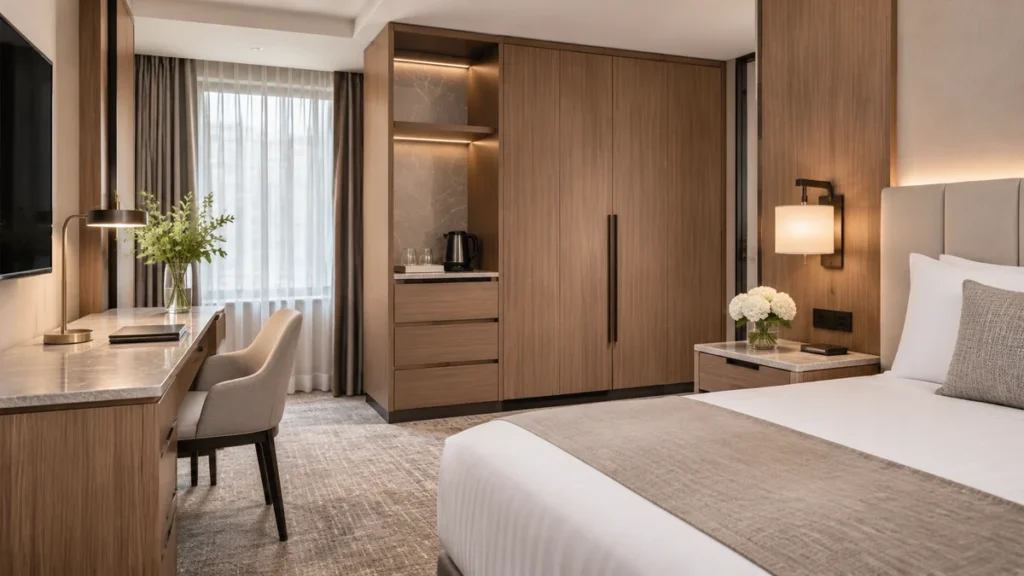
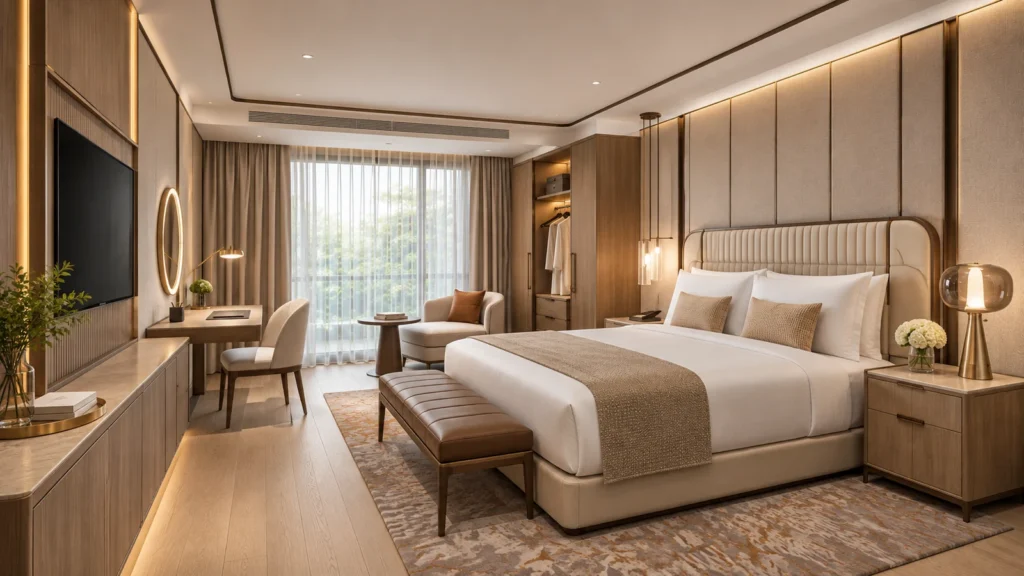
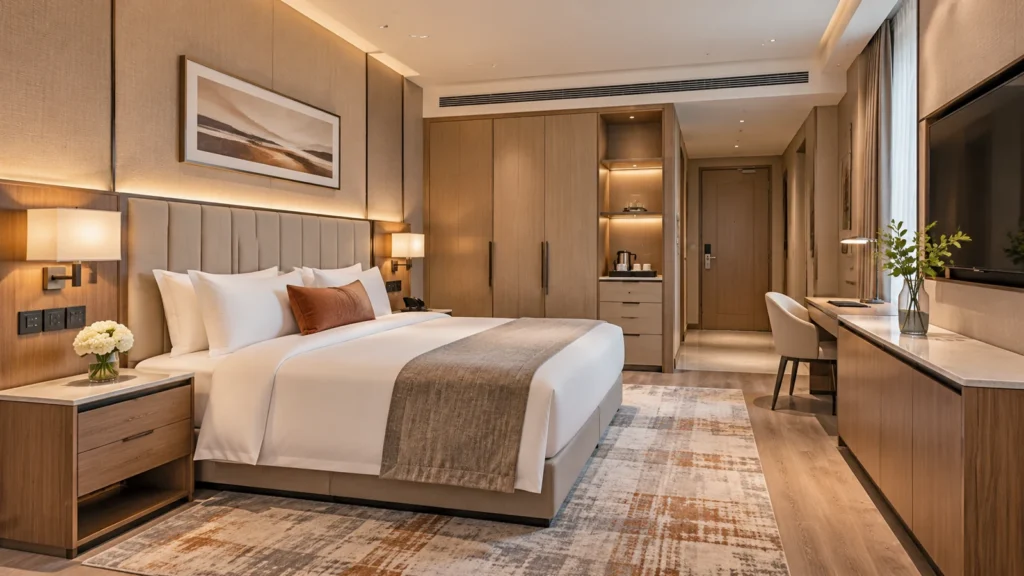
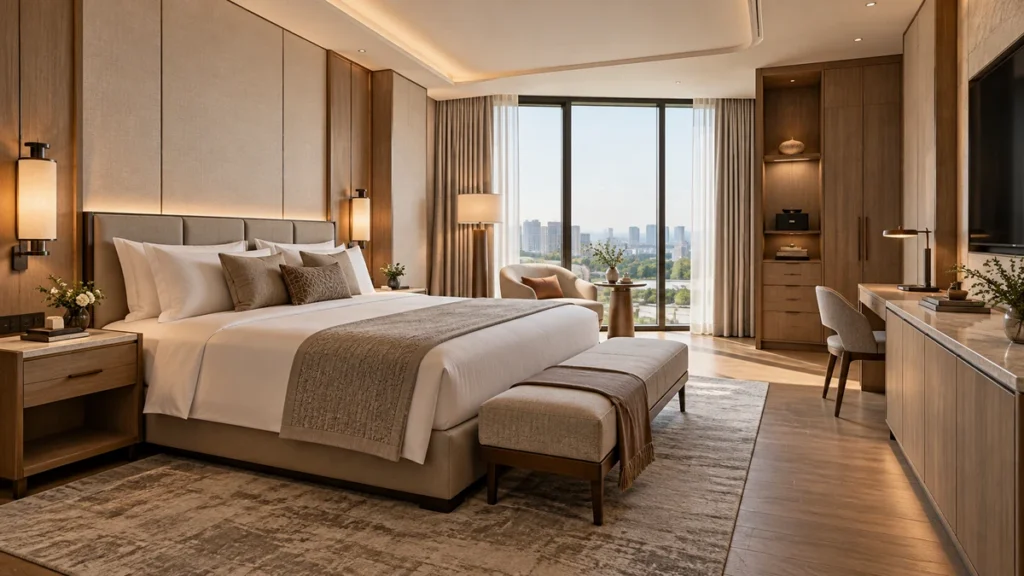
Choosing the right laminate is essential when specifying hotel casegoods. It affects surface durability, appearance, maintenance requirements, and overall project costs.
Two common options are High Pressure Laminate (HPL) and Low Pressure Laminate (LPL). Both provide decorative finishes, but their construction, manufacturing processes, and performance differ.
So, which is better for your hotel furniture project?
HPL generally suits high-contact surfaces exposed to frequent abrasion and impact. LPL is often a cost-effective choice for standardized cabinets and lower-wear components.
Ultimately, the right choice depends on furniture function, substrate quality, and the hotel environment.
This guide compares HPL vs. LPL in terms of durability, cost, and applications. It also explores how combining both materials can balance performance and project budgets.
What Are High Pressure Laminate (HPL) and Low Pressure Laminate (LPL)?
Before comparing HPL vs. LPL, it’s important to understand how each material is made.
The key difference lies in how the decorative surface is manufactured and bonded to the substrate.
What Is HPL?
High Pressure Laminate (HPL) is a durable decorative material made by pressing multiple resin-treated paper layers under high heat and pressure to form a separate laminate sheet.
Its main components include:
- Kraft paper: Impregnated with phenolic resin to form a strong, stable core.
- Decorative paper: Treated with melamine resin to create colors, patterns, and textures.
- Protective overlay: Added in selected grades to improve surface protection.
How Is HPL Made?
- Layer preparation: Resin-treated kraft paper, decorative paper, and protective layers are assembled.
- High-pressure pressing: The layers are pressed under high heat and pressure to form a dense, separate laminate sheet.
- Substrate bonding: The separate HPL sheet is bonded to a suitable wood-based substrate using adhesive.
Common substrates include MDF, plywood, and particleboard.
HPL is available as separate laminate sheets or factory-bonded panels, depending on the supplier and product format.
Key Characteristics of HPL:
- High surface durability: Generally offers good resistance to scratches, abrasion, and impact.
- Design flexibility: Available in various colors, woodgrain patterns, stone effects, and textures.
- Separate sheet construction: Allows the laminate to be applied to different suitable substrates.
- Additional processing: When supplied as a separate sheet, HPL requires adhesive bonding to a suitable substrate; factory-bonded panels have this step completed before furniture fabrication.
These characteristics make HPL a popular choice for hotel desks, nightstand tops, countertops, and other frequently used surfaces.
What Is LPL?
Low Pressure Laminate (LPL) generally refers to decorative surfacing produced using a low-pressure lamination process. In hotel furniture, a common example is a melamine-faced panel made by pressing resin-impregnated decorative paper directly onto an engineered wood substrate. This type of panel is often referred to as Thermally Fused Laminate (TFL).
Its main components include:
- Decorative paper: Provides the desired colors, patterns, and textures.
- Melamine resin: Impregnates the decorative paper and helps bond it to the substrate during pressing.
- Wood-based substrate: Typically MDF or particleboard, providing structural support.
What Is LPL?
- Paper preparation: Decorative paper is impregnated with melamine resin.
- Panel preparation: The treated paper is placed directly onto the prepared substrate.
- Direct thermal pressing: Heat and pressure fuse the melamine-resin-impregnated paper directly to the substrate, without first forming a separate laminate sheet.
In this common direct-pressed LPL panel format, these steps produce a prefinished panel, eliminating the need for a separate sheet-to-substrate bonding process. The panel still requires cutting, edge banding, machining, and assembly during furniture production.
Key Characteristics of LPL:
- Production efficiency: Combines the decorative paper and substrate in one pressing process for this type of LPL panel.
- Simplified processing: Eliminates the need for a separate sheet-to-substrate bonding step during production of this panel format.
- Consistent appearance: Supports uniform colors and patterns across large furniture orders.
- Practical applications: Commonly used for wardrobe interiors, cabinet sides, shelves, and drawer components.
Standard LPL panels generally offer less resistance to heavy wear and impact than comparable HPL products. However, performance varies by product grade and construction.
HPL vs. LPL: Manufacturing Process and Material Structure
How do these materials differ in construction and manufacturing?
| Comparison | HPL | LPL / TFL |
|---|---|---|
| Surface Construction | Multiple resin-treated paper layers | Melamine-resin-treated decorative paper |
| Manufacturing Process | Separately pressed into a laminate sheet | Directly pressed onto the substrate |
| Substrate Bonding | Bonded using adhesive | Fused directly to the substrate |
| Common Substrates | MDF, plywood, particleboard | MDF, particleboard |
| Additional Processing | Requires separate sheet bonding | No separate sheet-bonding process |
| Typical Product Format | Separate laminate sheets | Pre-finished decorative panels |
HPL is manufactured as a separate laminate sheet, while LPL is fused directly onto the substrate.
This distinction affects manufacturing requirements, fabrication methods, and overall material costs.
HPL vs. LPL: Durability and Performance Comparison
Hotel furniture faces daily wear from guests, luggage, and housekeeping activities.
Desks, nightstands, wardrobes, and reception counters all have different durability requirements.
So, how do HPL and LPL compare in real hotel environments?
Scratch and Abrasion Resistance
Hotel furniture surfaces experience constant friction. Guests place laptops, luggage, keys, and personal belongings on them. Housekeeping teams also clean these surfaces regularly.
HPL generally offers better scratch and abrasion resistance than standard LPL panels. Its dense, multi-layer construction makes it suitable for frequently used surfaces.
LPL works well for many standard cabinet components and lower-wear areas. However, some grades may show surface wear sooner under heavy use.
Typical applications:
- HPL: Writing desk tops, nightstand tops, and dresser surfaces.
- LPL: Wardrobe interiors, cabinet sides, and storage shelves.
Actual performance depends on the laminate grade, surface finish, and test results.
Impact and Wear Resistance
Hotel furniture often experiences repeated contact and occasional impacts.
Common examples include:
- Luggage hitting bench edges
- Suitcases contacting wardrobe doors
- Guests placing heavy items on countertops
- Repeated contact with reception desks
HPL generally provides a durable surface for these demanding applications. However, impact resistance depends on the entire furniture construction, not just the laminate.
Key factors include:
- Substrate quality: Affects panel strength and stability.
- Panel thickness: Influences structural support.
- Edge construction: Helps protect vulnerable corners and edges.
- Internal support: Prevents excessive bending under heavy loads.
For example, a luggage bench needs adequate structural support. A durable HPL surface alone cannot prevent panel failure under excessive loads.
Moisture and Heat Resistance
Moisture and heat exposure vary across hotel environments.
Guestrooms experience occasional drink spills and routine cleaning. Bathroom vanities face higher humidity and more frequent water splashes.
HPL generally provides a durable, easy-to-clean surface. Many grades also offer good resistance to heat and moisture exposure.
LPL performs well in many controlled indoor environments. However, exposed edges and damaged surfaces need proper protection.
For bathroom furniture, specify:
- Suitable moisture-resistant substrates
- Properly sealed edges
- Protected joints and cutouts
- Appropriate surface finishes
Also, check the manufacturer’s heat-resistance specifications before selecting materials for demanding applications.
Cleaning and Chemical Resistance
Hotel housekeeping teams clean furniture every day. Surface compatibility with cleaning products is therefore important.
Both HPL and LPL can offer easy-to-clean finishes. However, their chemical resistance varies by product grade and surface treatment.
Before approving materials, hotel buyers should:
- Check the manufacturer’s cleaning instructions.
- Confirm compatibility with commonly used cleaning agents.
- Test cleaning products on approved material samples.
- Avoid unapproved abrasive cleaners and harsh chemicals.
This helps prevent surface discoloration, damage, and premature wear.
Edge Durability and Delamination Risks
A durable laminate surface does not guarantee durable furniture.
Edge finishing, adhesive bonding, and substrate preparation also affect long-term performance.
The main risks differ between HPL and LPL:
HPL: Poor adhesive application can cause bubbles, lifting, or delamination.
LPL: Inadequate edge banding can expose the substrate to moisture and physical damage.
What Should Hotel Buyers Check?
- Edge banding thickness and adhesion.
- Substrate flatness and stability.
- Adhesive compatibility and bonding quality.
- Corner protection and edge finishing.
- Joint sealing and cutout protection.
- Quality of drilled openings and machined edges.
Small manufacturing details can make a significant difference in hotel furniture durability.
HPL vs. LPL Cost: Which Is More Cost-Effective for Hotel Furniture?
Cost is a major consideration in hotel furniture procurement.
Large hotel projects often involve hundreds of guestrooms. Even small differences in material costs can affect the total budget.
So, is HPL always more expensive than LPL?
Not necessarily. Pricing depends on material specifications, suppliers, order quantities, and manufacturing requirements.
The best choice should balance initial costs, production efficiency, and long-term maintenance.
Initial Material and Manufacturing Costs
HPL can involve additional material and processing costs, particularly when it is supplied as a separate laminate sheet. In that format, manufacturers must bond the sheet to a suitable substrate; factory-bonded HPL panels have already completed this step before furniture fabrication.
Some LPL panels, such as TFL melamine-faced panels, are made by fusing resin-treated decorative paper directly to the substrate during panel production. This avoids a separate laminate-sheet bonding step.
Key Cost Differences:
| Cost Factor | HPL | LPL / TFL |
|---|---|---|
| Surface Material | Separately manufactured laminate sheet | Resin-treated decorative paper |
| Substrate Bonding | Requires adhesive bonding | Direct thermal fusion |
| Additional Processing | Sheet bonding and trimming | Fewer lamination steps |
| Main Cost Drivers | Laminate grade, thickness, adhesive, and labor | Substrate, panel grade, finish, and quantity |
| Production Efficiency | Requires additional processing | Efficient for standardized panel production |
Factors That Affect Material Costs:
- Laminate thickness and surface grade
- Substrate type, density, and thickness
- Decorative patterns and surface finishes
- Adhesive and bonding requirements
- Processing and labor costs
- Order quantity and material availability
A premium LPL specification may cost more than a basic HPL option. Therefore, compare equivalent product specifications rather than material names alone.
Installation, Labor, and Material Waste Costs
Manufacturing efficiency also affects hotel casegoods costs.
When HPL is supplied as a separate laminate sheet, it must be bonded to a suitable substrate during panel or furniture fabrication.
Melamine-faced LPL panels made using TFL technology are typically supplied as prefinished panels. They do not require a separate laminate-sheet bonding step during furniture fabrication.
However, both materials still require accurate cutting, edge banding, machining, and assembly to become finished furniture.
What Can Help Reduce Production Costs?
- Digital cutting optimization: Improves panel utilization and reduces unnecessary offcuts.
- Standardized components: Simplifies manufacturing across multiple guestrooms.
- Efficient production planning: Reduces unnecessary material handling and processing.
- Accurate pre-production checks: Helps minimize rework and installation adjustments.
These improvements become more valuable in large hotel projects.
Maintenance and Replacement Costs
Initial purchase price does not tell the whole story.
A lower-cost surface may require more frequent repairs in high-use areas. A more durable surface can help reduce maintenance and replacement needs.
Different furniture components also have different maintenance requirements.
Consider These Hotel Furniture Applications:
- Writing desks: Need good scratch and abrasion resistance.
- Nightstands: Require stain resistance and easy cleaning.
- Wardrobes: Need durable edges and stable door construction.
- Bathroom vanities: Require suitable moisture protection.
- Reception counters: Need wear resistance and easy maintenance.
The right material specification should reflect actual usage conditions.
Total Cost of Ownership (TCO)
Hotel furniture buyers should look beyond initial material prices.
Total Cost of Ownership (TCO) considers the expenses involved throughout a furniture product’s service life.
For hotel projects, furniture replacement can also create operational challenges. Room closures, additional labor, and installation work may increase total expenses.
Combining HPL and LPL strategically can help balance initial investment and long-term performance.
The goal is not to choose the cheapest panel. It’s to achieve the best value throughout the furniture’s service life.
Best Applications of HPL and LPL in Hotel Casegoods
Different hotel furniture components face different levels of wear, moisture, and cleaning.
A desk top needs better surface protection than an internal wardrobe shelf. A bathroom vanity also requires careful moisture protection.
That’s why laminate selection should depend on how each furniture component is used.
Writing desks and nightstands face frequent contact, spills, and daily cleaning.
Balance surface durability with project costs.
Wardrobe doors, shelves, drawer boxes, and cabinet sides have different surface requirements.
Consider appearance, wear resistance, and production efficiency.
Decorative panels and headboards help establish the visual identity of hotel guestrooms.
Balance visual consistency, design flexibility, and maintenance.
Bathroom vanities require moisture protection, while minibar cabinets need practical and easy-to-clean finishes.
Specify suitable substrates and protect exposed edges and joints.
Public-area furniture faces frequent contact, heavy use, and regular cleaning.
Consider surface durability, structural support, and brand identity.
Hotel Furniture Material Selection Guide
The following table summarizes common material choices for different hotel casegoods components.
| Furniture Component | Recommended Surface | Main Consideration |
|---|---|---|
| Writing desk top | HPL | Scratch and abrasion resistance |
| Nightstand top | HPL | Cleaning and spill resistance |
| Nightstand cabinet | LPL or HPL | Cost and surface exposure |
| Wardrobe interiors | LPL / TFL | Production efficiency |
| Wardrobe doors | HPL, LPL, or veneer | Appearance and wear |
| Headboard panels | HPL, LPL, or veneer | Design and maintenance |
| Bathroom vanity | HPL on a suitable moisture-resistant substrate, or another approved finish | Sealed edges and joints |
| Minibar cabinet | LPL or HPL | Cleaning and spill exposure |
| Luggage bench | HPL on a suitable structural substrate | Surface wear and load support |
| Reception desk | HPL or other specified finish | Frequent use and cleaning |
These recommendations are general guidelines, not fixed specifications.
Final material choices should follow product grades, substrate quality, construction details, and approved project samples.
Why Combining HPL and LPL Is a Smart Hotel Furniture Strategy
Should you use HPL throughout an entire hotel project?
Not necessarily.
Using HPL on every surface can increase costs without delivering meaningful benefits for lower-wear components.
A smarter approach is to match materials with each furniture component’s usage requirements.
Prioritize durability where furniture faces frequent contact and cleaning.
- Guestroom desk tops
- Nightstand tops
- Dresser tops
- Luggage bench surfaces
- Reception counter surfaces
Use cost-efficient decorative panels for suitable lower-wear furniture components.
- Wardrobe interiors
- Cabinet sides
- Internal shelving
- Drawer components
- Storage panels
Balance Durability, Aesthetics, and Project Budget
A cost-effective hotel furniture specification follows three practical steps.
Step 1: Divide Furniture into Components
Identify individual furniture components and their different usage requirements.
Step 2: Assign Suitable Materials
Specify HPL for demanding surfaces. Consider LPL for suitable standardized components.
Step 3: Standardize Finishes Across the Project
Coordinate colors, textures, edge details, and material availability.
This helps maintain visual consistency across different guestroom types.
It also supports efficient manufacturing, material planning, and future furniture replacement.
What Should Hotel Buyers Check Before Choosing HPL or LPL?
Choosing between HPL and LPL involves more than comparing decorative samples.
Hotel buyers should evaluate the complete furniture specification before approving production.
Substrate quality, surface performance, edge construction, and environmental compliance all affect the final result.
Here are five important areas to check before placing a hotel furniture order.
Substrate Quality and Thickness
The substrate supports the decorative surface and affects the furniture’s structural performance.
Common options include MDF, plywood, and particleboard. Each has different structural and processing characteristics.
Check these factors before approval:
- Panel thickness: Confirm the specified thickness and dimensional tolerances.
- Density and flatness: Check panel consistency and surface stability.
- Screw-holding capacity: Ensure the substrate can support hinges, fittings, and other hardware.
- Structural support: Consider panel spans, loads, and fixing requirements.
- Moisture exposure: Match the substrate to the furniture’s operating environment.
- Edge protection: Ensure exposed edges receive suitable sealing and protection.
A durable HPL surface cannot compensate for an unsuitable substrate.
Always specify the substrate grade and construction details for each furniture component.
Laminate Grade and Performance Standards
Do not evaluate laminate quality by appearance alone.
Ask suppliers for technical data sheets and relevant test reports. Confirm that the documents match the specified product grade, thickness, and application.
For HPL, check these references:
ISO 4586-1:2018: Provides an overview of the ISO 4586 series and guidance on selecting relevant test methods and specifications.
ISO 4586-2:2018: Specifies test methods for determining the properties of high-pressure decorative laminate (HPL) sheets.
ISO 4586-3 to ISO 4586-8: Provide classification and specifications for particular HPL product types.
For melamine-faced boards, check these references:
- EN 14322:2021: Specifies surface requirements, dimensional tolerances, and classification for decorative melamine-faced boards used indoors.
- EN 14323:2021: Defines test methods for evaluating melamine-faced boards covered by EN 14322.
- CPA 5-25 (2025): The Composite Panel Association’s voluntary TFL Panel Standard sets requirements and test methods for surface performance and dimensional properties of TFL panels in the North American market.
These standards cover different product categories. Their test results should not be treated as directly interchangeable.
Compare specific performance properties using appropriate test methods and equivalent product specifications.
Edge Banding and Adhesive Quality
Edge construction plays an important role in the durability and quality of finished hotel furniture.
Poorly applied edge banding can leave the substrate vulnerable to moisture and physical damage. Weak bonding may also cause edges to lift or separate over time.
For hotel cabinetry specified as architectural wood casework, the ANSI/AWI 0641-2019 standard provides relevant requirements for materials, workmanship, and finished quality. Its edge-related requirements offer useful references for inspecting exposed and semi-exposed edges.
However, this standard does not cover all hotel casegoods or freestanding furniture.
Before approving production, ask suppliers to confirm:
- Edge banding material and thickness: Check material suitability and specified dimensions.
- Adhesive type and compatibility: Confirm compatibility with the substrate and decorative surface.
- Bonding methods: Review bonding processes and production quality controls.
- Corner finishing: Check edge consistency and corner protection.
- Cutout protection: Ensure drilled openings and exposed edges receive appropriate protection.
- Quality inspection: Confirm procedures for checking edge adhesion and finished details.
Pay particular attention to bathroom vanities and other furniture exposed to moisture.
Review finished samples before approving mass production. A loose material sample cannot demonstrate the quality of the completed edge.
Environmental Compliance and Formaldehyde Emissions
Environmental compliance matters in international hotel furniture projects.
For U.S. projects, check TSCA Title VI formaldehyde emission standards and the EPA’s guidance for regulated stakeholders.
The regulation covers three main categories of composite wood products:
- Hardwood plywood
- Medium-density fiberboard (MDF)
- Particleboard
For covered composite wood products, TSCA Title VI sets formaldehyde emission limits and generally requires testing, third-party certification, labeling, and recordkeeping, subject to specified exemptions.
These requirements apply to regulated composite-wood panels and covered finished goods containing them; they do not constitute a separate certification of the HPL or LPL decorative surface itself.
For California projects, also check the CARB Composite Wood Products Airborne Toxic Control Measure (ATCM).
Ask suppliers for TSCA Title VI documentation for the regulated composite-wood substrate and, where applicable, the finished good, along with product traceability. For other markets, confirm local emission regulations and project requirements.
Note that TSCA Title VI addresses formaldehyde emissions, not overall sustainability.
Samples, Mock-Ups, and Quality Inspection
Never approve a large hotel furniture order based on product descriptions alone.
Request physical samples and check the following:
- Surface appearance: Color, texture, gloss, and pattern consistency.
- Panel quality: Substrate thickness, flatness, and surface condition.
- Surface performance: Scratch, abrasion, and stain resistance.
- Edge construction: Edge adhesion, corners, and finishing.
- Cleaning compatibility: Compatibility with approved hotel cleaning products.
- Material consistency: Match between approved samples and production materials.
For large projects, request a full-scale mock-up room before mass production. This allows the team to check furniture dimensions, installation details, hardware operation, and finish consistency.
Approve the mock-up and retain reference samples before authorizing production.
How VOLANT Optimizes Material Selection and Hotel Casegoods Manufacturing
Choosing the right laminate is only one part of successful hotel furniture production.
The process also involves engineering, material preparation, machining, edge finishing, and quality control.
As an Industry 4.0 hotel furniture manufacturer, VOLANT integrates these processes into its manufacturing workflow.
Material selection starts during the design stage. Digital engineering helps optimize panel layouts and improve material utilization.
- Digital engineering and design coordination
- Material yield analysis
- Panel layout optimization
- Structural detail review
Automated machining supports consistent dimensions, accurate cutting, and precise furniture production.
- Automated panel cutting
- CNC nesting equipment
- Laser edge-banding technology
- Machining tolerances within 0.1 mm for specified operations
Digital production coordination and factory pre-assembly help maintain consistency across large hotel furniture orders.
- IDPI intelligent production system
- Digital design-to-production coordination
- Factory pre-assembly
- Production quality inspection
Material specifications can be coordinated with hotel furniture designs and project manufacturing requirements.
- Custom guestroom furniture
- Wardrobes and TV cabinets
- Bathroom vanities and public-area millwork
- HPL and LPL material coordination
Share your BOQ, design drawings, and material requirements with VOLANT. Our team can help review your specifications and manufacturing requirements.
Conclusion: Choosing the Right Laminate for Hotel Casegoods
HPL and LPL each serve distinct roles in hotel furniture manufacturing.
HPL is generally better suited to high-wear, high-contact surfaces, while LPL offers a practical solution for standardized cabinet components.
The right choice depends on component usage, substrate quality, construction details, and project budget.
For hotel developers and furniture buyers, a balanced material strategy helps achieve the required durability without unnecessary costs.
Choosing the right manufacturing partner is equally important. It helps ensure material specifications translate into consistent finished products.
With digital engineering, precision machining, and integrated quality control, VOLANT supports custom hotel furniture projects from design coordination through production.
Contact VOLANT to discuss your hotel casegoods specifications and custom furniture manufacturing requirements.
FAQs
What Is the Main Difference Between HPL and LPL?
HPL is first manufactured as a separate laminate sheet using multiple resin-treated paper layers. The finished sheet is then bonded to a substrate. LPL, commonly used for melamine-faced panels, typically involves pressing melamine-resin-treated decorative paper directly onto MDF or particleboard during panel production. This eliminates the need for separate sheet bonding.
Which Is Better for Hotel Furniture, HPL or LPL?
HPL generally offers better scratch and wear resistance than standard melamine-faced LPL panels, making it suitable for frequently used surfaces. The impact resistance of finished furniture also depends on the substrate, panel thickness, edge construction, and internal support. LPL can be a cost-effective option for suitable lower-wear cabinet components; the best choice depends on usage, construction, and budget.
Is LPL the Same as TFL or Melamine-Faced Board?
Not exactly. TFL describes a thermal fusion process, while melamine-faced board describes a finished panel with a decorative melamine surface. LPL is a commonly used industry term, but product specifications should always be checked.
Is HPL Waterproof?
No. HPL offers good moisture resistance, but it does not make furniture waterproof. Water can penetrate exposed edges, joints, and damaged areas. Suitable substrates and proper edge sealing are essential.
Is LPL Cheaper Than HPL?
Generally, standard melamine-faced LPL panels made using a direct-press process often cost less than comparable HPL options, particularly when the HPL is supplied as a separate sheet that requires bonding. Actual costs depend on product grade, substrate, finish, order quantity, and fabrication requirements.
Where Should HPL and LPL Be Used in Hotel Furniture?
HPL is commonly used for desk tops, nightstand tops, and reception counters. LPL is often suitable for wardrobe interiors, cabinet sides, shelves, and drawer components where surface wear is lower.
Can HPL and LPL Be Used Together in One Hotel Furniture Project?
Yes. HPL can be used for high-wear surfaces, while LPL suits many standardized cabinet components. Combining both materials helps balance surface durability, production efficiency, and overall project costs.
What Should Hotel Buyers Check Before Choosing HPL or LPL?
Check substrate quality, laminate grade, technical data sheets, edge banding, adhesive compatibility, and moisture protection. Request physical samples and relevant compliance documents before approving mass production.