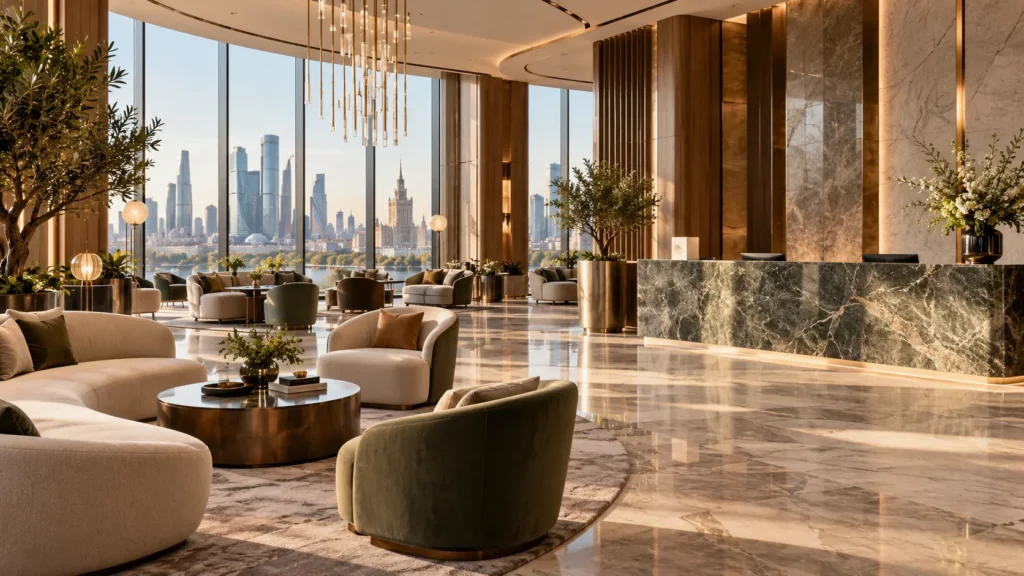
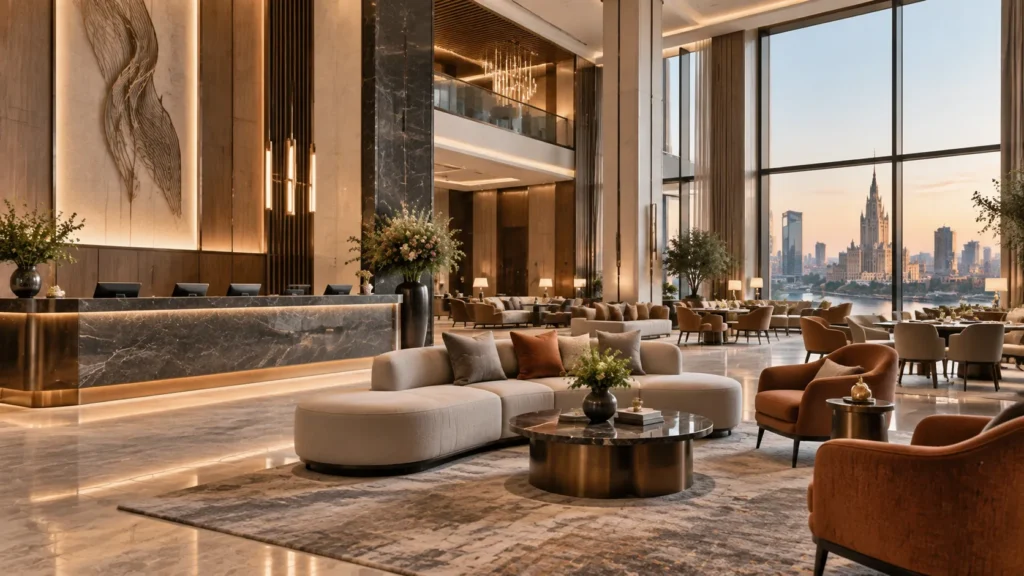
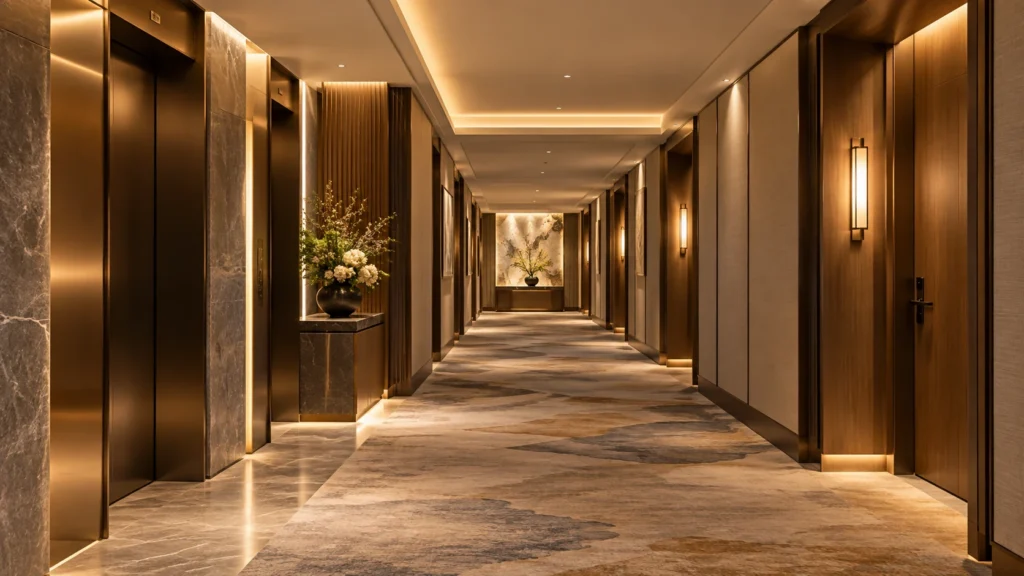
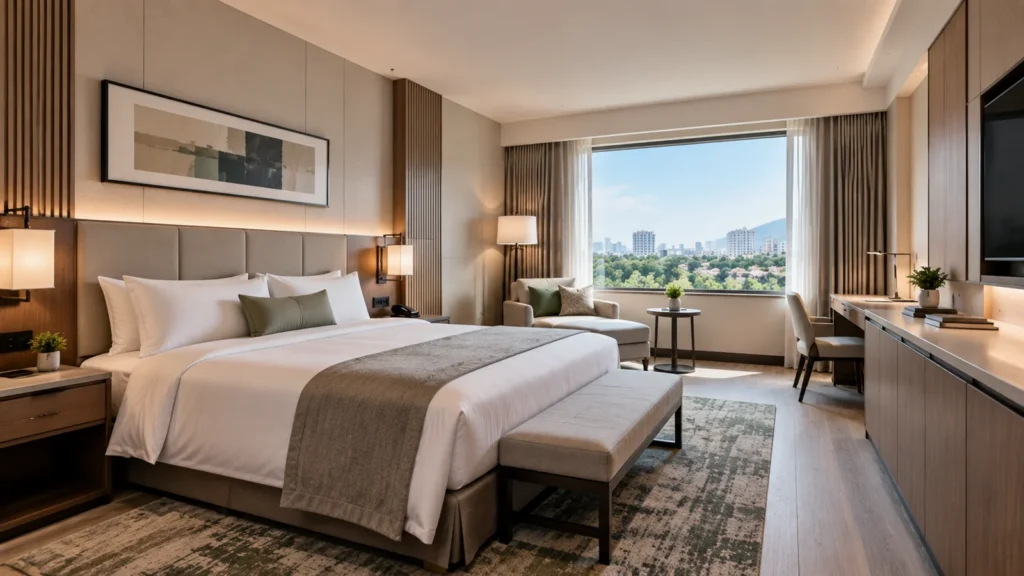
Wall panels can turn a plain guest room into a distinctive, memorable space. But good wall panel design does more than add color or texture.
A hotel wall panel must withstand daily use, support efficient cleaning, and allow practical repairs. It should look refined without becoming difficult to maintain or reproduce across many rooms.
This guide focuses on 15 hotel wall panel styles for modern guest rooms. The ideas are grouped into wood, upholstered, textured, and acoustic systems.
For design inspiration focused on specific guest room areas, explore our hotel headboard wall design ideas and hotel TV wall design ideas.
What Makes a Good Hotel Wall Panel Design?
A good hotel wall panel design goes beyond selecting an attractive surface.
A complete system may include the finish, substrate, backing, edges, joints, and mounting hardware. Guests see the finish. The components underneath determine stability, durability, and ease of repair.
A strong design should answer several practical questions:
- Does the pattern suit the scale of the wall?
- Can housekeeping clean the surface efficiently?
- Do the joints align with doors, wardrobes, and other fixed elements?
- Can damaged panels be replaced individually?
- Do switches, outlets, and service points remain accessible?
- Can the finish stay consistent across many guest rooms?
Proportion matters too. A small sample may look calm on a desk. The same pattern may feel busy across a full guest room wall.
Lighting also changes how wall panels appear. Side lighting highlights texture, joints, and surface imperfections. More direct lighting creates a flatter, more uniform effect.
Visual quality is only part of the approval process. The proposed assembly must also meet project performance and compliance requirements. For example, NFPA 286 provides a test method for evaluating how wall and ceiling interior finishes contribute to room fire growth. Required documentation still depends on local codes and project specifications.
For detailed guidance on layouts, coordination, materials, and complete assemblies, read our hotel wall panel design guide and hotel wall panel materials guide.
Wood Wall Panel Design Ideas for Modern Hotel Guest Rooms
Wood wall panels bring warmth, texture, and visual order to modern hotel guest rooms. Depending on the finish and layout, they can feel natural, refined, or distinctly contemporary.
Grain direction, color, panel size, and joint layout all shape the final result.
1. Natural Wood Veneer Wall Panels

Natural wood veneer adds warmth, natural grain variation, and visual depth to hotel wall panels. Light oak feels open and relaxed, while walnut and darker veneers create a richer atmosphere.
Because natural variation is unavoidable, approve an acceptable color and grain range rather than relying on one small sample.
Best for: Luxury hotels, resorts, boutique properties, and premium suites.
Key checks: Veneer species, grain direction, approved color range, edge protection, and replacement material availability.
2. Chevron or Herringbone Wood Wall Panels

Chevron and herringbone layouts arrange wood panels in angled patterns. They create more movement and visual character than conventional vertical panels.
Use larger modules and restrained wood tones in hotel guest rooms. Small, high-contrast patterns may make the wall feel busy.
Best for: Boutique hotels, lifestyle properties, resorts, and design-led suites.
Key checks: Pattern scale, grain direction, joint alignment, edge details, and room-to-room consistency.
3. Fluted or Slatted Wood Wall Panels

Fluted panels use routed grooves, while slatted panels use raised wood strips. Both add rhythm, shadow, and depth. Vertical profiles can also make a guest room feel taller.
Keep the profiles simple and shallow. Deep grooves collect dust, while narrow projections may chip at exposed corners. Decorative wood slats should not be described as acoustic unless they are combined with suitable absorptive backing and tested as part of a complete assembly.
Best for: Lifestyle hotels, modern resorts, boutique rooms, and natural contemporary interiors.
Key checks: Profile depth, slat spacing, cleanability, corner protection, and joint consistency.
4. Wood-Look HPL and Laminate Wall Panels

Wood-look HPL and decorative laminate panels provide more consistent grain and color across standardized guest rooms. Their easy-to-clean surfaces make them practical for busy hotels and large room programs.
Choose the pattern scale carefully. Obvious repeats and poorly finished edges can reduce the quality of the wall. For U.S. projects, confirm TSCA Title VI compliance when the panels contain regulated composite wood substrates.
Best for: Business hotels, midscale properties, serviced apartments, and large guest room programs.
Key checks: Pattern repetition, HPL grade, edge treatment, joint layout, and future supply.
Upholstered Wall Panel Design Ideas for Hotel Guest Rooms
Upholstered wall panels soften hard finishes and bring warmth, comfort, and tactile depth to hotel guest rooms.
With the right fabric, backing, seams, and mounting system, they can also be practical to clean, maintain, and replace over time.
5. Flat Fabric-Wrapped Wall Panels

Flat fabric-wrapped panels create a calm, understated backdrop without deep channels, buttons, or complex stitching. Subtle colors and woven textures can coordinate with curtains, seating, and other soft furnishings.
Use them in low-contact areas away from luggage and frequent hand contact. Removable modules make cleaning, repair, and replacement easier when stains or damage occur.
Best for: Boutique hotels, wellness properties, suites, and low-contact feature walls.
Key checks: Commercial-grade fabric, stain resistance, seam placement, backing stability, cleaning method, and replacement access.
6. Faux Leather Wall Panels

Faux leather wall panels create a smooth, tailored look with more structure than woven fabric. Commercial-grade faux leather can also be easier to wipe clean and maintain.
Use larger panels and simple seam layouts for a cleaner result. Poor-quality materials may crack, peel, or stretch, especially around edges and seams.
Best for: Urban hotels, executive rooms, upscale business hotels, and contemporary suites.
Key checks: Abrasion resistance, seam construction, cleaning compatibility, peeling risk, and replacement availability.
7. Vertical Channel Upholstered Wall Panels

Vertical channel panels create a soft, linear rhythm and can make a room with a low ceiling feel taller. Wider channels look calm and architectural, while very narrow channels may feel busy.
Consistent padding and straight seams are essential. Uneven foam or misaligned channels become especially visible under side lighting.
Best for: Lifestyle hotels, luxury rooms, boutique properties, and soft contemporary interiors.
Key checks: Channel width, foam density, seam alignment, cleanability, and modular replacement.
8. Geometric Upholstered Wall Panels

Geometric upholstered panels use squares, rectangles, angled modules, or controlled asymmetrical layouts. Their visual pattern comes from panel shape and proportion rather than printed decoration.
Use a limited number of shapes and module sizes. A restrained layout creates a distinctive hotel wall panel design without making the room feel busy.
Best for: Design hotels, boutique properties, branded interiors, and premium suites.
Key checks: Module size, pattern repetition, seam alignment, edge safety, and room-to-room consistency.
Textured Wall Panel Design Ideas for Hotel Guest Rooms
Textured wall panels add depth through grooves, relief, embossed patterns, or material effects. They can enrich a neutral guest room without adding more colors.
Lighting plays an important role. It highlights the texture but can also reveal uneven joints and surface defects.
9. Three-Dimensional Geometric Wall Panels

Three-dimensional panels use raised, recessed, or folded forms to create changing highlights and shadows. They work best as controlled features rather than full-room finishes.
Avoid deep projections or sharp edges in narrow areas. Use modular sections so damaged pieces can be replaced individually.
Best for: Boutique hotels, lifestyle properties, luxury suites, and selected feature walls.
Key checks: Projection depth, edge safety, lighting direction, cleanability, and module replacement.
10. Ribbed and Linear Textured Wall Panels

Ribbed panels use shallow, repeated lines to add controlled texture without the depth of wood slats or three-dimensional relief. Molded, coated, or composite surfaces can create a clean, understated look across wider walls.
Keep the lines continuous across panel joints. Even small misalignments become noticeable under directional lighting.
Best for: Modern business hotels, urban properties, and minimalist guest rooms.
Key checks: Rib depth, line spacing, joint continuity, cleanability, lighting direction, and repair method.
11. Stone-Look Wall Panels

Stone-look wall panels recreate the appearance of marble, travertine, slate, and other stone finishes without requiring thick slabs of natural stone. Depending on the assembly, the surface may be decorative laminate, porcelain, sintered material, or a lightweight composite.
Plan large patterns and veins across the full wall elevation. Poor joint placement or obvious pattern repetition can weaken the finished composition.
Best for: Luxury hotels, suites, premium entrances, and upscale modern guest rooms.
Key checks: Panel construction, weight, pattern repetition, vein layout, glare, edge treatment, and replacement matching.
12. Lacquered Color-Block Wall Panels

Lacquered wall panels use solid colors and clean joints to create a crisp, contemporary composition. Matte and satin finishes usually feel calmer than high-gloss surfaces.
Limit the color palette and align panel joints with doors, wardrobes, and fixed furniture. Dark or high-sheen finishes can make fingerprints, surface waviness, and edge damage more noticeable.
Best for: Urban hotels, design-led properties, executive rooms, and modern suites.
Key checks: Color matching, sheen consistency, surface flatness, joint alignment, edge protection, and repair method.
13. Mineral-Textured or Microcement-Look Wall Panels

Mineral-textured wall panels recreate the soft, matte appearance of microcement, lime plaster, or fine mineral finishes. They add subtle depth without prominent veins, deep grooves, or reflective surfaces.
Use large, simple modules with restrained joints. Confirm the approved color range, cleaning method, edge durability, and repair process before production.
Best for: Urban hotels, wellness properties, minimalist interiors, and contemporary suites.
Key checks: Texture consistency, color matching, joint layout, stain resistance, edge protection, and repair method.
Acoustic Wall Panel Design Ideas for Hotel Guest Rooms
Acoustic wall panels can reduce sound reflections and reverberation within a guest room. However, they do not, by themselves, prevent sound from passing through walls, doors, ceilings, or service penetrations.
ASTM C423 covers the measurement of sound absorption and sound absorption coefficients in a reverberation room. It does not evaluate room-to-room sound isolation. Ask suppliers for test reports that match the proposed panel thickness, backing, mounting method, and air cavity.
14. PET Felt Acoustic Wall Panels

PET felt acoustic panels provide a soft, matte surface and can be cut into large panels, linear forms, or simple geometric modules. Neutral colors create a restrained look, while selected accent colors can support the hotel’s brand palette.
Performance depends on the complete assembly, including panel thickness, backing, mounting method, and air cavity. A thin decorative felt layer should not be treated as a tested acoustic system.
Best for: Business hotels, modern guest rooms, seating areas, and selected acoustic feature walls.
Key checks: Acoustic test reports, panel thickness, mounting method, edge finish, cleaning method, and color consistency.
15. Microperforated Wood Acoustic Wall Panels

Microperforated wood acoustic panels combine a refined wood surface with very small openings and absorptive backing. From a normal viewing distance, the perforations can appear subtle, creating a calmer look than conventional drilled panels.
Acoustic performance depends on the complete tested assembly, including the wood face, backing, panel thickness, mounting method, and air cavity.
Best for: Luxury guest rooms, boutique hotels, suites, lounges, and design-led acoustic features.
Key checks: Microperforation pattern, acoustic backing, test data, panel thickness, mounting method, finish consistency, and replacement access.
Best Hotel Wall Panel Ideas by Hotel Type
No single hotel wall panel design suits every property. Start with the hotel’s positioning, guest profile, maintenance needs, and desired atmosphere.
Business and Midscale Hotels
Best choices
- Wood-Look HPL
- Ribbed Panels
- PET Felt Panels
These hotels usually need consistent finishes, efficient production, and straightforward maintenance. Keep the palette simple, with one dominant finish connecting the entrance, wardrobe, desk, and other fixed furniture.
Boutique and Lifestyle Hotels
Best choices
- Chevron Wood
- Fluted Panels
- Geometric Upholstery
- 3D Panels
These options create stronger patterns and more recognizable visual identities. Choose one main feature and keep the surrounding finishes restrained so the guest room does not feel overly designed.
Luxury Hotels and Suites
Best choices
- Natural Wood Veneer
- Faux Leather
- Stone-Look Panels
- Microperforated Wood
Luxury rooms can support natural variation, custom detailing, and refined material combinations. Careful sampling, grain control, precise joints, and protected edges remain essential.
Resorts and Wellness Hotels
Best choices
- Natural Veneer
- Flat Fabric Panels
- Mineral-Textured Panels
- Microperforated Wood
Warm colors and tactile surfaces can create a calmer atmosphere. Consider humidity, sunlight, cleaning methods, and replacement needs before approving the final hotel wall panel system.
How to Choose and Combine Hotel Wall Panel Designs
Use this checklist to balance design, maintenance, coordination, and technical performance.
- Match the design to the hotel’s positioning — Choose finishes that support the intended guest experience. Business hotels often need consistency, while boutique hotels can support stronger visual character.
- Consider contact and cleaning — Use durable, easy-to-clean panels near entrances, wardrobes, and luggage areas. Keep fabric and deeper textures in protected zones.
- Verify acoustic performance — A soft, slatted, padded, or perforated panel is not automatically acoustic. Request test data for the complete proposed assembly.
- Limit the number of finishes — Use one dominant wall panel design and one supporting finish. Too many materials can make the guest room feel fragmented.
- Coordinate fixed elements — Align panel joints with doors, wardrobes, furniture, switches, outlets, lights, and access panels wherever practical.
- Plan maintenance access — Conceal wiring and services without making them difficult to inspect, repair, or replace.
- Review full-size samples — Check color, grain, texture, seams, corners, lighting effects, cleanability, and replacement procedures.
- Confirm project documents — Verify the required fire-performance, indoor-air-quality, and product compliance documents before production.
Conclusion
The best hotel wall panel design gives the guest room a clear visual direction without making it feel overloaded.
Wood panels add warmth and structure. Upholstered panels bring softness. Textured panels create depth. Acoustic panels serve a more specific performance purpose. The right choice depends on the hotel’s positioning, cleaning requirements, contact levels, maintenance plan, compliance needs, and replacement strategy.
VOLANT FIT-OUT coordinates hotel wall panels with guest room doors, wardrobes, headboards, TV cabinets, and other fixed furniture. This helps coordinate finishes, module dimensions, joint lines, and installation interfaces across the wall panels and fixed furniture.
Planning a new hotel project or a guest room renovation? Contact VOLANT to discuss your project requirements and develop a coordinated wall panel and fixed-furniture solution.
FAQs
What Is the Best Wall Panel for a Hotel Room?
The best option depends on the hotel type, cleaning needs, contact level, and budget. HPL suits standardized rooms, while veneer and upholstered panels suit more customized interiors.
How Should I Choose a Hotel Wall Panel Design?
Start with the hotel’s positioning and intended guest experience. Then consider wall location, cleanability, maintenance, joint layout, and coordination with doors, wardrobes, and fixed furniture.
If you are sourcing wall panels for a hospitality project in Indonesia, you can also explore experienced wall panel suppliers in Indonesia to compare available solutions, materials, and customization options.
Are Acoustic Wall Panels the Same as Soundproofing?
No. Acoustic panels reduce sound reflections inside a room. They do not stop sound from passing through walls, doors, or ceilings.
Which Hotel Wall Panels Are Easiest to Clean?
Smooth HPL, laminate, lacquered, and selected faux leather panels are generally easier to clean than fabric or deeply textured surfaces.
How Many Wall Panel Types Should a Guest Room Use?
Most guest rooms need one main wall panel design and one supporting finish. Too many materials can make the room feel fragmented.
Can Damaged Hotel Wall Panels Be Replaced?
Yes, when the wall system uses modular panels and accessible mounting details. Spare panels should be kept for future repairs and finish matching.