Choosing hotel wall panels is more than a design decision. Materials affect cleaning, repairs, room downtime, and long-term operating costs.
So, which wall panel materials are best? There is no single answer. Entrance walls need impact resistance. Headboard walls need comfort and visual warmth. TV walls must coordinate with furniture, lighting, and electrical services.
This guide explains the differences between wall panel finishes, substrates, and complete assemblies. We compare their advantages, limitations, and best hotel applications. For guidance on layouts, proportions, and furniture coordination, read our hotel wall panel design guide.
What Makes Up a Hotel Wall Panel?
Most hotel wall panels are not made from one solid material. Think of each panel as a layered sandwich. Each layer has a different job, although not every system uses every layer.
- Surface finish: The visible layer, such as wood veneer, laminate, lacquer, fabric, metal, or a stone-look finish.
- Substrate or core: The supporting board, such as medium-density fiberboard (MDF), plywood, particleboard, wood-plastic composite (WPC), or mineral board.
- Backing or functional layer: Foam, acoustic felt, moisture-resistant backing, or another performance layer.
- Edge treatment: Edge banding, sealed paint, wrapped edges, metal trims, or shadow gaps.
- Fixing system: Adhesives, clips, screws, subframes, or concealed removable fittings.
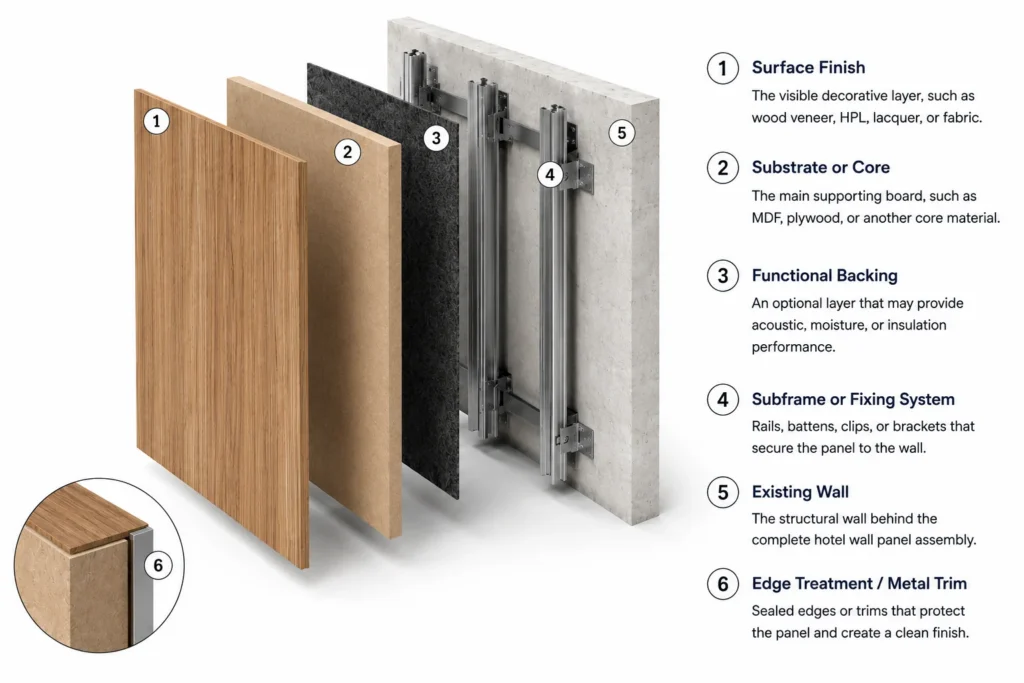
The finish and substrate perform different jobs, so they should not be treated as equivalent material choices. Wood veneer may create the visible appearance, while MDF or plywood provides the support behind it.
The project team should approve the complete wall panel assembly, not only a small finish sample. Even a durable finish can fail when its edges remain exposed, and an attractive surface may perform poorly on an unsuitable substrate.
Quick Comparison of Surface Finishes for Hotel Wall Panels
The table below compares common surface finishes used on hotel wall panels. These ratings are general. Final performance depends on the substrate, protective coating, edges, backing, and fixing system.
| Surface Finish | Appearance | Cleaning Ease | Wear Resistance | Color Consistency | Best Hotel Uses | Main Limitation |
|---|---|---|---|---|---|---|
| Wood Veneer | Natural and premium | Moderate care | Medium | Low to medium | Headboard walls, TV walls, and suites | Natural grain and color variation |
| HPL and Other Decorative Laminates | Consistent and versatile | Easy | High | High | Entrances, luggage zones, and standardized guest rooms | Poor edges and joints can look unfinished |
| Lacquer | Smooth and customizable | Usually easy | Low to medium | High | Modern feature walls and decorative details | Scratches, fingerprints, and chipped corners |
| Fabric | Soft and textured | Material dependent | Low to medium | Medium to high | Headboard walls and seating areas | Stains, dust, and specialist cleaning |
| Faux Leather | Soft and tailored | Usually easy | Medium | High | Headboards and selected feature areas | Cracking, peeling, and seam wear |
| Metal Finish | Precise and contemporary | Usually easy | Product dependent | Medium to high | Entrances, trims, corners, and lobby details | Fingerprints, glare, dents, and finish variation |
| Natural or Engineered Stone | Premium and distinctive | Usually easy when sealed | High | Low to medium | Lobbies, entrances, and luxury feature walls | Weight, cost, edge treatment, and difficult repairs |
| Stone-Look Finish | Consistent and decorative | Usually easy | Product dependent | High | TV walls, guest rooms, and feature areas | Pattern repetition and limited natural depth |
Common Surface Finishes for Hotel Wall Panels
Among common wall panel materials, the surface finish is the layer guests see and touch. It affects appearance, cleaning, and visible wear.
However, the finish does not work alone. The substrate, edges, backing, and fixing system still affect final performance.

Wood Veneer
Wood veneer gives hotel wall panels natural grain, depth, and warmth. It suits interiors that need a premium, residential feel.
Each veneer sheet is different. This creates character, but it also makes production control important. Confirm the grain direction, color range, veneer sequence, and approved batch before production.
Review a large veneer sample under actual guest room lighting. A small swatch cannot show the full grain pattern or natural color variation.
Best uses: Headboard walls, TV walls, suites, and boutique guest rooms.
Key checks: Grain direction, batch matching, edge protection, cleaning method, and replacement availability.
HPL and Other Decorative Laminates
HPL is one of the most practical finishes for standardized hotel guest rooms. Other decorative laminates can also provide consistent colors, patterns, and wood effects.
These surfaces are usually easy to clean. They also work well in entrances and luggage zones.
Still, the sheet itself does not guarantee a durable result. Poor edge banding, open joints, and weak corner details can quickly reduce performance.
Printed wood patterns may also look less natural than real veneer. Pattern scale and repetition should be reviewed on a large sample.
Best uses: Entrance walls, luggage zones, TV walls, and standardized guest rooms in business and midscale hotels.
Key checks: Surface grade, edge banding, joint alignment, corner protection, and future finish availability.
Lacquer Finishes
Lacquer is a coating system applied over a prepared substrate. It creates a smooth surface with controlled color and gloss.
Designers can use lacquer for grooves, shaped details, matte colors, and high-gloss features. It works especially well in modern interiors.
However, dark gloss can show fingerprints and surface waviness. Sharp corners may chip, while scratches can require professional repair.
The substrate must remain stable. All exposed edges and cutouts should also be sealed.
Best uses: Feature walls, decorative headboard details, grooves, and controlled guest room areas.
Key checks: Gloss level, substrate preparation, edge sealing, corner design, lighting, and repair method.

Upholstered Finishes: Fabric and Faux Leather
Fabric and faux leather add softness, texture, and comfort to hotel wall panels. They are often used behind the bed.
Fabric provides a wider range of textures and woven patterns. Faux leather is often easier to wipe, although performance varies by product.
The visible material is only one part of the assembly. Foam, stitching, backing boards, adhesives, and fixing details also affect durability.
Poor-quality faux leather may crack, peel, or stretch around seams. Fabric may collect dust or require professional stain removal.
Best uses: Upholstered headboard panels, suites, and selected seating areas.
Key checks: Cleaning instructions, abrasion performance, seam design, foam quality, colorfastness, and panel replacement access.
Headboard finishes should coordinate with bedside furniture, lighting, outlets, and maintenance access.
Metal Finishes and Decorative Trims
Metal may be used as a large sheet facing or as a narrow decorative trim. Common options include stainless steel, aluminum, and coated metal.
Narrow trims can frame veneer, divide finishes, or protect selected edges. Large metal surfaces create a stronger visual statement but need more careful detailing.
Fingerprints, glare, dents, and surface variation can become noticeable under hotel lighting. The final result also depends on thickness, coating, and backing support.
Best uses: Entrances, TV walls, lobby details, corners, frames, and material transitions.
Key checks: Metal grade, surface coating, reflection, backing support, edge safety, batch consistency, and cleaning products.
Natural and Engineered Stone
Natural and engineered stone create a premium and substantial appearance. They are often used in lobbies, entrances, and luxury feature areas.
Natural stone offers unique veining and variation. Engineered stone may provide more controlled color and pattern.
Both options can add weight to the wall system. Large pieces also require careful handling, edge finishing, support, and service coordination.
Best uses: Lobbies, entrances, reception features, TV walls, and luxury suites.
Key checks: Weight, support structure, slab size, edge treatment, pattern matching, sealing, and access to concealed services.
Stone-Look Finishes
Stone-look finishes recreate marble, granite, or other mineral surfaces without always using solid stone.
Options include printed laminate, porcelain, sintered surfaces, and composite panels. These products differ greatly in weight, durability, and installation needs.
Printed finishes usually provide greater pattern consistency and lower cost. However, repeated patterns can make large walls look artificial.
Porcelain and sintered surfaces may offer greater wear resistance. They also require suitable support, cutting, and edge detailing.
Best uses: TV walls, guest rooms, entrances, and decorative feature areas.
Key checks: Product type, panel weight, pattern repetition, edge treatment, fixing method, and repair options.
Which Finish Is Best for Hotels?
- Choose wood veneer for natural depth and premium character.
- Choose HPL or laminate for durability, cleaning, and consistency.
- Choose lacquer for custom colors, grooves, and shaped details.
- Choose upholstery for softness and comfort.
- Choose metal for trims, frames, and selected feature areas.
- Choose stone for a substantial premium finish.
- Choose stone-look surfaces for consistency and easier material control.
Most hotels combine several finishes. Veneer may define feature walls, while laminate protects high-contact areas. Lacquer and metal can then add controlled decorative details. For more visual inspiration, explore our 15 hotel wall panel design ideas for modern guest rooms, including wood, upholstered, textured, and acoustic options.
Quick Comparison of Wall Panel Substrates and Cores
Substrates sit behind the visible finish. They affect panel stability, weight, edge quality, fixing strength, and moisture response.
The ratings below are general. Actual performance depends on the board grade, density, composition, thickness, edge treatment, and installation system.
| Substrate or Core | Dimensional Stability | General Moisture Tolerance | Typical Weight | Edge and Fixing Requirements | Typical Surface Finishes | Main Limitation |
|---|---|---|---|---|---|---|
| MDF | Good in controlled dry interiors | Low for standard grades; higher for moisture-resistant grades | Medium to high | Seal exposed edges and cutouts; review fixing loads | Wood veneer, HPL, decorative laminate, and lacquer | Standard MDF may swell when moisture enters exposed areas |
| Plywood | Grade dependent | Product and adhesive grade dependent | Medium | Cover or seal exposed edges; confirm flatness and fixing details | Veneer, laminate, fabric-wrapped assemblies, and selected metal facings | Surface flatness, internal voids, and quality can vary |
| Particleboard | Good in controlled dry interiors | Low for standard grades; moderate for selected moisture-resistant grades | Medium to high | Use reliable edge banding and suitable fixings | Laminate, melamine, and veneer | Exposed edges and repeated fixings require care |
| WPC Board | Product dependent | Often good, but formulation dependent | Medium to high | Review thermal movement, fixing strength, and adhesive compatibility | Decorative film, laminate, coating, or direct-finished surface | Formulations, appearance, and performance vary widely |
| PVC Board | Product dependent | Generally high | Low to medium, depending on density | Review heat response, expansion, fixing, and adhesive compatibility | Printed film, laminate, coating, or direct surface | Heat movement, surface quality, and fixing strength vary by product |
| SPC Board | Generally rigid, but product dependent | Generally high | Medium to high | Review brittle edges, cutting, movement, and fixing method | Printed decorative film or factory-applied surface | Often supplied as a finished panel rather than a flexible substrate |
| Cement or Mineral-Based Board | Usually good | Usually high, but product dependent | High | Plan cutting, drilling, joints, wall support, and specialized fasteners | Stone, tile, coatings, veneer, or selected laminates | Greater weight and more difficult processing |
WPC, PVC, and SPC are not interchangeable materials. They may also be supplied as complete finished wall panel systems rather than bare substrates. Always review the exact product construction before specifying them.
Common Substrates and Core Materials for Hotel Wall Panels
The substrate sits behind the visible finish. It affects panel stability, fixing strength, edge quality, weight, and moisture response.
Material names alone do not guarantee performance. Board grade, density, thickness, composition, and installation details also matter.

MDF
MDF has a smooth and consistent surface. It works well beneath wood veneer, HPL, decorative laminate, and lacquer.
It is also easy to machine, making it suitable for grooves and shaped details. However, exposed edges and cutouts need sealing. Standard MDF may swell when moisture enters unprotected areas.
Different grades offer different performance. Always review the approved board specification, not only the generic material name.
Best uses: Flat decorative panels, lacquered details, grooves, and controlled indoor areas.
Key checks: Board grade, density, edge sealing, emissions, moisture exposure, thickness, and fixing method.
Plywood
Plywood consists of bonded wood veneer layers. Its performance depends on the wood species, veneer quality, adhesive, grade, and manufacturing process.
A suitable plywood grade can provide strong fixing support around fittings and removable panels. However, plywood is not automatically waterproof. Moisture performance still depends on the product and edge protection.
The face may also need preparation before receiving lacquer or another very smooth finish.
Best uses: Panels requiring stronger fixing support, removable sections, or complex furniture interfaces.
Key checks: Grade, flatness, internal quality, adhesive type, edge treatment, fixing loads, and required product certifications.
Particleboard
Particleboard is widely used in engineered furniture and interior panel systems. It offers cost efficiency and a flat surface for laminate, melamine, or veneer.
It can perform well in controlled, dry interiors when the board density, edge banding, and fixings suit the application. Exposed edges, repeated fixings, and moisture exposure require more care.
Best uses: Cost-controlled wall panels in dry, lower-risk interior areas.
Key checks: Density, thickness, edge banding, fixing requirements, moisture exposure, emissions, and replacement access.
WPC, PVC, and SPC Boards
WPC, PVC, and SPC are different wall panel materials. Their names should not be used interchangeably.
WPC combines wood-based content with polymers. PVC board is primarily plastic based. SPC usually combines mineral filler with a rigid polymer system.
These materials may provide good moisture tolerance, but performance varies by product. Weight, heat response, dimensional movement, fixing strength, and surface quality all need review.
Some products are sold as bare boards. Others are supplied as complete factory-finished wall panel systems. This distinction affects installation, repairs, and specification.
Best uses: Selected renovations, corridors, service areas, moisture-prone zones, and factory-finished panel systems.
Key checks: Exact composition, dimensional movement, heat response, fire reports, fixing details, adhesive compatibility, finish quality, and future supply.
Cement and Mineral-Based Boards
Cement and mineral-based boards can provide good dimensional stability and moisture tolerance. They may support stone, tile, coatings, veneer, or selected decorative surfaces.
These boards are often heavier than wood-based alternatives. Cutting, drilling, joints, wall support, and handling require careful planning.
A fire-rated board does not automatically make the complete hotel wall panel system compliant. The finish, backing, joints, fixings, and installation method may also affect performance.
Best uses: Moisture-prone areas, heavier surface finishes, and project-specific performance assemblies.
Key checks: Board type, weight, thickness, cutting method, wall support, fixings, joints, finish compatibility, and complete assembly testing.
Common Hotel Wall Panel Assemblies
Hotel projects usually specify and approve wall panels as complete assemblies, not as isolated finishes or substrates. The final system may include the surface finish, supporting board, backing, edges, and fixing method.
| Complete Wall Panel Assembly | Main Benefit | Typical Hotel Applications | Key Checks |
|---|---|---|---|
| Wood Veneer on MDF | Smooth surface with natural grain | Headboard walls, TV walls, and suites | MDF grade, edge sealing, veneer matching, and moisture exposure |
| Wood Veneer on Plywood | Natural finish with suitable fixing support | Feature walls and removable access panels | Plywood grade, thickness, flatness, edge treatment, and veneer matching |
| HPL on MDF | Durable finish with efficient production | Standardized guest rooms and controlled dry areas | HPL grade, edge quality, substrate protection, and fixing method |
| HPL on Plywood | Durable surface with suitable fixing support | Entrances, luggage walls, and service-access panels | Flatness, edge protection, fixing loads, and joint alignment |
| Lacquered MDF | Smooth custom color with grooves or shaped details | Decorative walls and modern guest room features | Substrate preparation, sealed edges, chipping, scratches, and repair method |
| Fabric-Wrapped Foam Panel on Backing Board | Soft texture, comfort, and visual warmth | Headboard walls, suites, and seating areas | Fabric performance, foam quality, seams, cleaning, and replacement access |
| PET Acoustic Panel System | Sound absorption with decorative texture | Headboards, seating zones, and selected feature walls | Product test reports, thickness, backing, fixing, and cleaning |
| Metal-Faced Composite Panel | Precise appearance with controlled panel construction | Entrances, lobbies, TV walls, and decorative details | Metal grade, core composition, backing support, edges, and fire documentation |
| Stone, Porcelain, or Sintered Panel System | Premium mineral appearance and durable surface | Lobbies, entrances, TV walls, and luxury features | Weight, support, cutting, edges, joints, and service access |
| Lightweight Stone-Look Laminate or Composite Panel | Consistent stone effect with simpler material control | Guest rooms, TV walls, and renovation projects | Pattern repetition, substrate, edge quality, impact resistance, and fixing |
| Factory-Finished WPC, PVC, or SPC Panel System | Moisture tolerance and efficient installation | Corridors, service areas, and selected renovations | Exact composition, movement, heat response, fixing, fire reports, and replacement supply |
| FRP Wall Panel System | Washable surface for demanding operational areas | Service corridors, back-of-house areas, and selected high-contact zones | Surface quality, joints, adhesives, fire reports, and compatibility with hotel design standards |
Two panels with the same visible finish may perform differently because their substrates, backing, edge treatments, and fixing systems vary. The project team should approve the complete wall panel assembly rather than the finish alone.
Acoustic Wall Panel Systems
Acoustic systems for hotel wall panels should be selected for performance, not appearance alone. Common options include:
- PET acoustic panels
- Fabric-wrapped panels with acoustic backing
- Perforated wood panels with absorptive backing
- Decorative panels with limited acoustic performance
These systems can reduce sound reflections and reverberation within a guest room. However, sound absorption and sound insulation are different. Absorption controls reflections inside the room, while insulation limits sound passing between rooms. ASTM C423 measures sound absorption in a reverberation room; it does not evaluate room-to-room sound isolation.
A decorative acoustic panel cannot replace a complete partition system. Doors, ceilings, joints, and service penetrations also influence acoustic privacy. Request acoustic test reports that match the proposed panel thickness, backing, mounting method, and installation configuration.
Best Wall Panel Assemblies by Hotel Area
The best assembly for hotel wall panels depends on how each wall is used, cleaned, touched, and maintained.
| Hotel Area | Recommended Assembly | Why It Works | Main Risk |
|---|---|---|---|
| Entrance and Luggage Wall | HPL on MDF or plywood with protected edges and corners | Supports frequent cleaning and regular luggage contact | Exposed edges, weak corners, and damaged joints |
| Headboard Wall | Veneer panel, upholstered panel, or tested acoustic panel on suitable backing | Adds visual warmth, comfort, and room identity | Stains, dust, electrical access, and difficult panel replacement |
| TV and Desk Wall | Veneer, HPL, or lacquered modular panels with planned service access | Coordinates wall finishes with furniture, lighting, and electrical services | Poor access to wiring, outlets, and concealed fixings |
| Corridor | Durable laminate, FRP, or a tested factory-finished panel system | Handles housekeeping contact, traffic, and repeated cleaning | Visible joints, damaged corners, and difficult local repairs |
| Lobby and Reception Area | Veneer, metal-faced, stone, porcelain, or engineered feature panel system | Creates a strong visual identity in high-visibility areas | Weight, complex support, finish variation, and difficult replacement |
| Moisture-Prone Area | Tested moisture-tolerant finish and substrate with sealed edges and protected cutouts | Supports cleaning and helps reduce swelling or surface damage | Unsealed edges, open joints, penetrations, and unsuitable adhesives |
Use this table as a starting point. Final wall panel materials should follow the project specification, local requirements, maintenance plan, and approved complete assembly.
How to Choose the Right Wall Panel Materials
Choosing the right wall panel materials requires more than comparing colors and prices. Review the finish, substrate, installation details, and daily operating conditions as one system.

1. Separate the Finish From the Substrate
First, confirm what you are selecting. Is it the visible finish, the supporting substrate, or the complete wall panel assembly?
A premium veneer cannot correct an unstable substrate. Likewise, a moisture-resistant board cannot protect an exposed fabric surface. Evaluate each layer according to its role.
2. Match the Assembly to the Wall Location
Consider how guests and staff will use the wall each day. Will luggage hit it? Will guests touch it often? Is it close to a minibar, entrance, or bathroom?
Entrance walls, headboard walls, and TV walls face different risks. Select the complete assembly around those conditions rather than using one material everywhere.
3. Review Cleaning Requirements
Confirm how often housekeeping will clean the surface and which products they will use. Deep grooves, open joints, rough textures, and soft fibers can increase cleaning time.
A dramatic surface may look impressive during approval. Could it become a daily maintenance problem after opening? Test the proposed finish using the actual cleaning method.
4. Check Moisture and Dimensional Stability
Do not rely only on a “waterproof” surface claim. Moisture may enter through exposed edges, joints, cutouts, electrical openings, damaged corners, and fixing points.
Review the finish, substrate, sealed edges, adhesives, humidity conditions, and expansion allowances together. A moisture-tolerant surface cannot compensate for poorly protected details.
5. Confirm Fire and Indoor-Air Requirements
Fire and indoor-air requirements depend on the project location, building code, hotel area, and complete wall assembly.
NFPA 286 is a room-scale test method used to evaluate how wall and ceiling interior finishes contribute to fire growth. It is not a universal approval for every material or project.
For composite wood products sold, supplied, offered for sale, manufactured in, or imported into the United States, TSCA Title VI applies to hardwood plywood, MDF, particleboard, and finished goods containing these materials.
LEED low-emitting-material requirements may also apply to composite wood. The criteria depend on the selected rating system and version.
Request documentation that matches the proposed product, substrate, finish, and installation configuration. A report for one component may not represent the complete hotel wall panel assembly.
6. Plan Repairs and Replacement
Consider what happens when one panel becomes damaged several years after opening. Can staff remove it without damaging neighboring panels or fixed furniture?
A maintainable system should provide access to concealed fasteners, wiring, outlets, and other services. Record finish codes, approved tolerances, supplier details, and production batches. Keep a planned quantity of spare panels from the original batch when practical.
7. Compare Lifecycle Value
The lowest material price does not always create the lowest project cost. Compare installation time, cleaning labor, repairs, spare materials, replacement access, room downtime, and future availability.
A slightly higher initial cost may reduce maintenance problems later. Treat the wall panel system like hotel equipment, not temporary decoration.
8. Approve Full-Size Samples
Do not approve wall panel materials from a small swatch alone. Review larger samples under actual room lighting to check grain, gloss, color variation, joints, edges, and cleaning performance.
Approve the finish and substrate together whenever possible. Keep the approved sample, finish code, and batch information as references for production and future replacement.
Common Hotel Wall Panel Material Selection Mistakes
The following wall panel material mistakes can reduce the durability, appearance, and service life of hotel wall panels.
- Treating finishes and substrates as equivalent choices — They serve different purposes and must be evaluated as parts of a complete assembly.
- Choosing by appearance alone — An attractive finish may not suit the wall’s cleaning, impact, moisture, or maintenance conditions.
- Ignoring edges, joints, and cutouts — Wall panel failures often begin where moisture or impact reaches exposed details.
- Using one assembly everywhere — Entrances, headboard walls, TV walls, corridors, and lobbies face different operating demands.
- Relying on generic material claims — Terms such as waterproof, fire-resistant, or acoustic do not replace product-specific test reports.
- Approving only small samples — Small swatches cannot show full grain movement, gloss, joints, corners, or room lighting.
- Forgetting future repairs — Missing finish codes, batch records, spare panels, and removal access can make replacement difficult.
Final Thoughts
Choosing the right wall panel materials starts with three questions: What will guests see and touch? What will support the panel? How will the complete assembly perform in daily hotel use?
The finish controls appearance and surface care. The substrate provides stability and support. Edges, backing, and mounting hardware bring the entire system together. No single material suits every hotel area, so the best hotel wall panels balance design, cleaning, durability, maintenance, compliance, and lifecycle cost.
VOLANT coordinates wall panels with headboards, wardrobes, doors, TV cabinets, and other fixed furniture. This helps align finishes, dimensions, service access, and installation details across the guest room.
Send VOLANT your elevations, room schedules, finish references, and performance requirements for project review.
FAQs
What Are Hotel Wall Panels Made Of?
Hotel wall panels usually combine a visible finish, supporting substrate, edge treatment, backing, and fixing system.
What Is the Best Material for Hotel Wall Panels?
There is no single best option. The right wall panel materials depend on appearance, cleaning, impact, moisture, maintenance, and budget.
What Is the Difference Between a Wall Panel Finish and a Substrate?
The finish is the visible surface, while the substrate supports it from behind. Both affect the performance of the complete wall panel assembly.
Is MDF Suitable for Hotel Wall Panels?
Yes. MDF works well under veneer, HPL, and lacquer in dry interiors, provided its edges are sealed and the correct grade is used.
Is Plywood Better Than MDF for Wall Panels?
Not always. A suitable plywood grade may provide stronger fastener support, while MDF usually offers a smoother surface for lacquer and detailed machining.
Is Wood Veneer or HPL Better for Hotels?
Wood veneer offers natural depth and premium character. HPL usually provides easier cleaning, greater consistency, and better wear resistance.
Are Hotel Wall Panels Waterproof?
Not automatically. Moisture resistance depends on the finish, substrate, sealed edges, joints, adhesives, and protected cutouts.
Can Acoustic Wall Panels Soundproof Hotel Rooms?
No. Acoustic panels reduce reflections inside a room, while soundproofing depends on the complete partition, doors, joints, ceilings, and service penetrations.