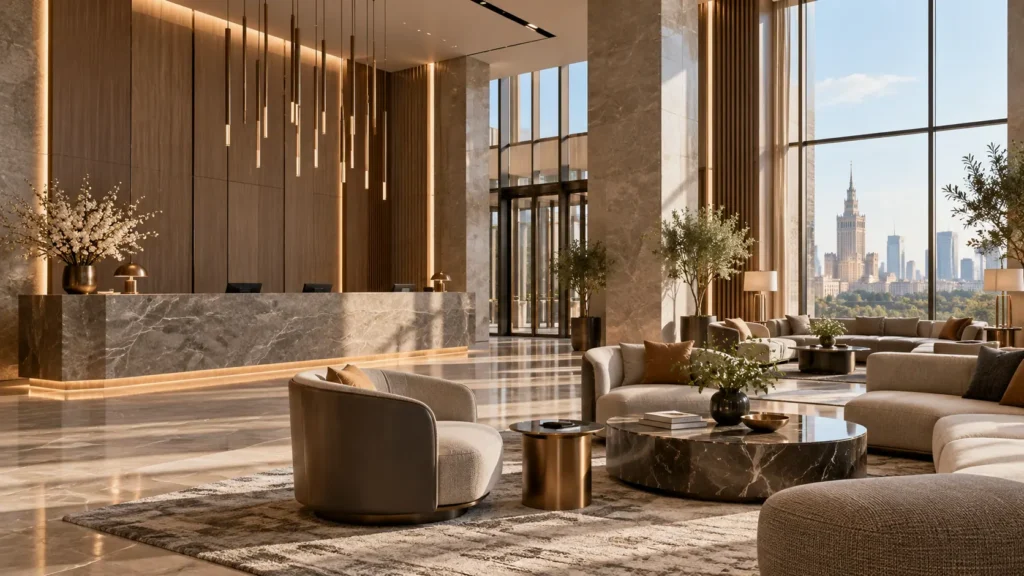
Hotel reception desk dimensions can decide whether a front desk works well or becomes a daily problem. A hotel reception desk can look beautiful, but still fail if the height, width, depth, or clearance is wrong.
That’s why these dimensions should be planned before production starts. A reception counter is not just a front panel with a nice finish. It is a workstation, a guest service point, and a key part of the lobby layout. If the size is wrong, staff feel it every day. Guests feel it too.
In this guide, we’ll look at reception desk counter height, width, depth, staff work surfaces, accessible counter notes, layout clearance, equipment planning, and production details. Use it as a practical reference before ordering a custom hotel reception desk. For the full design process, including lobby placement, materials, styles, and functional planning, read our Hotel Reception Desk Design Guide.
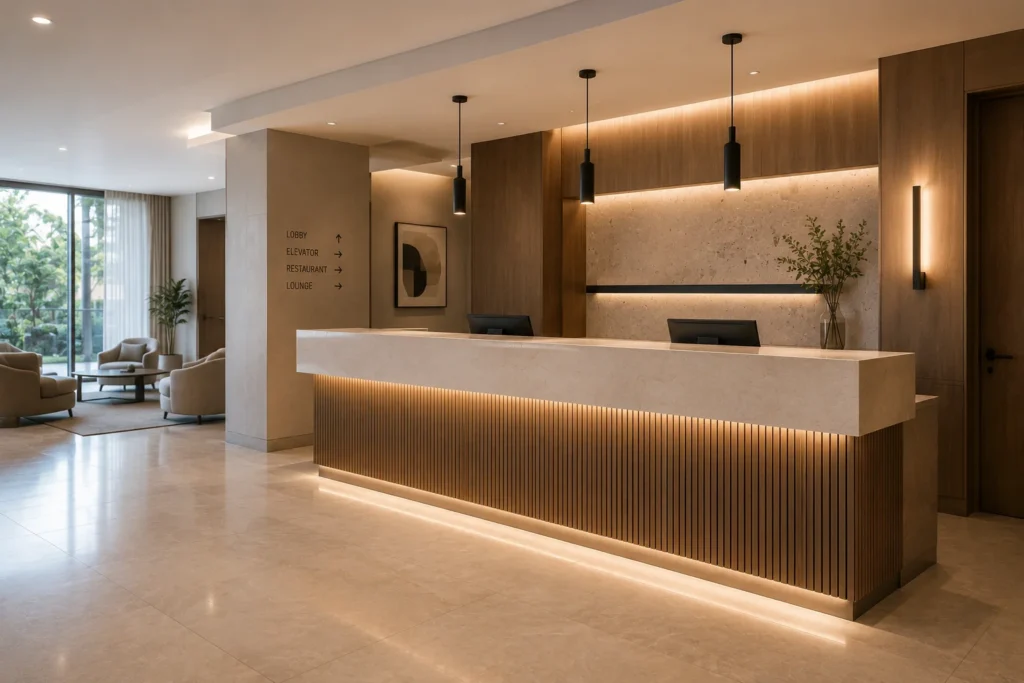
Standard Hotel Reception Desk Dimensions at a Glance
There is no single size that fits every hotel. A small hotel and a large resort do not need the same front desk.
Still, most hotel reception desks follow a few common ranges. These hotel reception desk dimensions help you start the planning process before drawings or production begin.
| Dimension Item | Common Range | Best Used For | Notes |
|---|---|---|---|
| Guest-facing counter height | 42–44 in | Standing check-in | Good for guest interaction and transaction tasks |
| Staff work surface height | 28–30 in | Computer work | Better for keyboards, monitors, and long shifts |
| Accessible counter height | 36 in max | Wheelchair access | Check ADA and local code requirements |
| Desk width, one staff member | 48–72 in | Small hotels | Depends on equipment and storage |
| Desk width, two staff members | 96–144 in | Medium hotels | Allows two service positions |
| Desk depth | 28–36 in | Most reception desks | Deeper desks allow more equipment space |
| Staff-side clearance | 36 in or more when possible | Staff movement | More space helps with drawers, chairs, and printers |
| Guest-side circulation | Keep main paths open | Lobby flow | Plan for guests, luggage, and queues |
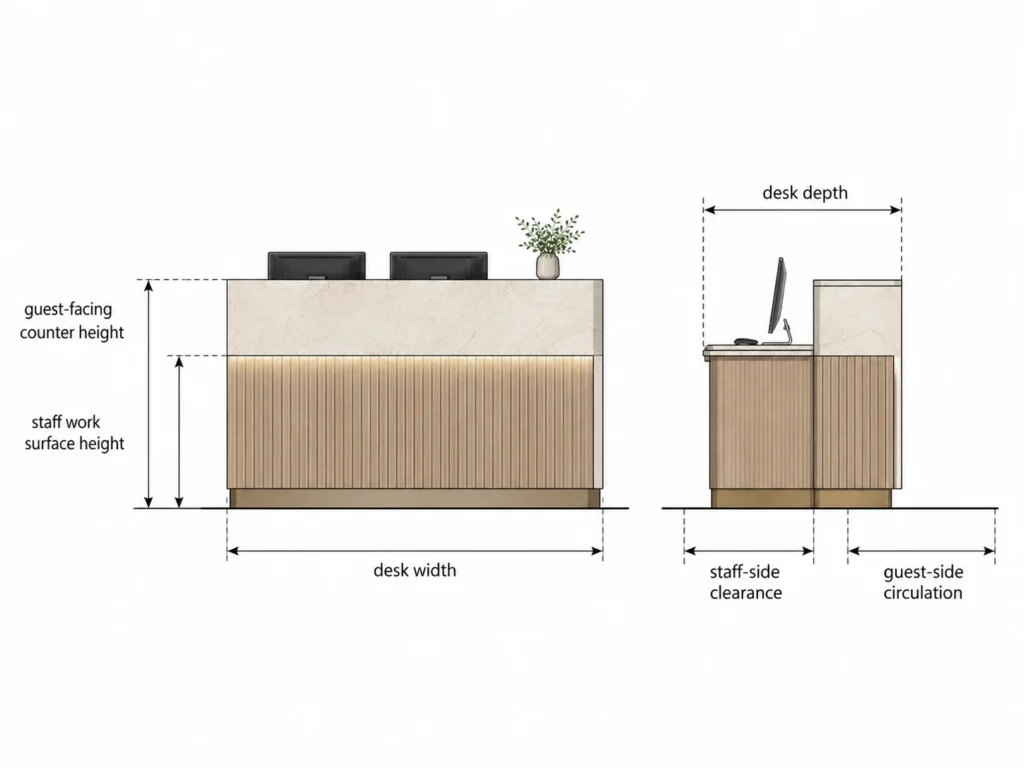
These hotel reception desk dimensions are planning ranges, not final shop drawings. The final size should match the lobby plan, staff count, guest volume, and local code.
Hotel Reception Desk Counter Height

Counter height is often the first hotel reception desk dimension people ask about, and for good reason. Height affects how guests check in, sign forms, make payments, and talk with staff.
Guest-Facing Counter Height
For most hotel reception desk dimension plans, the guest-facing counter height is about 42 to 44 inches. This height works well for standing guests, gives the front desk a clear presence in the lobby, and creates some privacy for documents, screens, and staff work below.
But taller is not always better. A counter that is too high can feel uncomfortable. Guests may struggle to write, tap a card, or place documents on the counter. The desk may also feel like a barrier instead of a welcome point.
Think of the guest counter as a bridge. It should connect guests and staff, not separate them.
Staff Work Surface Height
The staff side is different. Staff usually need a lower work surface for computers, keyboards, phones, printers, and room key tools. A common staff work surface height is around 28 to 30 inches.
This is closer to a standard desk height. It supports seated computer work better than a high transaction counter.
This matters in hotels. Front desk staff may stand, sit, type, answer calls, check IDs, print documents, and manage room keys for long hours. CCOHS notes that workstations should support neutral posture, which is a useful reminder when planning staff work height, monitor placement, and keyboard zones.
A beautiful counter should still protect staff comfort.
Two-Level Reception Counter Design
Many hotel reception desks use two levels. The higher guest-facing counter creates a polished front view, while the lower staff work surface supports daily tasks behind it.
This layout works well when the desk needs to hide computers, cables, documents, drawers, and printers. It also helps separate the public face from the working zone.
But two-level designs need careful planning. If the staff surface is too narrow, equipment will spill into the guest view. If the upper counter is too deep, it may feel bulky.
A good two-level desk should look simple from the lobby and work hard behind the scenes.
Accessible Counter Height and ADA Notes
Accessibility should not be added at the end. It should be planned from the start.
For U.S. projects, ADA Standards include requirements for sales and service counters. For many U.S. sales and service counters, the accessible counter portion must be no higher than 36 inches above the finish floor.
This accessible portion should also have proper clear floor space. The details can vary based on the counter type and approach, so always check the current code and local project requirements before production.
For international projects, follow the accessibility rules in the project location. Hotels in the U.S., UAE, UK, EU, and Asia may follow different standards.
The main point is simple: don’t wait until the desk is built to think about accessibility.
Reception Desk Width by Staff Count
Desk width is another key part of hotel reception desk dimensions. It depends on how many staff members work at the front desk, as well as guest volume, hotel type, equipment, storage, and service style.
A small hotel may only need one service position. A resort may need several check-in points, luggage support, and concierge space.
| Staff Position | Suggested Desk Width | Best For | Notes |
|---|---|---|---|
| One staff member | 48–72 in | Small hotels, serviced apartments | Keep equipment compact |
| Two staff members | 96–144 in | Boutique and business hotels | Allows two guest service positions |
| Three staff members | 144–216 in | Larger hotels | Plan privacy between stations |
| Four or more staff members | 216 in and above | Resorts and high-volume lobbies | Consider segmented service zones |
| Reception plus concierge | Varies by service model | Full-service hotels | Keep zones connected but not crowded |
Do not choose width by appearance alone. A long stone desk may look premium, but it can overwhelm a small lobby. A narrow desk may save space, but it can create daily frustration for staff.
Start with the number of service positions. Then plan equipment, storage, and guest approach space.
Reception Desk Depth and Equipment Space
Depth is one of the most overlooked hotel reception desk dimensions, but it decides whether the desk can actually support daily work.
A hotel front desk often needs space for PMS terminals, computer monitors, key card encoders, payment terminals, passport scanners, printers, phones, drawers, forms, brochures, cable trays, and personal storage.
A common reception desk depth is about 28 to 36 inches. Larger desks may need deeper staff zones if the equipment layout is more complex.
Countertop Depth
The guest-facing countertop should allow basic check-in tasks. Guests may place a phone, passport, credit card, luggage tag, or document on the counter. The surface should not feel like a thin shelf.
For many hotel projects, a deeper top also feels more substantial. Still, avoid unnecessary bulk. A counter that is too deep can push staff away from guests.
Staff-Side Depth
The staff side needs more functional planning. A monitor, keyboard, mouse, phone, card encoder, and printer cannot all fight for the same small surface.
Plan the equipment before confirming the desk depth. This is especially important for custom reception desk production. Once the millwork is built, changing cable routes, drawers, or printer zones can be expensive.
Cable Access and Service Panels
A clean front desk needs hidden cables. Plan cable grommets, floor boxes, power access, data access, and removable service panels before production.
Do not trap cables behind fixed panels. Staff will need access later. Future maintenance should be easy, not a small construction project.
Clearance Around the Hotel Reception Desk
Hotel reception desk dimensions are not only about the desk itself. The space around the desk matters just as much.
Guests need to approach the counter. Staff need to move behind it. Luggage needs space. Queues need room. Elevators and corridors must stay clear. For a broader look at seating, luggage support, public areas, and lobby furniture planning, read our Hotel Lobby Furniture Guide.
ADA Standards also include requirements for accessible routes. Walking surfaces generally need a minimum clear width of 36 inches, with some exceptions. That’s a useful reminder: the path around the desk matters.

| Area | What to Check | Why It Matters |
|---|---|---|
| Guest approach path | Is the desk easy to find? | Guests should know where to go |
| Queue area | Is there space to wait? | Prevents crowding near the entrance |
| Luggage movement | Can bags move easily? | Reduces bumps and blocked paths |
| Staff working zone | Is there enough room behind the desk? | Supports drawers, chairs, and equipment |
| Elevator route | Is the path still clear? | Guests need direct movement |
| Accessible route | Is clearance code-compliant? | Supports inclusive access |
| Concierge connection | Is service support nearby? | Helps full-service hotels operate smoothly |
Do not fill every open area with furniture. In a hotel lobby, empty space is useful. It gives guests room to move, pause, and understand the space.
Layout Specs by Reception Desk Shape
The right reception desk shape affects hotel reception desk dimensions, clearance, delivery, and installation. It should match the lobby size, service style, staff activity, and guest flow. For more visual direction, see our 15 Modern Reception Desk Design Ideas for Hotel Lobbies.

Straight Reception Desk Dimensions
A straight reception desk is the most common option. It works well in small hotels, serviced apartments, business hotels, boutique lobbies, and narrow spaces.
Straight desks are usually easier to manufacture, deliver, and install. They also help keep the reception area clean, simple, and easy to understand.
Best for: small hotels, serviced apartments, business hotels, compact urban lobbies
Planning note: make sure the desk does not block the entrance, elevator path, or main luggage route.
L-Shaped Reception Desk Specs
An L-shaped reception desk gives staff more workspace without making the guest-facing counter too wide. The side return can hold printers, files, payment tools, or admin equipment.
This layout keeps the front view cleaner while giving staff a more practical work zone.
Best for: medium hotels, business lobbies, front desks with more staff activity
Planning note: place the side return on the staff side, and keep admin tasks out of the guest view.
Curved Reception Desk Specs
A curved reception desk feels softer and more welcoming, but it also needs more careful production planning. Curved panels, stone edges, joints, LED details, and radius dimensions should be confirmed early.
This shape can become a strong visual feature, but it usually needs more space than a simple straight desk.
Best for: luxury hotels, boutique hotels, resorts, design-led lobbies
Planning note: confirm the curve radius, panel joints, countertop edge details, and installation method before production.
Island Reception Desk Specs
An island reception desk works best in large, open lobbies. Guests can approach it from more than one side, which can make the arrival area feel more flexible.
But this shape needs careful planning for floor power, data access, staff movement, and circulation on all sides.
Best for: resorts, large lobbies, lifestyle hotels, open arrival areas
Planning note: plan floor boxes, power, data, lighting, and guest circulation before the desk is made.
Technical Details to Confirm Before Production
A reception desk is often custom-made. That means every key hotel reception desk dimension and production detail should be confirmed before work starts.
Use this checklist before ordering:
- Confirm final site measurements
- Confirm guest-facing counter height
- Confirm staff work surface height
- Confirm accessible counter needs
- Confirm desk width by staff count
- Confirm desk depth and equipment layout
- Confirm printer and key encoder locations
- Confirm monitor and keyboard positions
- Confirm drawer and storage layout
- Confirm cable access and floor boxes
- Confirm power and data points
- Confirm countertop thickness and edge detail
- Confirm front panel material
- Confirm kickboard protection
- Confirm lighting integration
- Confirm back wall connection
- Confirm delivery route
- Confirm installation sequence
- Confirm maintenance access
This step may feel slow, but it prevents expensive changes later. Good millwork is like a tailored suit. The fit matters as much as the fabric.
Common Hotel Reception Desk Dimension Mistakes
Many problems with hotel reception desk dimensions start before production, and most of them start with weak planning.
- Choosing the look before checking dimensions
- Making the guest counter too high
- Making the staff work surface uncomfortable
- Forgetting accessible counter requirements
- Not leaving enough staff-side clearance
- Ignoring luggage movement
- Underestimating printer and equipment space
- Forgetting cable access
- Making the desk too large for a small lobby
- Using fragile materials at kick areas
- Approving finishes without samples
- Not checking delivery and installation access
The best reception desk feels effortless. But that effortless feeling comes from careful dimensions, clear layout, and strong production details.
Hotel Reception Desk Dimensions by Hotel Type
Different hotels need different hotel reception desk dimensions. Small hotels, airport hotels, resorts, and luxury properties do not serve guests in the same way. Their desks should not be planned the same way either.
| Hotel Type | Recommended Desk Approach | Dimension Notes | Layout Notes |
|---|---|---|---|
| Small hotel | Compact straight desk | Keep width efficient | Protect open walking paths |
| Boutique hotel | Custom desk with feature wall | Balance style and function | Match the desk with seating and lighting |
| Business hotel | Functional multi-position desk | Plan equipment carefully | Add clear zones and power access |
| Luxury hotel | Larger desk with concierge support | Allow proper counter presence and staff space | Keep the lobby elegant, not crowded |
| Resort | Open or island-style reception | Allow more guest approach space | Connect reception with lounge areas |
| Serviced apartment | Compact reception with storage | Focus on daily use | Keep materials durable |
| Airport hotel | Efficient desk with luggage support | Plan fast check-in zones | Prioritize flow and cleaning |
| Wellness hotel | Warm desk with natural finishes | Avoid bulky forms | Keep the arrival mood calm |
This is where hotel reception desk dimensions become strategic. Start with the hotel type, then plan how guests arrive, wait, ask questions, and move with luggage.
Hotel Reception Desk Dimension Checklist
Before final approval, review the hotel reception desk dimensions one more time.
- Confirm the lobby size
- Confirm guest flow
- Confirm number of staff
- Confirm guest counter height
- Confirm staff work surface height
- Confirm accessible counter needs
- Confirm desk width
- Confirm desk depth
- Confirm staff-side clearance
- Confirm guest-side circulation
- Confirm equipment layout
- Confirm storage needs
- Confirm cable access
If one item is unclear, pause before production. It is easier to adjust drawings than rebuild a finished desk.
Conclusion
Hotel reception desk dimensions affect more than the desk. They affect check-in, staff comfort, guest flow, accessibility, equipment, cleaning, and installation.
A beautiful front desk still needs the right hotel reception desk dimensions, including height, width, depth, clearance, and production details. Without those, the design may look good but work poorly.
Planning a new hotel reception desk or renovating an existing lobby? VOLANT FIT-OUT works with hotel owners, interior designers, contractors, and procurement teams to create custom reception desks for hospitality spaces.
Tell us about your project, and we’ll help you build a hotel reception desk that looks refined, works smoothly, and fits your guest experience.
FAQs
What is the standard height of a hotel reception desk?
In most hotel reception desk dimensions, the guest-facing counter height is about 42 to 44 inches. This height works well for standing check-in, guest interaction, payments, and basic transaction tasks.
How deep should a hotel reception desk be?
A common hotel reception desk depth is about 28 to 36 inches. The right depth depends on the full hotel reception desk dimensions, including monitor space, keyboard space, printers, payment terminals, storage, and cable access.
How wide should a hotel reception desk be?
Desk width is an important part of hotel reception desk dimensions. A one-person desk may use about 48 to 72 inches of width, while two staff positions often need about 96 to 144 inches.
What is the ADA height for a hotel reception counter?
ADA planning should be included when reviewing hotel reception desk dimensions. For many U.S. sales and service counters, the accessible counter portion should be no higher than 36 inches.
How much space is needed behind a reception desk?
Clearance is part of hotel reception desk dimensions, not an afterthought. Many hotel projects aim for at least 36 inches of staff-side clearance when possible, with more space for drawers, printers, equipment access, and staff movement.