Hotel reception desk design plays a bigger role than many hotel owners realize. A hotel lobby works like a handshake, and the reception desk sits right at the center of that first impression.
It tells guests what to expect before they even reach their room. A good hotel reception desk is more than a beautiful counter. It’s a check-in point, a service hub, a brand statement, and a daily workstation for your staff. It should help guests find their way, support check-in and payment, manage key cards and luggage questions, and keep the front desk area clean and organized.
Sounds like a lot for one piece of furniture, right? That’s exactly why the design needs planning. In this guide, we’ll walk through hotel reception desk layout, dimensions, materials, styles, functional features, and common design mistakes. Whether you’re planning a new hotel lobby, renovating an old front desk, or ordering a custom reception counter, this guide will help you create a front desk that looks good and works even better.
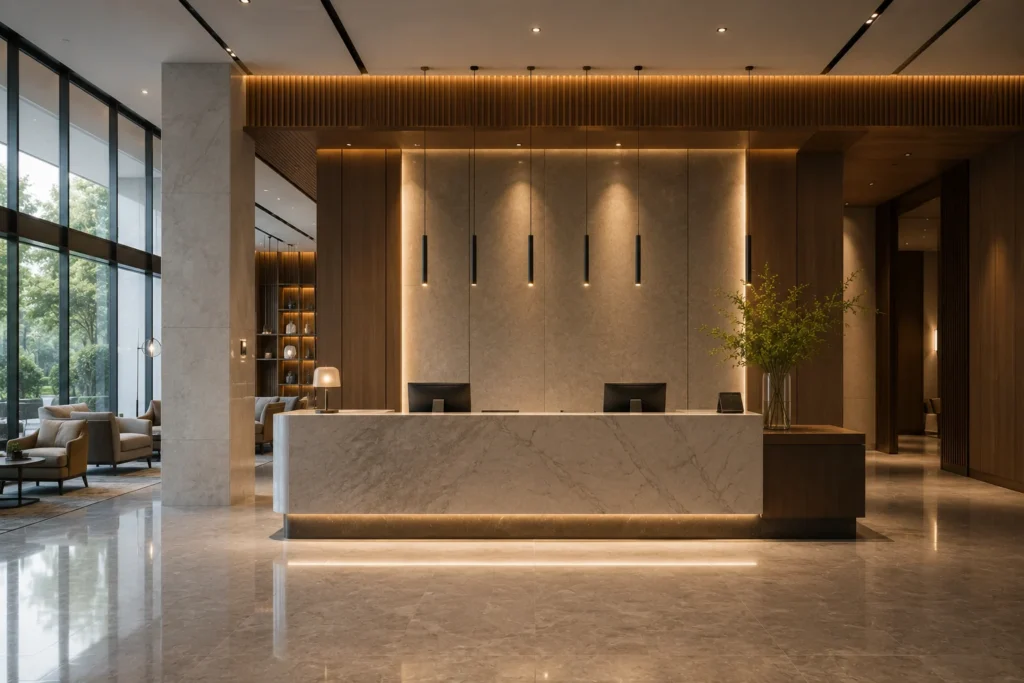
What Is a Hotel Reception Desk?
A hotel reception desk is the main service counter in a hotel lobby. Guests use it for check-in, check-out, payment, room keys, and everyday questions. In many hotels, it’s also the first place guests go when they need help.
You may also hear related terms like hotel front desk, hotel reception counter, hotel check-in counter, lobby reception desk, or concierge counter. They sound similar, but they don’t always mean the same thing. A reception desk usually handles arrivals, departures, and front desk service. A concierge counter focuses more on local advice, reservations, transportation, and special guest requests.
In smaller hotels, one desk often handles both reception and concierge service. In larger hotels, reception, concierge, luggage service, and guest relations may each have their own zone.
A strong hotel lobby reception desk should do three things well. It should welcome guests, support staff, and express the hotel brand. The front should feel clear, warm, and professional. The staff side should include storage, cable access, workspace, and equipment zones. And the overall design should match the hotel type. A boutique hotel, business hotel, resort, and luxury hotel shouldn’t all use the same front desk design.
Think of the reception desk as the front cover of the hotel experience. Guests start judging the story before they turn the first page.
Hotel Reception Desk Layout: Where to Place It in the Lobby
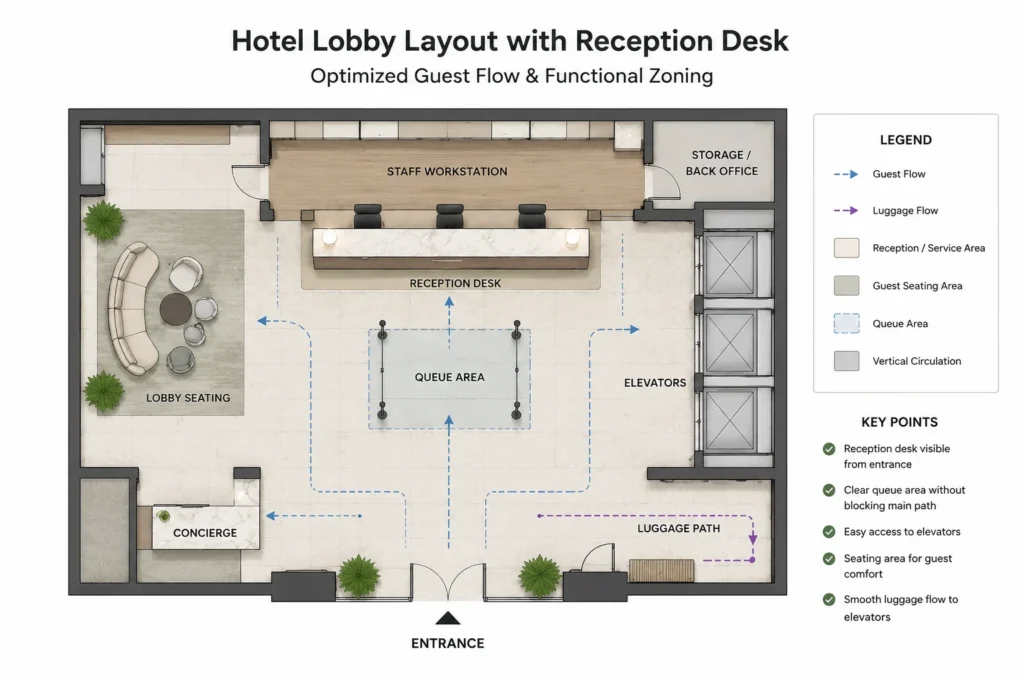
Great hotel reception desk design starts with placement. You can choose expensive stone, beautiful lighting, and a custom logo wall. But if guests can’t find the desk quickly, the lobby experience already feels broken.
Make the Desk Visible from the Entrance
Guests should understand where to go within seconds. The reception desk doesn’t always need to face the front door, but it should be easy to see from the main entrance. If it isn’t, use lighting, signage, flooring, ceiling details, or a feature wall to guide the eye.
Think of it like a lighthouse. It should quietly tell guests, “Start here.”
For small hotel lobbies, a straight desk against the wall often works well. It saves space and keeps the arrival path clear. For luxury hotels, the reception desk may sit deeper inside the lobby. In that case, strong visual cues become even more important.
Keep Guest Flow Clear
A hotel lobby has many moving parts. Guests arrive with luggage, others wait on sofas, staff move between the desk and back office, and people walk toward elevators, restaurants, restrooms, or meeting rooms. The reception desk shouldn’t block these paths.
Leave enough queue space in front of the counter. Also think about luggage. A guest with two suitcases needs more room than someone carrying only a backpack.
Avoid placing loose chairs, planters, brochure stands, or decorative tables in the main circulation path. These items may look nice, but they can create friction. Good lobby layout feels natural. Guests shouldn’t need to think too hard.
Connect Reception With Seating, Elevators, and Concierge Areas
The reception desk should work with the rest of the lobby, not fight against it. Waiting seating should be nearby, but not inside the queue. Elevators should be easy to find after check-in. Concierge or luggage service should be close enough for a smooth staff handoff.
If your hotel welcomes many first-time guests, wayfinding matters even more. A clear hotel front desk layout can reduce repeated questions, shorten check-in time, and improve the whole guest journey.
Here’s a simple planning guide:
| Lobby Type | Best Desk Placement | Recommended Desk Style |
|---|---|---|
| Small hotel lobby | Near entrance or against wall | Straight compact desk |
| Boutique hotel lobby | Visible focal point | Curved or sculptural desk |
| Business hotel lobby | Along main traffic path | Long linear counter |
| Luxury hotel lobby | Integrated with feature wall | Custom stone desk |
| Resort lobby | Open arrival area | Island or pod-style desk |
A reception desk should not be planned as a standalone counter. It should work with lobby seating, luggage support, elevator access, and nearby public areas. For a broader look at sofas, tables, seating zones, and public area furniture, read our Hotel Lobby Furniture Guide.
The goal is simple: make check-in easy before making it dramatic. A beautiful lobby should still feel practical.
Hotel Reception Desk Dimensions and Counter Height
Size can make or break a hotel reception desk design. If the desk is too small, staff feel crowded. If it’s too large, it can eat up the whole lobby. The right dimensions depend on your hotel size, service style, staff count, equipment needs, and guest traffic.
Standard Reception Desk Height
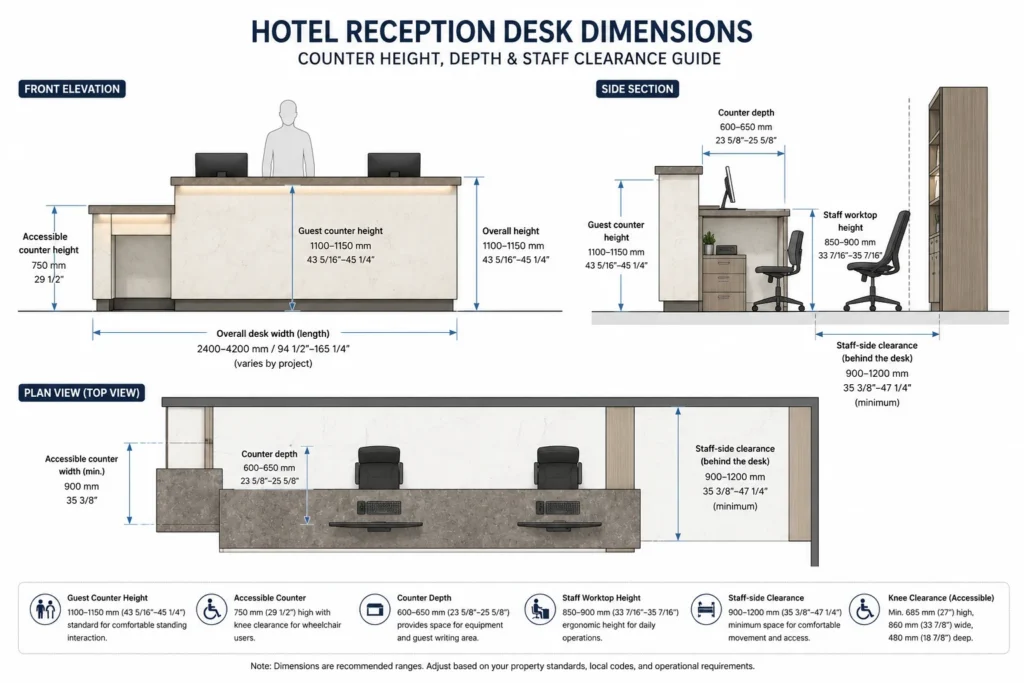
Many hotel reception counters use a guest-facing height of about 42 to 44 inches. This works well for standing check-in, short conversations, and quick guest service.
The staff work surface is usually lower. For seated workstations, a worktop around 28 to 30 inches high is common. That gives staff a more comfortable height for typing, printing, payment processing, and daily front desk tasks.
Many hotels use a dual-height counter. The higher side faces guests, while the lower staff side supports computers, keyboards, printers, and other equipment. This setup keeps the guest-facing area clean and hides daily tools from the lobby view.
Accessible Counter Section
Accessibility shouldn’t be an afterthought. For U.S. projects, the ADA Standards include requirements for sales and service counters. For many sales and service counters, the accessible portion must be no higher than 36 inches and should provide clear floor space for wheelchair access.
Always check local codes before production. Requirements can vary by country, state, and project type. Still, the design principle is simple: every guest should be able to check in comfortably.
A lower counter section can look elegant when it’s planned early. It only looks awkward when it’s added at the last minute.
Recommended Desk Width by Hotel Size
Desk width depends on how many staff members need to work at the same time. It also depends on whether the desk handles only check-in or also supports concierge service, luggage questions, payment, and guest relations.
| Hotel Type | Suggested Width | Best For |
|---|---|---|
| Small hotel or guesthouse | 47–71 in / 1200–1800 mm | 1 staff member |
| Boutique hotel | 71–118 in / 1800–3000 mm | 1–2 staff members |
| Business hotel | 118–197 in / 3000–5000 mm | 2–3 check-in stations |
| Large hotel | 197 in+ / 5000 mm+ | Multiple service points |
| Luxury hotel | Custom size | Reception plus concierge |
These are planning ranges, not fixed rules. A small boutique hotel may need a larger custom counter if it offers concierge service. A compact business hotel may use a smaller desk if it has self-check-in kiosks.
The best size follows the operation, not the trend.
Counter Depth and Staff Clearance
Depth matters more than many hotel owners expect. The counter needs enough space for monitors, keyboards, payment terminals, phones, key card encoders, printers, forms, and guest documents. Staff also need comfortable legroom and enough movement space behind the desk.
For the staff side, office ergonomics is a useful reference. CCOHS recommends that workstations support a neutral posture and fit the person using them. For hotel front desk design, that means the work surface should allow comfortable reach, clear legroom, and enough space for daily tools.
That’s why you should plan the staff side first. Once the workstation works well, you can design the guest-facing beauty around it.
A stunning counter that hurts staff every day isn’t good design.
For detailed height, width, depth, clearance, and ADA planning notes, read our Hotel Reception Desk Dimensions Guide.
Popular Hotel Reception Desk Layouts and Shapes
There isn’t one best shape for every hotel. The right reception desk layout depends on your lobby size, guest flow, staff workflow, and brand style.
Straight Reception Desk
A straight reception desk is simple, efficient, and easy to install. It works well for small hotels, business hotels, and narrow lobbies. If your lobby is compact, this is often the safest choice.
L-Shaped Reception Desk
An L-shaped reception desk gives staff more work surface and storage. It’s useful when the desk needs a side return for printers, files, payment tools, or guest documents.
Curved Reception Desk
A curved reception desk feels softer and more welcoming. It’s popular in modern hotel reception desk design, boutique hotels, and luxury lobbies. It can create a strong focal point.
Island Reception Desk
An island reception desk can serve guests from multiple directions. It works best in large lobbies, resorts, and open arrival spaces. Just plan floor outlets and cable routing early.
Pod-Style Check-In Desk
A pod-style check-in desk feels modern and personal. Instead of one long counter, staff use smaller stations. This layout suits lifestyle hotels, resorts, and self-check-in concepts.
Looking for more visual ideas? Explore our guide to 15 Modern Reception Desk Design Ideas for Hotel Lobbies to compare minimalist, luxury, boutique, small-lobby, and tech-friendly reception desk concepts before choosing the right visual direction for your project.
Best Materials for Hotel Reception Desk Design

Materials shape the mood of the lobby. They also affect cost, cleaning, durability, installation, and long-term maintenance. A hotel reception counter has to handle luggage bumps, guest traffic, coffee spills, cleaning chemicals, and daily front desk use. So yes, beauty matters. But survival matters too.
Marble, Granite, and Quartz
Stone creates a premium look and works well in luxury hotels, resorts, premium serviced apartments, and high-end commercial lobbies. Marble feels timeless and elegant. Granite is strong and durable. Quartz offers a clean, consistent appearance and good resistance to daily wear.
The main concerns are weight, cost, sealing, edge protection, and installation. Natural stone can also stain, chip, or show wear if it isn’t maintained properly. Use stone when the budget supports both the look and the upkeep.
Solid Surface
Solid surface is a strong choice for modern hotel front desk design. It can create seamless shapes, soft curves, and clean edges, which makes it useful for minimalist and contemporary lobbies.
It’s not always as dramatic as natural stone, but it’s practical. Scratches can often be repaired more easily than with some other materials, and the smooth surface helps the reception area feel clean and calm.
Wood Veneer
Wood veneer brings warmth to a hotel reception desk. It works especially well in boutique hotels, resorts, lodges, and hospitality spaces that want a more natural feel.
Wood can make the desk feel less corporate and more welcoming. It also pairs well with stone, metal, fabric panels, and warm lighting. The key is protection. Edges, corners, and kick areas need durable detailing, or luggage and cleaning tools can damage the finish over time.
Laminate and HPL
Laminate and HPL are cost-effective and practical options for budget hotels, high-traffic lobbies, and renovation projects with tight timelines. They come in many colors, textures, and wood-look finishes, so they’re more flexible than many people expect.
They’re also easy to clean and easy to replace compared with premium materials. The limitation is perception. Some laminates can look less upscale, but good detailing, lighting, and edge treatment can make them feel much better.
For many mid-market hotels, HPL gives a strong balance of cost, durability, and performance.
Metal, Brass, and Stainless Steel Accents
Metal details can make a reception desk feel more refined. Brass, bronze, black metal, and stainless steel are often used for trims, kick plates, logo details, edge bands, and decorative lines.
They work well with stone, wood, and solid surface. Just be careful with fingerprints and scratches. Polished finishes may need more maintenance, especially in busy lobbies.
| Material | Best For | Key Advantages | Design Notes |
|---|---|---|---|
| Marble | Luxury hotels | Premium, timeless, and visually impressive. | Heavy and expensive. Needs proper sealing, edge protection, and careful maintenance. |
| Quartz | High-traffic lobbies | Durable, consistent, and easier to maintain than many natural stones. | Less natural variation than marble, but more practical for busy hotel front desks. |
| Solid surface | Modern hotels | Seamless, repairable, and suitable for curved or minimalist reception desks. | Can scratch over time. Works best when paired with clean detailing and soft lighting. |
| Wood veneer | Boutique hotels | Warm, natural, and welcoming. Great for softer hospitality interiors. | Edges, corners, and kick areas need protection from luggage and cleaning tools. |
| HPL or laminate | Budget hotels | Affordable, easy to clean, and available in many colors and textures. | May look less premium, but good lighting and edge details can improve the finish. |
| Metal accents | Luxury or modern hotels | Stylish, durable, and useful for trims, kick plates, logo details, and edge bands. | Polished finishes can show fingerprints and scratches in busy lobbies. |
Hotel Reception Desk Design Styles by Hotel Type
A good reception desk should match the hotel, not just the mood board. A business hotel, boutique hotel, resort, and luxury hotel all serve different guests, so they shouldn’t use the same front desk design.
Modern Hotel Reception Desk Design
Modern hotel reception desk design focuses on clean lines, simple shapes, hidden storage, and integrated lighting. It works well for city hotels, serviced apartments, and lifestyle brands.
Luxury Hotel Reception Desk Design
Luxury reception desks often use stone, brass, dark wood, custom lighting, and dramatic back walls. The design should feel rich and confident, but never too loud.
Boutique Hotel Reception Desk Design
Boutique hotels can use sculptural counters, local materials, handmade tiles, or bold wall panels. The desk should express the hotel’s personality as soon as guests arrive.
Small Hotel Reception Desk Design
Small hotel reception desk design should save space and reduce clutter. A compact straight desk, wall-mounted storage, light colors, and a clear logo wall can make the lobby feel more open.
Resort Hotel Reception Desk Design
Resort reception desks often use natural materials, island layouts, pod-style counters, warm textures, and soft lighting. The goal is to make arrival feel calm and easy.
Business Hotel Reception Desk Design
Business hotels need speed, order, and durability. Use easy-to-clean materials, clear queue space, multiple check-in stations, and strong cable management.
Functional Features Every Hotel Reception Desk Needs
Guests see the front. Staff work behind it every day. That’s why function matters just as much as style in hotel reception desk design.
A well-designed front desk should hide clutter, support daily tools, protect guest information, and help staff move through check-in without friction.
Storage and Lockable Cabinets
A hotel front desk needs storage for key cards, forms, office supplies, cash drawers, and guest documents. Use drawers, cabinets, and hidden compartments to keep the staff side clean and secure.
Cable Management and Power Access
Plan space for PMS terminals, POS machines, card readers, printers, phones, charging points, and network cables. Cable trays, grommets, and access panels should be built in from the start.
Staff-Side Workstation Design
Staff need comfortable reach, clear legroom, and enough work surface for daily tools. A well-planned workstation can improve both comfort and service quality during long shifts.
Guest-Facing Writing Surface
Guests need space to sign forms, place IDs, tap cards, or set down phones. Keep the guest side clear and avoid crowding it with brochures, signs, or loose devices.
Lighting and Logo Integration
Use layered lighting with ambient lobby light, task lighting, under-counter LEDs, or a backlit logo wall. The logo should be visible, but it shouldn’t feel like a billboard.
Privacy and Security Details
Plan screen angles, document space, payment terminal placement, and lockable storage with privacy in mind. Good security should protect guests without feeling heavy.
Common Hotel Reception Desk Design Mistakes
Even a beautiful desk can fail if the details are wrong. Most problems don’t come from the main design idea. They come from small decisions that affect guest flow, staff comfort, cleaning, and daily operations.
| Mistake | Why It Hurts | Better Solution |
|---|---|---|
| Desk is too large | Blocks guest flow | Match the desk size to the lobby area |
| Poor visibility | Guests feel confused | Make the desk easy to see from the entrance |
| No accessible counter section | Excludes some guests | Add a lower counter area |
| Weak storage | Staff area gets messy | Add drawers, cabinets, and hidden compartments |
| Exposed cables | Looks unprofessional | Plan hidden wiring before production |
| Wrong surface material | Becomes hard to maintain | Choose durable lobby-grade finishes |
| Bad lighting | Desk lacks focus | Use layered lighting |
| Queue blocks entrance | Creates congestion | Separate the queue from the main path |
The biggest mistake is designing only for photos. A hotel lobby isn’t a showroom. It’s a working space where guests arrive, wait, ask, pay, and leave. The reception desk has to handle all of that with grace.
Hotel Reception Desk Design Checklist
Before you approve a design, use this hotel reception desk design checklist to review the key details. A good front desk should look right, work well, and support both guests and staff.
Layout and Guest Flow
- Is the reception desk visible from the entrance?
- Is the guest path clear?
- Is there enough queue space?
- Does the queue block doors, elevators, or seating areas?
Dimensions and Accessibility
- Is the counter height comfortable?
- Is there an accessible counter section?
- Is the staff work surface practical?
- Is there enough movement space behind the desk?
Storage and Technology
- Is there enough storage?
- Are cables hidden?
- Is there room for PMS, POS, printers, card readers, and key card encoders?
Materials and Branding
- Is the material durable and easy to clean?
- Does the design match the hotel brand?
- Is the logo wall visible?
- Is lighting planned before production?
Production and Installation
- Can the desk be installed without site issues?
- Will staff enjoy working behind it?
Conclusion
Hotel reception desk design is about more than choosing a beautiful counter. It’s about guiding guests, supporting staff, and showing your brand in one clear moment. The best hotel reception desks may look simple from the front, but that simplicity comes from careful planning, from the guest path and counter dimensions to material choices, wiring, accessibility, and staff workspace.
When all these pieces work together, the lobby feels effortless. A great reception desk shouldn’t make guests stop and wonder what to do next. It should welcome them in, point the way, and quietly say, “You’re in the right place.”
Planning a new hotel lobby, renovating an existing front desk, or sourcing a custom reception counter? VOLANT FIT-OUT works with hotel owners, interior designers, contractors, and procurement teams to create hotel reception desks that balance design, durability, and daily function.
Tell us about your project, and we’ll help you shape a reception desk solution that fits your lobby, your brand, and your guest experience. Contact VOLANT FIT-OUT today to start your hotel reception desk design project.
FAQs
What is the best height for a hotel reception desk?
Many hotel reception desks use a guest-facing counter height of about 42 to 44 inches for standing check-in. The staff work surface is often lower, around 28 to 30 inches, especially when staff use computers, keyboards, and printers.
Where should a reception desk be placed in a hotel lobby?
A hotel reception desk should be easy to see from the main entrance. It should guide guests naturally without blocking the entrance, elevators, seating area, luggage path, or main circulation route.
What materials are best for hotel reception desk design?
The best material depends on your budget, hotel style, and traffic level. Marble and quartz work well for luxury or high-traffic lobbies. Wood veneer adds warmth. Solid surface suits modern designs. HPL or laminate is practical for budget-friendly projects.
Does a hotel reception desk need an accessible counter section?
Yes. Accessibility should be planned early. For U.S. projects, many sales and service counters need an accessible portion no higher than 36 inches, with clear floor space for wheelchair access. Always check local code requirements before production.
How do you design a reception desk for a small hotel lobby?
For a small hotel lobby, choose a compact straight desk, keep the counter depth practical, use hidden storage, and avoid bulky shapes. A clear logo wall, light finishes, and good lighting can make the space feel larger.