In hotel construction, millwork vs casework is more than a question of terminology. The distinction can affect your project costs, supplier quotes, and installation plans.
But where do you draw the line? Is a built-in wardrobe millwork or casework? What about a bathroom vanity or reception desk? In some cases, the two categories even overlap.
This guide breaks down the key differences, costs, and applications of millwork and casework in hotels. You’ll also learn how to classify common components and make smarter decisions for your budget and design.
Quick Answer: What’s the Difference Between Millwork and Casework?
Millwork refers to architectural woodwork, such as wall paneling, trim, and custom interior features. Casework focuses on cabinet-based units, including wardrobes, bathroom vanities, and storage cabinets.
Both can be custom-made, factory-produced, and built into a hotel. The key difference is their design purpose and construction, not simply how they’re manufactured. Some components, like built-in wardrobes, fall into both categories.

Millwork vs Casework: 7 Key Differences for Hotels
The table below compares seven practical factors that affect how hotels specify, manufacture, install, and maintain millwork and casework.
| Factor | Millwork | Casework |
|---|---|---|
| Primary Purpose | Architectural details and integrated interior features | Functional cabinetry and storage systems |
| Hotel Applications | Headboard walls, decorative panels, and reception desk features | Wardrobes, bathroom vanities, and minibar cabinets |
| Customization | Often tailored to architectural dimensions and design details | Available in standard, modular, and fully custom designs |
| Manufacturing & Materials | Factory-made woodwork using solid wood, veneers, engineered panels, and other finishes | Factory-made cabinet units using similar materials, plus functional hardware |
| Installation | Requires coordination with walls, ceilings, and surrounding finishes | Requires accurate fitting, anchoring, and equipment clearances |
| Cost Factors | Design complexity, finishes, site conditions, and installation | Cabinet dimensions, materials, hardware, and order quantity |
| Maintenance | May require specialized finish or panel repairs | Doors, drawers, and hardware can often be serviced individually |
Millwork and casework aren't mutually exclusive. A built-in hotel wardrobe, for example, is casework by construction but may also fall within the architectural millwork scope. For hotel projects, the priority is defining clear specifications, supplier responsibilities, and installation requirements.
What Is Millwork in Hotel Construction?
Hotel millwork refers to architectural woodwork that enhances the design and finish of hotel interiors. It includes decorative wall panels, wood trims, and custom features integrated into the building.
Unlike freestanding furniture, these components often connect directly to walls, ceilings, or surrounding architectural elements.
Common Architectural Millwork Examples
You’ll find custom millwork throughout hotel guestrooms and public areas. Common applications include:
- Integrated headboard walls
- Decorative wood wall panels
- Custom wood trims and surrounds
- Custom reception desk surrounds
- Architectural feature walls
- Decorative wood partitions

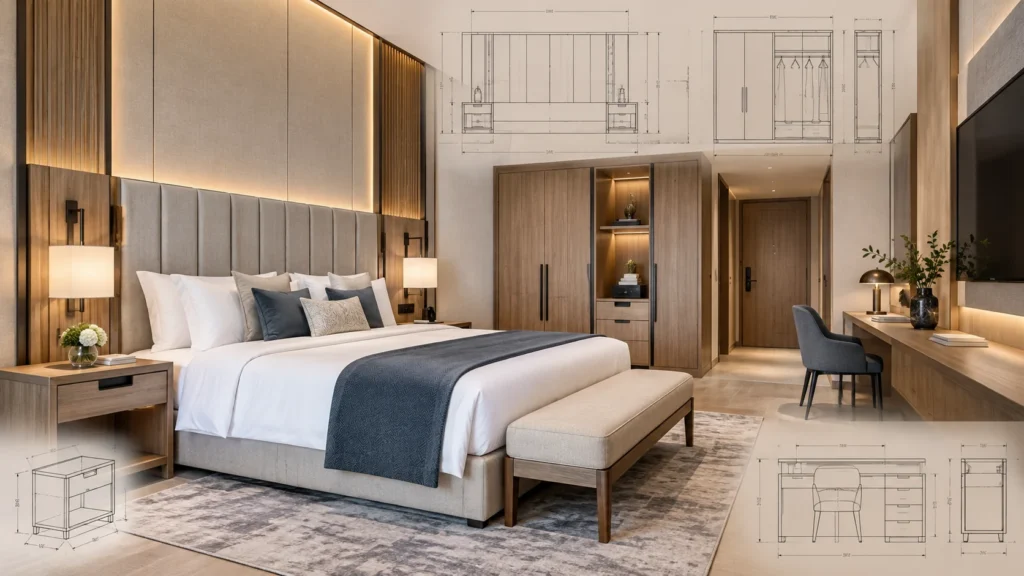
Take a custom hotel headboard wall, for example. Its panels must align with room dimensions, lighting, electrical outlets, and nearby furniture. Even when factory-made, these components require precise measurements and coordinated installation.
When Does a Hotel Need Custom Millwork?
Custom millwork makes sense when your hotel design requires precise architectural integration. It’s especially useful when:
- Design consistency matters: Wood veneers, decorative profiles, and finishes must create a unified appearance.
- Standard sizes won’t fit: Walls, ceilings, or existing structures require project-specific dimensions.
- Multiple materials must work together: Woodwork needs to integrate with lighting, stone, metal, or building services.
However, custom doesn’t mean everything must be built on-site. Many millwork components can be manufactured and pre-assembled in a factory, reducing the amount of fabrication required during installation.
The Architectural Woodwork Institute (AWI) Millwork & Wood Trim Standard covers both catalog and made-to-order millwork, including shop-fabricated assemblies.
For more details on materials, shop drawings, and installation, explore our Hotel Millwork Guide.
What Is Casework in Hotel Projects?
Hotel casework refers to cabinet-based units designed for storage, organization, and equipment integration. Common examples include wardrobes, bathroom vanities, and minibar cabinets.
Unlike decorative architectural millwork, casework focuses primarily on function and cabinet construction. It typically includes cabinet bodies, shelves, drawers, doors, and hardware.
Common Hotel Casework Examples
You’ll find hotel casework in guestrooms, bathrooms, restaurants, and service areas. Typical applications include:
- Built-in hotel wardrobes — Storage for clothing, luggage, and guest belongings.
- Bathroom vanity cabinets — Storage units designed around sinks and plumbing.
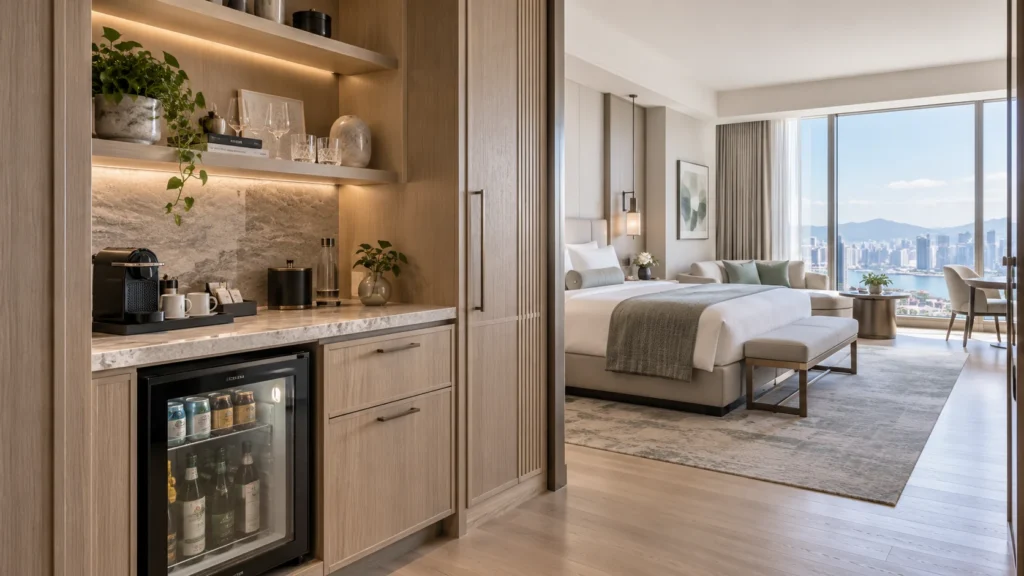
- TV and minibar cabinets — Integrated storage for entertainment equipment and refreshments.
- Storage cupboards — Cabinets for linens, supplies, and everyday essentials.
- Restaurant service cabinets — Storage for tableware, equipment, and service supplies.
- Built-in shelving units — Shelves integrated into walls or other interior features.
Take a built-in hotel wardrobe, for example. Its cabinet structure provides storage, while its doors, shelves, and hardware support daily use.
When the wardrobe integrates with surrounding walls or ceiling panels, it may also fall within the architectural millwork scope.

Can Casework Be Custom-Made?
Yes. Casework isn’t limited to standard cabinet sizes or mass-produced furniture. It can be tailored to different hotel layouts, design requirements, and budgets.
Three common approaches include:
-
01
Standard Casework
Uses established cabinet dimensions and configurations. Best suited to consistent room layouts and straightforward storage needs.
-
02
Modular Casework
Uses repeatable cabinet components that can be combined or adapted. Ideal for hotels with multiple room types and similar storage requirements.
-
03
Custom Casework
Follows project-specific dimensions, materials, finishes, and hardware requirements. Suitable for distinctive interiors and complex architectural conditions.
The Architectural Woodwork Institute’s ANSI/AWI 1235–2024 Specialty Casework Standard recognizes Hospitality Casework under CSI MasterFormat Section 12 35 25, providing industry requirements for specialty casework.
Where Are Millwork and Casework Used in Hotels?
The examples below show how common hotel components are classified and which construction or installation details need special attention.
Guestroom Millwork vs Casework
A typical hotel guestroom includes several types of woodwork. Headboard walls create visual appeal, while wardrobes, vanities, and minibar cabinets provide everyday functions.
Here’s how common guestroom components are typically classified:
| Hotel Component | Typical Classification | Key Considerations |
|---|---|---|
| Built-in Wardrobe | Casework; often included in millwork scope | Site dimensions, anchoring, and door clearance |
| Headboard Wall System | Architectural millwork | Lighting, electrical outlets, panel joints, and wall backing |
| Bathroom Vanity Cabinet | Casework; sometimes included in millwork scope | Moisture resistance, plumbing, and countertop coordination |
| TV & Minibar Cabinet | Casework or built-in casegoods | Ventilation, cable management, and equipment access |
| Decorative Wall Paneling | Architectural millwork | Wall substrate, panel alignment, and finish consistency |
| Freestanding Nightstand | Hotel casegoods, typically FF&E | Durability, stability, and ease of replacement |
Important: These are typical classifications, not fixed rules. Final procurement and installation responsibilities should follow your approved drawings, specifications, and bill of quantities (BOQ).
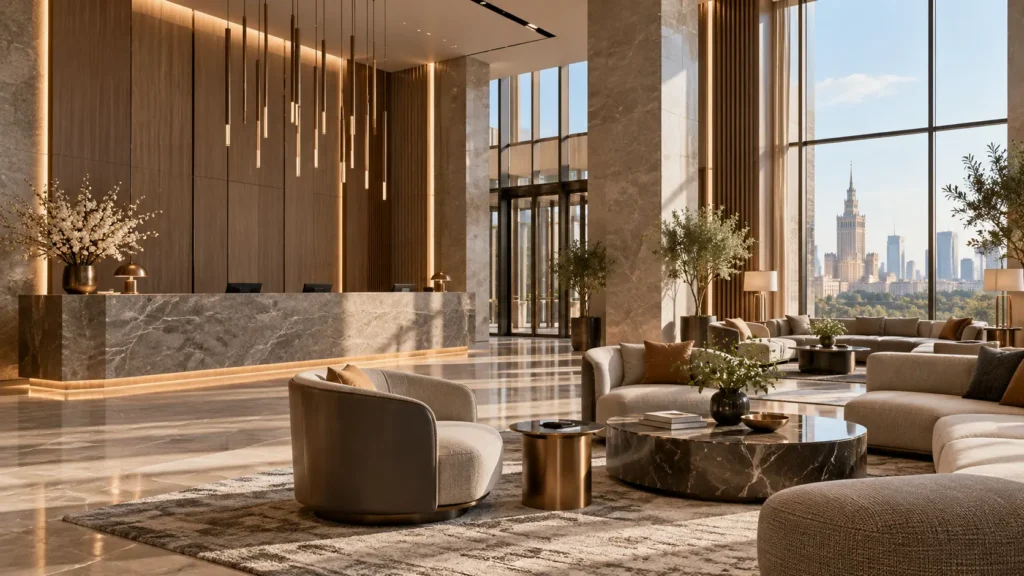
Millwork vs Casework in Hotel Lobbies and Public Areas
Public areas often require more complex coordination between millwork, casework, and other construction trades.
Take a custom hotel reception desk, for example. A single desk may combine several components:
- Casework: Internal cabinets, drawers, and equipment storage.
- Architectural Millwork: Decorative wood panels, custom cladding, and integrated surrounds.
- Other Trades: Stone countertops, metal details, and electrical or data connections.

Similar combinations appear in lobby feature walls, restaurant service stations, and bar counters.
When different suppliers contribute to one reception desk, confirm countertop dimensions, cable openings, and assembly interfaces before approving shop drawings.
Millwork vs Casework vs Hotel Casegoods vs FF&E
These four terms often appear in hotel drawings, furniture schedules, and procurement documents. However, they describe different aspects of a hotel project.
Here’s how they relate:
-
Architectural Millwork Building Integration
Wall panels, trims, and fitted headboard features.
-
Casework Cabinet Construction
Wardrobes, vanities, and minibar cabinets.
-
Hotel Casegoods Furniture Category
Desks, nightstands, dressers, and TV units.
-
FF&E Procurement Category
Loose furniture and selected fixed items.
Hotel Casegoods vs Casework
This distinction matters when a hotel item is scheduled as furniture but manufactured and installed as built-in cabinetry.
For example, a freestanding dresser is typically hotel casegoods. A built-in wardrobe is casework but may also appear in a hotel’s casegoods schedule.
For example, a freestanding dresser is typically hotel casegoods. A built-in wardrobe is casework but may also appear in a hotel’s casegoods schedule.
For a detailed breakdown, read our Hotel Casegoods Guide.
Does Built-in Millwork Fall Under FF&E?
Sometimes, but not always.
A built-in wardrobe or bathroom vanity may fall under FF&E procurement in one hotel project. In another, it may belong to the millwork or construction package.
The difference depends on the approved project scope, not simply whether the furniture is fixed to the building.
Procurement Tip: Check whether fixed cabinetry appears in the BOQ, the FF&E schedule, or both, and resolve conflicting package assignments before requesting quotations.
Millwork vs Casework Cost: What Hotels Should Budget For
Is casework cheaper than millwork? Not necessarily. Use the two lists below to compare the cost drivers behind each quotation.
What Affects Custom Millwork Costs?
-
Design Complexity
Curved surfaces, unusual shapes, and detailed profiles require additional fabrication.
-
Materials & Finishes
Premium veneers, matched wood grain, and specialized coatings increase material and finishing costs.
-
Engineering & Shop Drawings
Complex designs need detailed drawings, measurements, and technical coordination.
-
Site Conditions
Uneven walls, tight tolerances, and difficult access may require additional adjustments.
-
Installation Requirements
Specialized labor and coordination with lighting, stone, or metalwork affect the final cost.
What Affects Hotel Casework Pricing?
-
Cabinet Size & Configuration
Larger units and complex internal layouts require more materials and processing.
-
Material Selection
Laminate, engineered panels, natural veneer, and specialty finishes have different costs.
-
Hardware & Accessories
Hinges, drawer systems, lighting, and integrated fittings affect pricing.
-
Customization Level
Standard modules may reduce repeated engineering, while unique designs require additional development.
-
Order Quantity
Repeated configurations can improve production efficiency and reduce unit costs.
A curved reception feature with continuous wood grain usually requires more fabrication than simple trim. Similarly, a wardrobe with natural veneer, integrated lighting, and custom fittings may cost more than a comparable unit with laminate and standard hardware.
Total Installed Cost vs Unit Price
The lowest factory price doesn’t always mean the lowest final project cost.
Use this framework to assess the full installed scope:
Total Installed Cost = Engineering + Mock-Ups + Manufacturing + Logistics + Installation + Site Adjustments
This is a simplified budgeting framework. Include applicable duties, taxes, storage, and other project-specific expenses where required.
Long-term maintenance and replacement costs should also be evaluated separately.
For example, lower-priced wardrobes may require additional fillers, wall preparation, or on-site modifications.
The better comparison is cost per completed, installed unit—not just cost per factory-produced unit.
How Can Modular Manufacturing Improve Cost Efficiency?
For repeated hotel room layouts, standardized cabinet modules can help manufacturers:
- Reduce repeated engineering work.
- Improve material planning and production consistency.
- Simplify quality inspections.
- Support more efficient packaging and replacement-part management.
However, modular manufacturing doesn’t eliminate the need for accurate site measurements.
Cabinets still require proper clearances, fixing details, and allowances for construction tolerances.
Millwork or Casework: Which Is Better for Different Hotel Projects?
Project type changes the balance between repeatable cabinetry, custom architectural features, and site-specific adjustments. The three situations below show where each approach works best.
Branded Hotels and Standard Guestrooms
Hotels with repeated room layouts often benefit from modular casework. Consistent cabinet dimensions can simplify manufacturing and quality control. Custom millwork can support brand-specific headboard walls and decorative features.
Standardize repeatable cabinets while customizing brand-defining details.
Luxury Hotels and Boutique Resorts
Distinctive interiors often require custom architectural millwork. Reception features, decorative walls, and premium finishes express the hotel's identity. Custom casework also supports wardrobes, vanities, and specialized storage.
Customize signature architectural features while selecting suitable casework for functional storage.
Hotel Renovation Projects
Existing walls may be uneven, plumbing locations may vary, and installation access can be limited. Modular cabinets can still work when accurate site measurements and adaptable installation details are included.
Combine adaptable casework with site-specific millwork to address existing building conditions.
When Should You Combine Both?
Use this decision matrix to match your project needs with a suitable manufacturing strategy.
| Project Situation | Recommended Approach |
|---|---|
| Repeated Guestroom Layouts | Modular casework for consistent storage, with custom millwork where needed |
| Unique Lobby & Reception Features | Custom architectural millwork with integrated functional casework |
| Premium Built-in Storage | Custom casework coordinated with surrounding millwork finishes |
| Renovation with Irregular Dimensions | Adaptable casework combined with site-specific millwork |
| Large Hotels with Multiple Room Types | Repeatable cabinet modules with customized interfaces and finishes |
These recommendations are starting points, not fixed rules. Final specifications should reflect your design, site conditions, and project requirements.
The goal isn’t to choose millwork over casework. It’s to standardize what can be repeated and customize what makes your hotel unique.
How to Define Hotel Millwork and Casework in a BOQ
A clear hotel millwork and casework BOQ helps suppliers quote the same scope and reduces costly misunderstandings.
For example, two suppliers may quote the same wardrobe. But does each price include hardware, site measurements, delivery, and installation?
Here’s what your BOQ should cover before manufacturing begins.
Define Product Scope Before Requesting Quotes
Each millwork or casework item should have a unique BOQ reference and clear technical specifications.
Include these essential details:
- Product Identification: Item code, product name, and installation location.
- Room Types & Quantities: Required units for each guestroom type or public area.
- Dimensions & Materials: Sizes, panel specifications, finishes, and edge details.
- Hardware & Accessories: Hinges, drawers, lighting, and integrated equipment.
- Supply & Installation Scope: What’s included, excluded, or supplied by other trades.
- Drawings & Standards: Approved drawings, relevant specifications, and quality requirements
Do not group wardrobes, headboard walls, and reception desks into one generic “custom millwork” item. Specify each component’s production details and installation boundaries separately.
Assign Supply and Installation Responsibilities
Even when one manufacturer supplies both millwork and casework, installation responsibilities may involve several contractors.
A scope responsibility matrix helps identify who handles each critical interface.
| Component & Typical Package | Critical Interface | Responsibility to Confirm |
|---|---|---|
| Built-in Wardrobe Casework / Millwork | Wall backing, dimensions, electrical points | Site measurements, anchoring, installation |
| Headboard Wall Millwork | Lighting, outlets, wall supports | Panel fitting, electrical coordination, final connections |
| Bathroom Vanity Casework / Millwork | Plumbing, countertop, waterproofing | Cabinet installation, countertop fitting, plumbing connections |
| Reception Desk Combined Packages | Stone, power, data, accessibility | Final dimensions, assembly sequence, handover |
Note: These are illustrative responsibilities. The approved project contract must identify the actual responsible parties.
For example, a casework manufacturer may prepare sink openings in a bathroom vanity. A plumbing contractor may handle the final connections.
Coordinate Shop Drawings and Site Measurements
Shop drawings turn architectural designs into manufacturing instructions.
Before approving production, confirm:
-
01
Site Dimensions
Verify actual site measurements and construction tolerances.
-
02
Construction Details
Check panel thickness, cabinet sizes, and fixing methods.
-
03
Clearances
Confirm door swings, drawer access, and equipment ventilation.
-
04
MEP Interfaces
Coordinate electrical, plumbing, and ventilation requirements.
-
05
Finishes
Approve materials, colors, panel joints, and edge treatments.
The AWI ANSI/AWI 0620–2024 Finish Carpentry/Installation Standard requires installers to follow applicable manufacturer instructions for casework installation. It also addresses wall and ceiling panel fastening.
Confirm which standards and acceptance criteria apply to your hotel project.
Approve Mock-Ups Before Mass Production
A hotel mock-up room helps your team identify issues before repeating them across multiple guestrooms.
Check the details guests will see and use every day:
- Cabinet doors, drawers, and hardware operation.
- Wood finishes, panel joints, and color consistency.
- Lighting positions, electrical access, and equipment clearances.
- Installation details and connections to surrounding finishes.
Record the approved mock-up’s dimensions, finishes, hardware, and installation details as the reference for mass production and quality inspections.
Review Delivery and Installation Requirements
Manufacturing is only part of the process. Your BOQ and supply agreement should also clarify delivery and installation expectations.
Confirm these requirements:
- Packaging & Labeling: Identify components by room type, location, or BOQ reference.
- Delivery Schedule: Align shipments with site readiness and installation sequences.
- Site Handling: Define unloading, storage, protection, and access responsibilities.
- Quality Inspection: Establish acceptance criteria and procedures for damaged or missing items.
- Final Handover: Confirm installation checks, defect correction, and required documentation.
Before releasing production, reconcile the final BOQ, approved shop drawings, mock-up decisions, delivery schedule, and installation responsibilities.
How VOLANT Manufactures Custom Millwork and Modular Casework
At VOLANT Fit-Out, we combine digital manufacturing with project-specific engineering to deliver custom millwork and modular casework for hotel projects.

Digital Engineering & CNC Manufacturing
Our CAD engineering, IDPI digital production system, and CNC machining help turn hotel designs into accurate, repeatable components while accommodating custom details.
Precision & Production Consistency
Factory Pre-Assembly & Quality Control
We inspect dimensions, joinery, finishes, and hardware before shipment. Selected components can also be pre-assembled to identify potential issues earlier.
Quality Checks Before Delivery
Coordinated Delivery & Installation Support
We coordinate component packaging and delivery requirements, with installation guidance and technical support based on the agreed project scope.
Better Factory-to-Site Coordination
Discuss your custom millwork and modular casework requirements with VOLANT. Our team can help you explore the right manufacturing approach for your project.
Discuss Your Project With VOLANT →Conclusion: Choosing the Right Millwork and Casework for Your Hotel
Millwork shapes a hotel’s architectural character, while casework provides the cabinetry and storage that guestrooms and public areas rely on. Most hospitality projects benefit from a combination of both.
The key is to define each component clearly in your BOQ, compare total installed costs, and coordinate manufacturing, site measurements, and installation responsibilities.
FAQs
Are cabinets considered millwork or casework?
Cabinets are generally classified as casework because they use cabinet-based construction. However, casework can also fall under the broader architectural millwork scope, depending on the project’s specifications and contract packages.
Can casework be custom-made?
Yes. Hotel casework can be standardized, modular, or fully custom-made. Custom wardrobes, bathroom vanities, and minibar cabinets remain casework when their primary construction is cabinet-based.
Is casework cheaper than millwork?
Standardized casework can be more cost-efficient for repeated hotel rooms, but it isn’t always cheaper. Materials, finishes, hardware, customization, and installation requirements determine the total installed cost of each solution.
Are built-in hotel wardrobes considered millwork or casework?
Built-in hotel wardrobes are typically classified as casework. However, they may be supplied under a millwork or FF&E package. Check the BOQ and project specifications to confirm the actual scope.
Are hotel headboard walls millwork or casework?
Decorative headboard wall panels are usually architectural millwork. Integrated drawers, bedside cabinets, or other storage components may be casework. A complete headboard system can include both.
Is built-in millwork included in hotel FF&E?
It depends on the project’s procurement structure. Some hotels include built-in cabinetry or fixed millwork in the FF&E package, while others assign it to the interior fit-out scope. Always verify the BOQ and FF&E schedule.
What should a hotel millwork and casework BOQ include?
A hotel BOQ should specify item codes, quantities, locations, dimensions, materials, finishes, hardware, and relevant drawings. It should also clarify site measurements, supply boundaries, installation responsibilities, and coordination with other trades.