How much does custom furniture cost for a hotel? The answer depends on each project’s scope, specifications, materials, and delivery requirements.
One hotel may need only custom headboards, wardrobes, vanities, and TV units. Another project may require complete guestroom casegoods, public-area furniture, lighting, equipment, and softgoods. Those scopes can produce very different budgets.
This guide explains realistic hotel furniture cost benchmarks, the factors that shape pricing, and how a professional hotel furniture manufacturer builds project quotations. It also shows you how to compare supplier quotes more accurately.
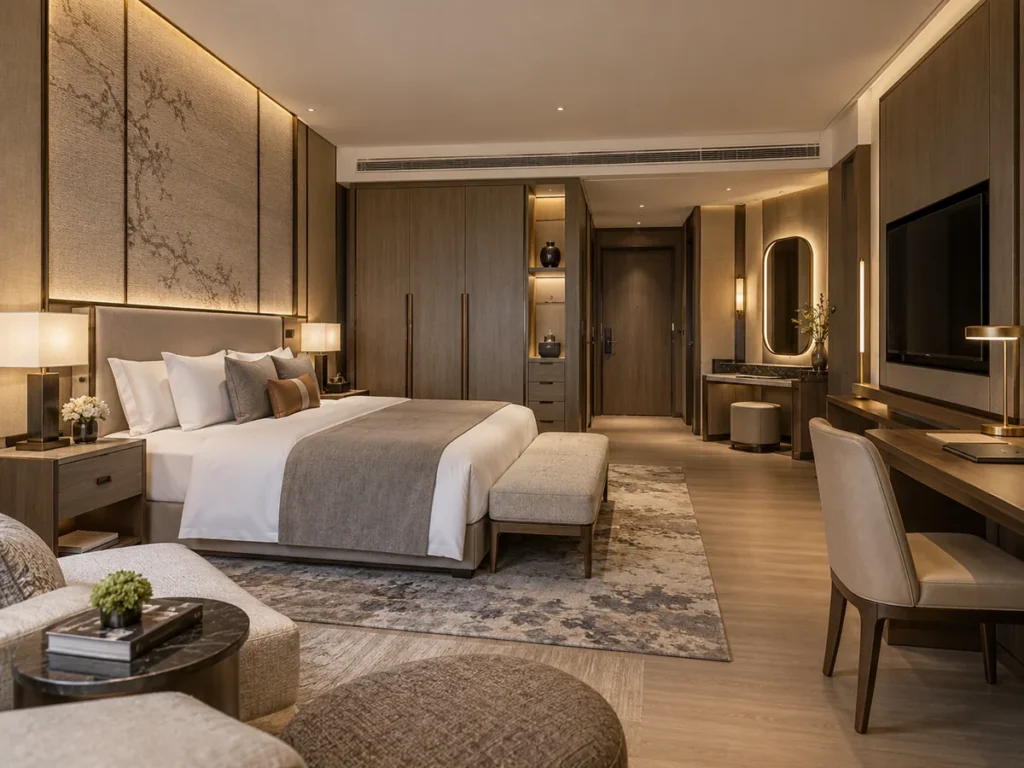
How Much Should You Budget for Hotel Furniture?
For early-stage budgeting, the HVS U.S. Hotel Development Cost Survey 2026 provides a useful reference. HVS analyzed hotel projects proposed or under construction during 2025 and reported FF&E costs separately.
| Hotel Type | Median FF&E Cost per Room |
|---|---|
| Limited-Service | $16,079 |
| Extended-Stay — Midscale | $16,594 |
| Select-Service | $18,321 |
| Extended-Stay — Upscale | $25,661 |
| Full-Service | $36,752 |
| Luxury | $138,317 |
HVS includes guestroom furniture, public-area furniture, kitchen equipment, softgoods, technology, and other FF&E items. So, a $25,000 FF&E allowance does not mean the custom furniture package alone costs $25,000 per room.
For a meaningful custom furniture cost estimate, you need to isolate the furniture scope first. That usually means identifying the exact casegoods, millwork, finishes, quantities, and delivery requirements included in the project.
What Do Hotel Furniture Cost Benchmarks Actually Include?
Hotel furniture cost benchmarks can be confusing because different sources may measure different scopes.
One estimate may cover only custom furniture. Another may refer to the entire FF&E package. Both might still use terms like “cost per room” or “cost per key.”
Furniture Cost vs. FF&E Cost
The difference is mainly about scope.
Custom Furniture May Include
- Headboards
- Nightstands
- Wardrobes
- TV units
- Desks
- Vanities
- Minibar cabinets
- Wall panels
- Luggage benches
- Custom millwork
Broader FF&E May Also Include
- Loose seating
- Lighting
- Curtains and window treatments
- Artwork and mirrors
- TVs and safes
- Operating equipment
- Kitchen or laundry equipment
- Other room accessories
- Public-area FF&E
- Meeting-room FF&E
HVS uses a broad FF&E category that includes guestroom furniture, public-area items, equipment, softgoods, and other project components. This is why an FF&E benchmark should not be treated as a custom furniture quotation.
The rule is simple: compare the scope before comparing the price.
Fixed Furniture vs. Loose Furniture
Even a furniture-only budget can cover different products.
Fixed furniture typically includes built-in wardrobes, headboard walls, vanities, wall panels, and reception counters. These items are usually designed around the architecture and room dimensions.
Loose furniture includes movable items such as chairs, tables, sofas, benches, and luggage racks.
Some hotel furniture manufacturers supply both categories. Others focus on casegoods, millwork, or loose furniture.
Before comparing two quotations, ask one question:
What exactly is included in the quoted price?
What Determines Custom Furniture Cost?
Once the furniture scope is defined, several factors influence the final custom furniture cost.
The final price is not determined by materials alone. It also reflects design complexity, engineering requirements, production efficiency, quality control, and delivery conditions.
Furniture Design, Type, and Complexity
Different furniture items require different levels of engineering and production work. More room types and bespoke designs usually require more drawings, samples, and coordination.
Materials and Finish Requirements
Materials directly affect custom furniture cost. Hotels need to balance appearance, durability, maintenance, and budget when selecting finishes and construction materials for custom hotel furniture .
Hardware and Integrated Features
Hardware, lighting, power integration, and functional components influence both production cost and long-term furniture performance.
Quantity, Repetition, and Production Efficiency
Larger quantities can improve efficiency, but repeated designs matter as much as volume. Standardized production helps reduce unnecessary complexity.
Samples, Mock-Ups, and Project Coordination
Samples and mock-up rooms help confirm finishes and details before mass production. They add upfront work but reduce costly mistakes later.
Delivery Requirements and Project Conditions
Location, packaging, delivery schedule, installation scope, and site conditions all affect the final project cost.

How Does a Hotel Furniture Manufacturer Calculate Project Pricing?
A professional hotel furniture manufacturer does not calculate a project price from room count alone. A reliable quotation starts with clear project information because every detail affects materials, engineering, production planning, quality control, and delivery requirements.
The pricing process usually begins with the BOQ and continues through drawings, room types, dimensions, materials, finishes, hardware specifications, samples, packaging, delivery terms, and installation requirements.
BOQ & Quantities
Define furniture scope and required quantities.
Drawings & Dimensions
Confirm sizes, construction details, and layouts.
Materials & Finishes
Select specifications, surfaces, and design details.
Hardware Specifications
Define functional components and performance requirements.
Samples & Approval
Verify finishes and details before production.
Packaging & Delivery
Plan logistics, installation, and project delivery.
Among these steps, the BOQ is one of the most important documents. It defines what needs to be produced, how many units are required, and where each item belongs within the project. A clear BOQ allows manufacturers to estimate material requirements, production time, packaging needs, and delivery planning more accurately.
Without a complete BOQ, manufacturers need to make assumptions. These assumptions can create price differences and make supplier comparisons less reliable.
What Makes a Quote More Accurate?
The accuracy of a quotation depends on the quality of the project information provided. A simple request such as “Please quote furniture for a 200-room hotel” gives a manufacturer very limited information.
A more complete request includes room quantities, room types, BOQ, drawings, finish schedules, hardware specifications, and delivery requirements.
Limited Project Information
"Please quote furniture for a 200-room hotel."
- No BOQ provided
- Unknown room types
- Unclear materials and finishes
- No hardware specifications
- Unknown delivery requirements
Complete Project Information
"Please quote 200 guestrooms across four room types using the attached BOQ, drawings, finish schedule, and hardware specifications."
- Clear BOQ and quantities
- Defined room layouts
- Confirmed materials and finishes
- Specified hardware requirements
- Clear delivery and installation scope
The difference is simple. The first request asks the manufacturer to estimate based on assumptions. The second provides measurable information that can be calculated.
That is the difference between a rough budget allowance and a project-based quotation.
Factory Price vs. Landed Cost vs. Installed Cost
The price shown on a supplier quotation is not always the final project cost. Hotel buyers should understand three different cost levels before comparing supplier quotations.
A factory price, landed cost, and installed cost represent different stages of the purchasing process. Confusing these terms can lead to inaccurate budget comparisons.
Factory Price
The manufacturing cost based on the agreed furniture scope, specifications, quantities, and production requirements.
- Furniture production
- Materials and finishes
- Manufacturing processes
- Factory quality control
Landed Cost
The total cost after adding logistics and import-related expenses before the furniture reaches the project location.
- Export packaging
- Freight
- Cargo insurance
- Customs charges
- Import duties and taxes
- Local delivery
Installed Cost
The complete project cost including onsite handling, installation, and final adjustments.
- Site unloading
- Room distribution
- Assembly
- Fixing and adjustment
- Punch-list corrections
Why Country and Incoterms Matter
The same furniture may leave the same factory, but the final delivered cost can change significantly depending on the destination. Import duties, taxes, freight, local transportation, warehousing, and installation costs all vary between countries. A furniture budget prepared for New York may not apply to a project in Dubai because the logistics and import conditions are different.
The WTO Tariff & Trade Data platform provides official tariff information across more than 150 economies, showing why destination markets can affect final project costs. Incoterms are also important when comparing supplier quotations. The ICC’s Incoterms® rules define buyer and seller responsibilities for transportation, costs, and risk. For example, an FOB quotation and a delivered quotation do not represent the same level of supplier responsibility.
Before comparing prices, always confirm what is included, where responsibility transfers, and which costs remain with the buyer.
How to Compare Hotel Furniture Quotations Correctly?
Three manufacturers may send you three different prices, and the lowest quotation may look attractive at first. However, price alone does not tell the full story. Before choosing a supplier, make sure each quotation is based on the same project scope, specifications, and delivery conditions. A lower price may simply mean that some items, materials, or services are not included.
Compare the Same Scope
Check furniture items, quantities, and room types. Missing items can make one quotation appear cheaper.
Compare the Same Materials
Review board specifications, veneer, laminate, stone, metal, upholstery, hardware, and finish systems.
Compare Delivery Terms
Confirm Incoterms, destination, packaging, freight, customs support, and local delivery responsibilities.
Check Exclusions
Identify costs that may not be included, such as samples, mock-ups, installation, storage, and spare parts.
Look Beyond Unit Price
Consider quality consistency, damage risk, delays, replacement costs, and installation issues.
The goal is not to find the lowest number, but to identify the supplier that provides the best overall value for the project. A reliable comparison should consider product scope, material specifications, delivery responsibilities, quality control, and potential risks throughout the project lifecycle. The cheapest quotation is not always the lowest-cost solution.
How Manufacturing Efficiency Can Control Custom Furniture Cost?

Custom furniture cost depends on more than materials and design. The manufacturing system behind a project also affects production efficiency, consistency, quality control, and final delivery performance.
For large hotel projects, small improvements in manufacturing processes can create measurable cost advantages.
Standardized Engineering
Standardized construction methods reduce unnecessary variation, simplify production planning, and improve consistency across large hotel projects.
Digital Engineering & Material Optimization
Digital workflows, material-yield analysis, and CNC nesting support efficient hotel furniture manufacturing with better material utilization and production accuracy.
Quality Control & Pre-Assembly
Factory inspections and pre-assembly checks identify potential issues before shipping, reducing rework, delays, and onsite costs.
Packing & Delivery Efficiency
Room-based packing and tracking systems simplify onsite sorting, improve installation efficiency, and support smoother project execution.
Manufacturing efficiency is not only about producing furniture faster. It is about creating a more predictable process from design approval to final installation.
How Can Hotels Control Custom Furniture Cost Without Sacrificing Quality?
Cost control does not mean choosing the cheapest materials or reducing quality. The better approach is to remove unnecessary complexity while protecting the elements that influence guest experience and long-term performance.
1. Standardize Where Guests Do Not Notice
Hotels can reduce custom furniture cost by standardizing elements that have little impact on guest perception.
For example, different room types may share the same internal wardrobe structure, hardware systems, or construction methods while maintaining different visible finishes.
This reduces unnecessary complexity without affecting the overall design experience.
2. Invest in High-Impact Design Areas
Not every furniture component needs the same level of investment.
Premium finishes and special details are often more valuable on visible surfaces, such as headboards, desks, vanities, and public-area furniture.
For less visible areas, durable and practical materials may provide better value.
The goal is to allocate the budget where guests can actually see and feel the difference.
3. Reduce Unnecessary Design Variations
Every additional furniture variation increases engineering, sampling, production, and coordination requirements.
Before adding a new design element, ask whether it creates meaningful value for the guest experience.
Simplifying unnecessary variations can improve efficiency while keeping the overall design intent.
4. Involve the Manufacturer Early
A design may look excellent on paper, but manufacturing experience can reveal better solutions.
Early involvement of a hotel furniture manufacturer allows designers and production teams to identify alternative materials, construction methods, or details that improve manufacturability.
Value engineering is not about removing design value. It is about achieving the same design goal with a smarter production approach.
5. Approve Specifications and Consider Lifecycle Cost
Late changes after production begins can create additional costs, including new drawings, new samples, material changes, remakes, and schedule delays.
Approving specifications early gives the project a clearer cost baseline.
Hotels should also consider lifecycle cost instead of only the initial purchase price. Furniture that requires frequent repairs or replacement may create higher costs over time.
What Information Is Needed for an Accurate Custom Furniture Quote?
A more accurate quotation starts with better project information.
A hotel furniture manufacturer needs clear details about the furniture scope, specifications, quantities, and delivery requirements before preparing a reliable project quote.
| Project Information | Why It Matters |
|---|---|
| Furniture BOQ | Defines the exact furniture supply scope |
| Quantities | Establishes production volume and pricing basis |
| Room-Type Breakdown | Shows different furniture variations required |
| Drawings | Defines dimensions, layouts, and construction details |
| Materials | Sets the base specification and construction requirements |
| Finishes | Defines surface appearance and finishing requirements |
| Hardware | Clarifies quality, functionality, and performance expectations |
| Mock-Up Requirements | Defines approval process and sample requirements |
| Project Location | Supports logistics planning and delivery calculation |
| Delivery Date | Supports production scheduling and project planning |
| Incoterm | Defines buyer and supplier responsibilities |
| Installation Scope | Clarifies onsite responsibilities and requirements |

Do you need every detail before contacting a manufacturer?
Not necessarily.
Early discussions can start with preliminary information. However, the final quotation should be based on confirmed project data to reduce assumptions and avoid unexpected cost changes.
Market benchmarks can help with early budgeting, but actual custom furniture cost should always be calculated from the real project scope, specifications, and delivery conditions.
Conclusion
Custom furniture cost for hotels depends on more than a single price benchmark. Market data can support early budgeting, but accurate pricing requires real project information, including BOQ, drawings, specifications, quantities, and delivery requirements.
The best cost strategy is not choosing the lowest quotation. It is working with a manufacturer that understands design, production, quality control, and project delivery.
VOLANT supports project-based quotations with a 105,000-square-meter manufacturing center, digital engineering, CNC production, material optimization, and quality control systems. If you are planning a hotel furniture project, contact us with your project details, and our team can help you build a quotation based on your actual requirements.
FAQs
How much does custom furniture cost for a hotel?
Custom furniture cost for a hotel depends on the furniture scope, materials, design complexity, quantity, finishes, delivery requirements, and installation needs.
There is no fixed price per room because every hotel project has different specifications. A reliable estimate requires project details such as BOQ, drawings, room types, and material requirements.
What factors affect custom furniture cost for hotels?
The main factors affecting custom furniture cost include furniture design, materials, finishes, hardware, order quantity, room types, customization level, delivery conditions, and installation requirements.
Large hotel projects can reduce unit costs through repetition, but complex designs and multiple room types may increase production and coordination costs.
How much does hotel furniture cost per room?
Hotel furniture cost per room varies widely depending on the hotel category, furniture scope, materials, and project requirements.
Benchmark figures can help with early budgeting, but they should not be treated as final furniture pricing. A complete quotation requires project-specific information.
What is the difference between hotel furniture cost and FF&E cost?
Hotel furniture cost usually refers to specific furniture items such as headboards, wardrobes, desks, nightstands, and vanities.
FF&E is a broader category that may include furniture, fixtures, equipment, softgoods, technology, and other project components. A complete FF&E budget is not the same as a custom furniture quotation.
How do hotel furniture manufacturers calculate project pricing?
Hotel furniture manufacturers calculate project pricing based on the actual project scope, including BOQ, drawings, room types, dimensions, materials, finishes, hardware specifications, quantities, packaging, delivery terms, and installation requirements.
A clear project scope helps reduce assumptions and creates a more accurate quotation.
How can hotels reduce custom furniture costs without reducing quality?
Hotels can control custom furniture costs by standardizing internal structures, reducing unnecessary variations, selecting materials strategically, involving manufacturers early, and considering lifecycle value instead of only the initial price.
The goal is not simply to choose cheaper furniture, but to create better project value.