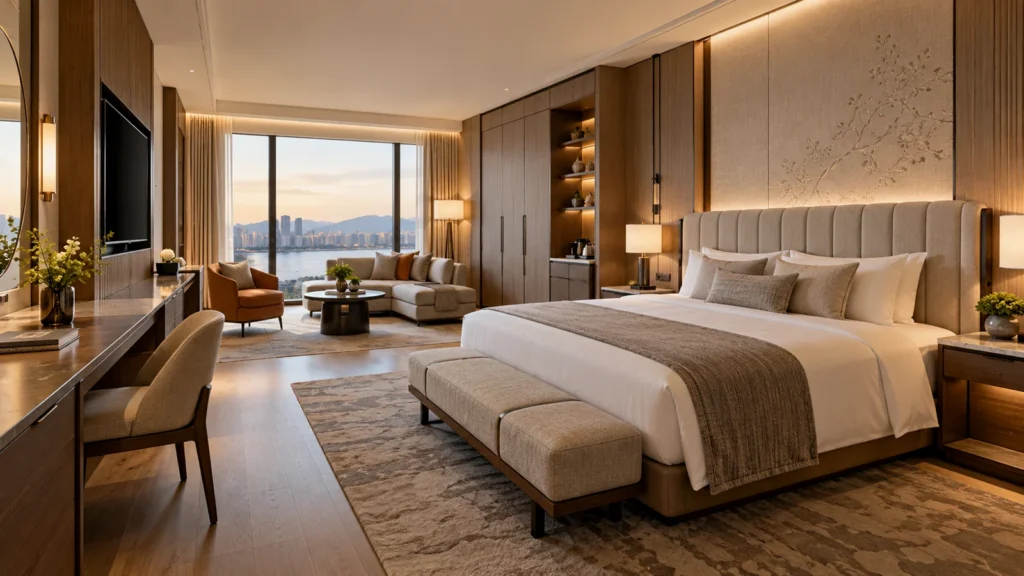
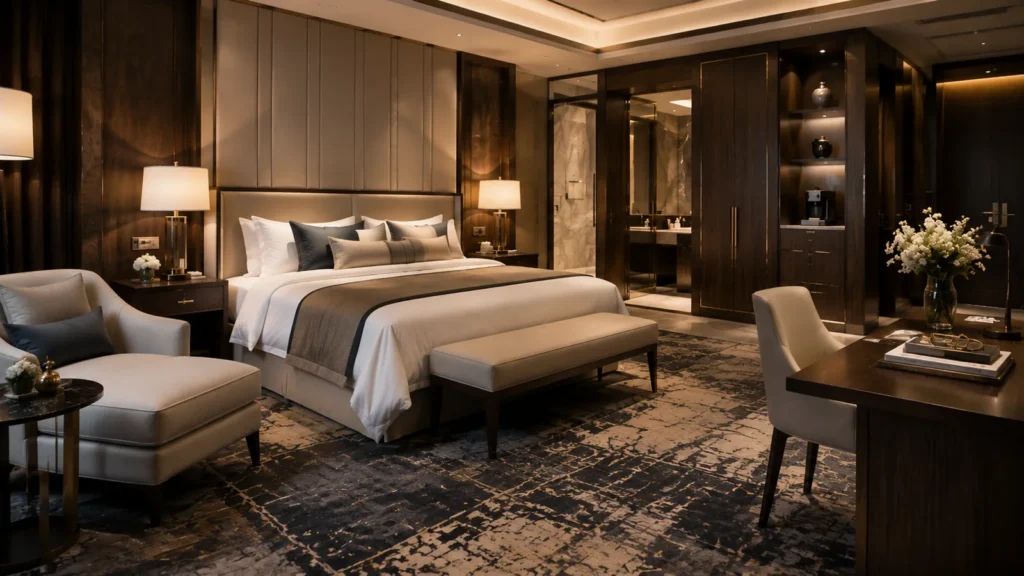
2026 has officially become the year of the hotel renovation wave, making it crucial to select the right hotel furniture suppliers to ensure the success of any project. Today, the market is flooded with numerous providers offering a wide variance in products, quality standards, and market positioning. Furthermore, the internet is saturated with AI-generated lists that often lack the accuracy and depth needed to make an informed decision.
In an era of information overload and a market filled with suppliers of uneven quality, the procurement process can quickly become overwhelming. For hotel developers, owners, and procurement professionals, the core challenge is clear: how to efficiently cut through the noise and accurately find a contractor and fixed furniture supplier who possesses a profound, uncompromising understanding of strict brand standards, while simultaneously keeping project costs firmly under control?
What is Hotel Fixed Furniture?
Hotel fixed furniture (also called built‑in furniture) refers to pieces that are permanently attached to the building structure, designed to remain in place rather than be moved or rearranged. These elements are often the parts of the hotel that guests interact with the most, from wardrobes and headboards in guest rooms to seating and display units in lobbies and public areas.
Types of Hotel Fixed Furniture and Use in Hotel Areas:
| Product | Hotel Area | Material & Surface Finish |
|---|---|---|
| Built-in Wardrobes | Guest Rooms | High-density MDF or Plywood, Melamine / Lacquer / Veneer Finish |
| Custom Headboards | Guest Rooms | Wood or MDF base, Upholstery (Fabric / Leather), Veneer Finish |
| Wall-mounted Desks and Tables | Guest Rooms, Business Suites | MDF or Solid Wood, Laminate or Lacquer Finish |
| Fixed Bathroom Vanities | Bathrooms | Moisture-resistant MDF or Plywood, Quartz or Solid Surface Countertop, Laminate / Lacquer Finish |
| Built-in Seating | Lobbies, Guest Rooms, Suites, Lounge Areas | Wood or MDF base, Upholstered Seat, Fabric / Leather / Vinyl Finish |
| Custom Cabinetry and Shelving | Guest Rooms, Lobbies, Public Spaces | MDF or Plywood, Veneer, Laminate, or Lacquer Finish |
| Fixed Lounge Chairs and Benches | Lobbies, Corridors, Public Spaces | Wood or MDF Frame, Upholstered Seat, Fabric / Leather Finish |
| Fixed Display Units | Lobbies, Corridors, Conference Rooms | MDF or Plywood, Laminate / Veneer / Lacquer Finish, Glass Panels for Display |

As a result, the durability and longevity of both guest rooms and public spaces heavily depend on the quality of the fixed furniture. Selecting the right designs and working with experienced suppliers is therefore crucial—not only to maintain aesthetic consistency and brand standards but also to ensure that furniture withstands daily use over many years.
Why Supplier Selection Is the Make-or-Break Decision for Hotel Projects
Hotel development and renovation are entering a new growth cycle worldwide. According to JLL Hotels & Hospitality Group, the global hospitality industry invested more than $42 billion in renovations and new hotel construction in 2024. Large hotel brands continue expanding while existing properties undergo periodic upgrades to stay competitive.
However, construction data reveals a serious challenge behind this growth. McKinsey’s research on megaprojects found that 98% suffer cost overruns of more than 30%, and 77% are at least 40% late relative to the original schedule.For hotel developments, supply chain and procurement breakdowns are consistently cited among the top drivers of these overruns, alongside scope creep and weak project controls.
Unlike typical procurement decisions, hotel fit-out suppliers influence multiple critical project factors:
Project timeline
Manufacturing delays or logistics problems can easily push opening dates back by months. Every delayed opening means lost room revenue and brand exposure.
Budget control
Poor manufacturing planning or rework caused by quality issues often results in unexpected costs. Once installation begins, changes become significantly more expensive.
Brand compliance
Hotel brands such as Marriott, Hilton, Accor, and IHG enforce strict design standards. Suppliers who lack experience with brand guidelines often produce items that fail approval inspections.
Long-term asset value
Durable materials and precise construction extend product life cycles. This reduces replacement costs and protects the property’s long-term investment value.
Why Fixed Furniture Matters More Than Most People Think
In many hotel projects, fixed casegoods and millwork represent a substantial share of the interior fit‑out budget — often in the range of 25–35%, according to aggregated industry benchmarks derived from cost‑estimating guides and consultant data.
Importance of Fixed Furniture
Unlike loose furniture, fixed furniture installation must be coordinated with:
- electrical works
- plumbing
- flooring
- wall finishing
- lighting systems
Even small dimensional errors can cause installation conflicts.
Global hotel brands maintain strict design guidelines covering:
- Materials
- finishes
- hardware specifications
- dimensions
- lighting integration
Suppliers unfamiliar with these standards may produce items that fail brand approval.
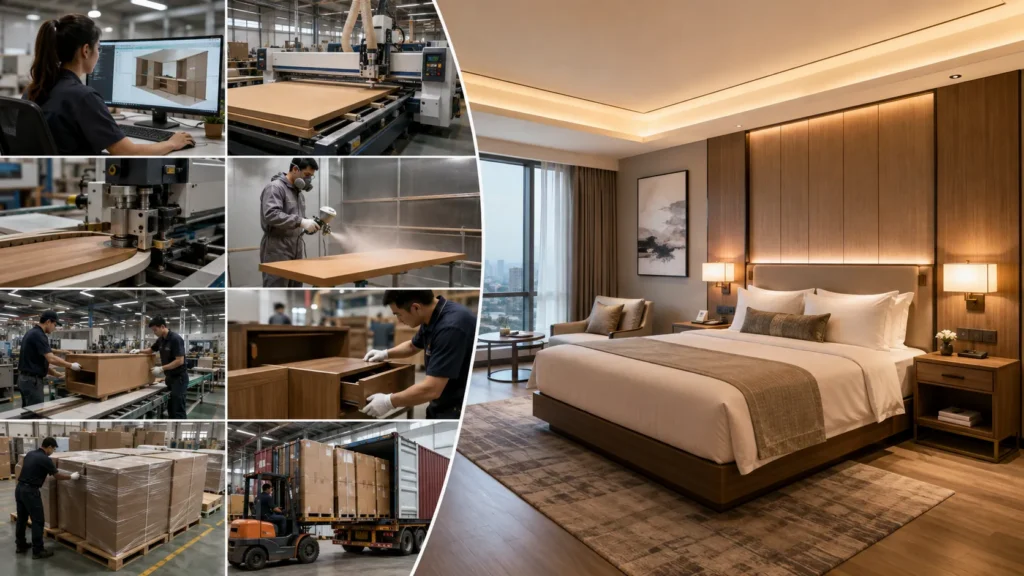
Fixed furniture manufacturing involves several technical processes:
- shop drawing production
- CNC machining
- surface finishing
- hardware installation
- quality inspection
- logistics packaging
Suppliers must therefore combine manufacturing expertise, engineering knowledge, and project management capability.
Built-in furniture determines how efficiently guests can use the space. Poor layout planning can make even large rooms feel cramped.
- Storage efficiency
- Space circulation
- Multi-functional design
- Ergonomics and usability
- Technology integration
- Cleaning and maintenance efficiency
The 5-Phase Evaluation Framework
Selecting a hotel fit-out supplier should never rely on price comparison alone. The most successful hotel developers follow a structured evaluation process that examines manufacturing capability, engineering expertise, project management systems, and long-term service reliability.
Pre-Qualification (Before You Even Start Talking)
- Factory scale (㎡), automation level (CNC/Industry 4.0), annual output capacity
- Benchmark: Suppliers with 30,000㎡+ facilities and automated production lines can handle 500+ room projects simultaneously
- Completed hotel projects (count, scale, star rating)
- Brand-specific experience (Marriott, Hilton, IHG, Accor, etc.)
- Geographic coverage and export capability
- Quality: ISO 9001, ANSI/BIFMA
- Environmental: FSC, CARB P2/NAF, ENF, ISO 14001
- Fire safety: ASTM E84, BS 476 compliance
| Error Type | Description | Consequence |
|---|---|---|
| Only reviewing online brochures, skipping factory visit | Many buyers rely on supplier websites, marketing videos, or trade show booths to assess capability. These often overstate actual production scale. | Discover capacity cannot handle your volume after contracts are signed; production delays of 4–8 weeks or forced multi-factory subcontracting with quality inconsistency |
| Ignoring the difference between “trading company” and “manufacturer” | Some suppliers present themselves as manufacturers but are actually intermediaries outsourcing to multiple small workshops. | No direct quality control, markup of 15–30% with no added value, communication chain lengthened, accountability gaps when problems arise |
| Accepting certifications at face value | Certificates may be expired, issued to a different legal entity, or cover only a narrow product line — not the products you need. | Non-compliant materials arriving on site; failed brand inspections; rework costs of $500–$2,000/room; potential project shutdown |
| Not verifying actual project references | Supplier claims “worked with Marriott” but may have supplied a single small order, not a full-scope fit-out. | Overestimating supplier capability; discovering mid-project that they lack experience with your project’s complexity or brand standards |
Technical Capability Assessment (The Deep Dive)
- Shop drawing capability, BIM integration, value engineering capacity
- Why this matters: Suppliers who can generate shop drawings reduce coordination errors by up to 60% (Source: Construction Industry Institute)
- Wood veneer, laminate, solid surface, stone, metal, upholstery
- Sustainability credentials per material category
- For 100+ room projects: mandatory mock-up before mass production
- Mock-up evaluation checklist: fit, finish, hardware, durability, brand compliance
- Industry standard: 8–14 weeks for production (post shop drawing approval)
- Red flag: Any supplier promising < 6 weeks for 200+ rooms
| Error Type | Description | Consequence |
|---|---|---|
| Skipping the mock-up room | To save time or budget, buyers approve mass production directly from 2D renderings or small material samples without building a full-scale mock-up room. | Color, texture, and proportion mismatches only discovered after 200+ rooms are manufactured; rework costs can reach $3,000–$5,000/room; brand QA rejection at final inspection |
| Not distinguishing “design capability” from “shop drawing capability” | Supplier shows beautiful 3D renders but cannot produce manufacturing-grade shop drawings with precise dimensions, tolerances, and material call-outs. | Design intent lost in translation to production; gaps, misalignments, and fitting errors on site; expensive field modifications requiring skilled carpenters |
| Overlooking material humidity/climate adaptation | Materials tested in a factory climate may not perform the same in tropical Southeast Asia or arid Middle East. | Warping, delamination, or cracking within 6–12 months of installation; guest complaints; premature replacement costs |
| Accepting unrealistic production timelines | Supplier promises aggressive timelines to win the contract but lacks actual capacity or subcontracts to lower-quality workshops. | Delayed delivery cascading into delayed hotel opening; penalty clauses triggered; revenue loss of $500–$2,000/room/day during delayed opening |
Project Management & Communication
- Single point of contact with 3+ years hospitality fit-out experience
- Weekly progress reporting, real-time production tracking
- Digital project dashboards, photo documentation, milestone tracking
- Time zone and language compatibility for international projects
- In-line inspection, pre-shipment inspection (PSI), third-party QC options
- IDPI (Integrated Digital Production Inspection) systems for zero-defect manufacturing
| Error Type | Description | Consequence |
|---|---|---|
| No dedicated project manager assigned | Supplier uses sales rep or shared coordinator who manages 10+ projects simultaneously; no single person owns your project end-to-end. | Critical change orders missed or delayed; design revisions not communicated to production floor; errors discovered only at shipping or installation stage |
| Relying on email as the sole project tracking system | No centralized dashboard; updates scattered across chat threads, email chains, and phone calls; no version control on drawings or specs. | Approved revisions overwritten by outdated files; conflicting instructions sent to factory; disputes over “who approved what” with no audit trail |
| Skipping in-line QC, relying only on pre-shipment inspection | All quality checks deferred to the final PSI stage. By then, hundreds of units are already manufactured. | Systemic defects (wrong veneer grain direction, incorrect hardware, color batch variance) discovered too late; scrapping or reworking entire production runs; 4–8 week delays |
| Ignoring time zone and language barriers | For cross-border projects, buyers assume the supplier’s English-speaking sales team will manage all communication, but production teams often operate in a different language. | Technical specifications mistranslated; urgent issues take 24–48 hours to resolve due to time zone gaps; misunderstandings compound into costly errors |
Logistics, Delivery & Installation
- Room-by-room packaging, container loading optimization
- Protection standards for international shipping (humidity, impact, customs)
- On-site supervision vs. full installation team deployment
- Phased installation planning (critical for renovation projects)
- Delivery windows coordination with other trades
- Buffer planning for customs clearance and site readiness
| Error Type | Description | Consequence |
|---|---|---|
| Not specifying room-by-room packaging in the contract | Supplier ships furniture by product type (all headboards together, all wardrobes together) instead of room-by-room. | On-site sorting chaos requiring additional labor and warehouse space; mismatched components between rooms; installation slowed by 30–50%; damage during re-handling |
| Underestimating customs clearance timelines | Buyer assumes “4 weeks shipping” means goods arrive on site in 4 weeks, ignoring customs documentation, inspections, port congestion, and inland transport. | Containers stuck at port for 2–4 weeks; demurrage charges of $150–$300/container/day; cascading delay to all downstream trades on site |
| No pre-installation site readiness check | Furniture arrives but walls are not finished, floors are not leveled, or MEP (mechanical/electrical/plumbing) rough-ins are incomplete. | Furniture stored on site exposed to dust, moisture, and construction damage; installation cannot proceed; storage costs and damage claims |
| Supplier provides no on-site installation supervision | Buyer hires local carpenters to install custom millwork without factory-trained guidance. | Incorrect assembly sequences; improper anchoring to walls; visible gaps and misalignments; hardware installed incorrectly; warranty voided due to “improper installation” |
| Ignoring protection of installed furniture during ongoing construction | Fixed furniture installed while other trades (painting, tiling, MEP) are still working in the same rooms. | Scratches, stains, water damage to finished surfaces; touch-up or replacement costs of $200–$800/room; delayed handover |
Post-Delivery & After-Sales
- Industry standard: 2–5 year structural warranty
- What to negotiate: material defects, hardware failures, finish degradation
- On-going spare parts availability (minimum 5 years)
- Maintenance documentation and training
- Portfolio pricing for multi-property owners
- Priority service for repeat clients
| Error Type | Description | Consequence |
|---|---|---|
| Not defining warranty scope in the contract | Buyer assumes “2-year warranty” covers everything, but the supplier’s fine print excludes hardware, finish wear, and “normal use” degradation. | Drawer slides fail at 18 months — supplier claims “wear item, not covered”; veneer peeling — supplier claims “environmental damage”; owner bears full repair cost |
| No spare parts agreement | Project completed, supplier relationship ends. Two years later, a guest damages a custom panel — no replacement is available. | Custom components cannot be matched; entire wall/unit must be redesigned and rebuilt at 3–5x the per-unit cost; visible patchwork repairs degrade guest experience |
| Failing to document installation details | No as-built drawings, no material specification records, no hardware model numbers retained after project completion. | Future maintenance teams cannot identify replacement parts; renovation planning 5–7 years later starts from scratch; brand audit cannot verify original specifications |
| No defect reporting protocol established | Issues discovered post-handover (soft-close hinges failing, edge banding lifting) but no clear process for reporting, response timeline, or resolution responsibility. | Issues escalate from minor repairs to major complaints; hotel operations team loses confidence in furniture quality; negative guest reviews citing room condition |
Choosing a Contractor for PIP Renovations
- What is PIP: Brand-mandated renovation requirements triggered by franchise agreement renewal, property acquisition, or periodic compliance cycles
- PIP vs. standard renovation: Stricter brand compliance, fixed deadlines with franchise penalties, revenue protection requirements
- Data point: Major hotel brands (Marriott, Hilton, IHG) typically mandate PIP compliance within 5–7 years; non-compliance can result in franchise termination
- Unique contractor requirements for PIP:
- Brand standard familiarity — must understand specific brand design guidelines
- Phased renovation expertise — ability to renovate while hotel remains operational
- Speed-to-completion — fast-track pre-fabrication to minimize revenue loss
- Revenue impact awareness — every day of room closure = direct revenue loss
- ROI framework: STR Global data shows PIP-compliant hotels achieve 15–25% ADR increase within 12 months of renovation completion
- Checklist: PIP-specific contractor evaluation (8 criteria)
Budget Allocation & ROI Analysis for Hotel Fit-Out
- Budget benchmarks (per room, by hotel tier):
- Midscale: $8,000–$15,000/room (fixed furniture)
- Upper Upscale: $15,000–$30,000/room
- Luxury: $30,000–$80,000+/room
- Source: HVS Design benchmarking data
- Total cost of ownership (TCO) framework
- Unit price + shipping + installation + maintenance + replacement cycle
- Why the cheapest quote often costs the most over 10 years
- ROI calculation model
- Input: renovation cost per room, pre/post ADR, occupancy rate
- Example: 200-room hotel, $20K/room renovation = $4M investment → 20% ADR increase = $1.2M additional annual revenue → 3.3-year payback
Supplier Comparison Matrix & Decision Checklist
- Downloadable comparison matrix (evaluating 3–5 shortlisted suppliers)
- Scoring dimensions: Manufacturing capability (25%), Quality & Compliance (20%), Project Management (20%), Delivery & Installation (15%), Cost & Value (10%), After-Sales (10%)
- Red flags checklist: 10 warning signs to walk away from a supplier
- Green flags checklist: 10 indicators of a reliable partner
Why Volant — A Fit-Out Partner Built for the Realities of Global Hospitality
Volant may not claim to be the world’s single largest hotel furniture manufacturer — but when it comes to full-category, one-stop export-ready hotel fit-out, Volant consistently ranks among the global top tier. Here’s what that actually means for your project:
Volant’s manufacturing DNA fuses three traditions: the engineering precision of German HOMAG Industry 4.0 production lines, the cost efficiency and scale of Chinese manufacturing, and an Italian-influenced design philosophy that understands spatial aesthetics, material harmony, and the nuances of luxury hospitality interiors. The result is a product that looks and performs like a European import — at a price point that protects your project ROI.
Unlike traditional furniture factories that think in “units shipped,” Volant thinks in RevPAR, ADR, and guest satisfaction scores. Our team understands that every design decision — from wardrobe interior layout to bathroom vanity ergonomics — impacts operational efficiency, housekeeping turnaround time, and ultimately your property’s revenue performance. We don’t just build furniture; we help you build a revenue-generating asset.
Volant’s multi-continent manufacturing footprint isn’t about being “big” — it’s about being strategically positioned. This means your project benefits from localized production and logistics — reducing shipping costs, customs complexity, and delivery timelines — while maintaining the centralized quality standards of a single manufacturer.
Most hotel furniture factories operate on a “receive drawings → cut panels → ship” model, prone to human error, version control failures, and batch inconsistencies.
- Digital thread from design to production: AutoCAD/SanWeiJia designs link directly to CNC machinery — eliminating manual translation errors
- Parallel production scheduling: All product categories (cabinets, walls, doors, bathrooms) are manufactured concurrently and synchronized to ship as a complete room package
- Real-time quality tracking: Every component is digitally inspected at each production stage, not just at pre-shipment
- Result: Zero rework, minimal waste, and projects delivered up to 30% faster than industry benchmarks
FAQs
1. How do I evaluate a supplier's manufacturing capability?
Focus on four hard indicators:
- Factory scale & automation: ≥30,000㎡ production space + CNC/Industry 4.0 lines (HOMAG, Biesse, SCM). Top-tier suppliers operate 80,000㎡+ with IDPI systems, error rate <0.1%.
- Full-category coverage: Can one factory deliver guestroom furniture, millwork, doors, walls, and bathroom vanities? Single-source production cuts vendor management 60–80% and eliminates cross-category finish variance.
- Shop drawing capability: Request actual manufacturing drawings from past projects — not renderings. In-house engineering reduces on-site errors by up to 60% (Source: CII).
- Factory visit: McKinsey data shows 35% of supply chain failures trace to inadequate qualification. Live or video tour is non-negotiable.
2. How much does hotel fixed furniture cost per room?
Industry benchmarks (Source: HVS Design):
| Hotel Tier | Cost/Room | Scope |
|---|---|---|
| Midscale (3-star) | $8,000–$15,000 | Headboard, wardrobe, desk, vanity, basic wall panels |
| Upper Upscale (4–4.5 star) | $15,000–$30,000 | Full millwork + custom joinery + public area pieces |
| Luxury (5-star) | $30,000–$80,000+ | Bespoke finishes, stone/metal, extensive public area millwork |
Unit price ≠ total cost. A complete TCO includes: manufacturing (50–60%) + shipping (8–15%) + customs/duties (5–20%) + installation (10–15%) + 7–10 year maintenance (15–25%). A $10,000/room quote that generates $2,000 rework + $1,500 delay penalties + $3,000 early replacement = $16,500 actual cost — more than a $13,000/room quality supplier with zero rework.
ROI: 200-room hotel × $20K/room = $4M → 20% ADR lift = $1.2M/year additional revenue → 3.3-year payback (Source: STR Global).
3. How long does hotel fixed furniture production and delivery typically take?
End-to-end: 16–30 weeks from contract to installation complete.
| Phase | Duration |
|---|---|
| Design & shop drawings | 3–5 weeks |
| Approval cycle | 2–4 weeks |
| Mock-up room (100+ rooms) | 2–3 weeks |
| Mass production | 8–14 weeks |
| Shipping & customs | 3–6 weeks |
| Installation | 2–6 weeks |
Key traps: Brand approvals (Marriott/Hilton/IHG) add 2–4 weeks if unplanned. Always add 3–4 weeks customs buffer beyond quoted shipping date — demurrage runs $150–$300/container/day. Any supplier promising <6 weeks production for 200+ rooms is subcontracting or cutting QC. CII reports 60% of millwork projects revise timelines — build 15–20% buffer.