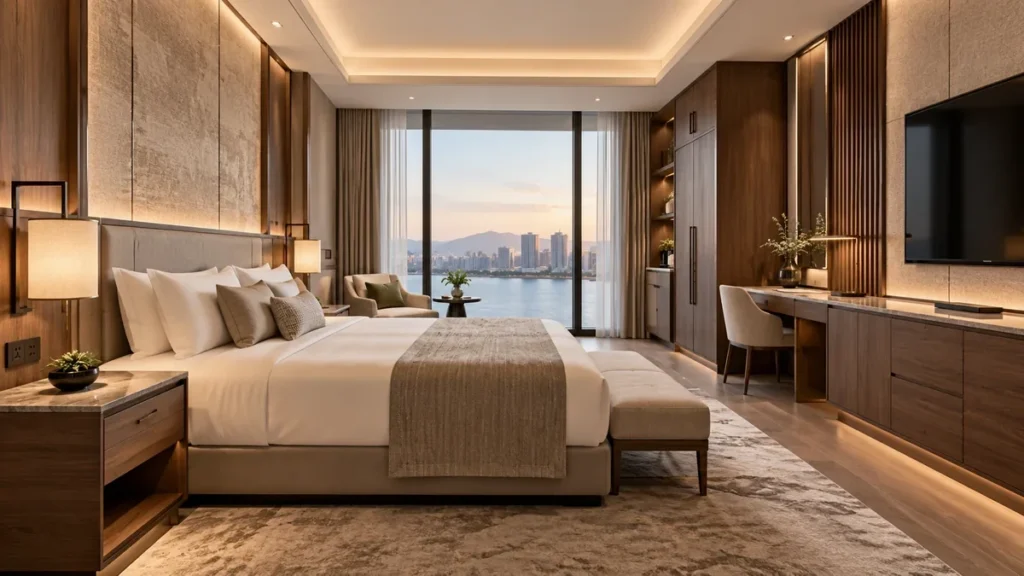
Hotel wardrobe design may look simple at first. After all, a wardrobe is just a place to hang clothes, right? Not exactly. In a hotel guest room, the wardrobe works like a small command center. It stores clothes, luggage, robes, safe boxes, shelves, and sometimes even minibars. It also affects how guests move through the room.
Good hotel wardrobe design makes a guest room feel calm, organized, and easy to use. Poor design creates small daily problems. Doors hit the bed. Hangers don’t fit properly. Luggage has no proper place. The safe box feels awkward to reach. Guests may not praise a perfect wardrobe, but they will notice a bad one.
For hotel owners, interior designers, developers, and procurement teams, the wardrobe is not just another piece of furniture. It is part of the guest experience. It also affects durability, housekeeping efficiency, maintenance, and project cost. In this hotel wardrobe design guide, we will explain how to design hotel wardrobes for guest rooms, including layouts, dimensions, materials, finishes, door types, room types, and manufacturing details.

What Is Hotel Wardrobe Design?
Hotel wardrobe design is the planning of storage furniture inside a hotel guest room, and it is an important part of the overall guest room furniture layout. It covers the wardrobe’s size, position, internal layout, materials, doors, lighting, hardware, and accessories. It also considers how the wardrobe works with the bed, entrance, bathroom, minibar, safe box, TV unit, and luggage area.
A residential wardrobe is usually personal. It serves one owner for many years. A hotel wardrobe is different because it serves many guests every week. It must handle constant use, fast cleaning, luggage impact, repeated door opening, and different guest habits.
That’s why hotel room wardrobes need more than a nice appearance. They need practical design, strong materials, reliable hardware, and easy maintenance. A good hotel wardrobe should answer four simple questions:
- Can guests use it easily?
- Does it fit the room layout?
- Can housekeeping clean it quickly?
- Can the hotel maintain it for years?
If the answer is yes, the design is on the right track.
Why Wardrobe Design Matters in Hotel Guest Rooms
The wardrobe is often one of the first furniture pieces guests use after check-in. They open their suitcase, hang a jacket, place valuables in the safe, and look for extra hangers or a laundry bag. That moment should feel effortless.
When the wardrobe is well designed, guests may not think about it much. Everything just works. But when it is poorly designed, small problems appear quickly. The door hits the bed, hangers do not fit properly, luggage stays on the floor, and the safe box feels awkward to reach.
Guest Convenience
Guests want storage that feels obvious. They should not need to search for the safe box, fight with a heavy door, or place luggage on the floor because there is no shelf.
A practical hotel wardrobe should include enough hanging space, shelves, luggage support, and clear storage zones. For business guests, hanging space matters most. For resort guests, luggage space and open shelving may matter more. For long-stay guests, drawers and extra shelves become more important.
The best design starts with the guest, not the cabinet.
Space Efficiency
Hotel rooms are getting more compact in many markets, so every inch matters. A bulky wardrobe can make a room feel smaller, while a smart wardrobe can make the same room feel more open.
Built-in wardrobes help create a clean wall line. Sliding doors save swing space. Open wardrobes can make compact rooms feel lighter. The goal is simple: the wardrobe should store more while visually taking less.
Think of it like a suitcase. The best one does not look huge, but it holds everything neatly.
Housekeeping Efficiency
Housekeeping teams interact with wardrobes every day. They check hangers, clean shelves, inspect drawers, replace laundry bags, and look for lost items.
If the wardrobe is too deep, too dark, or too complex, cleaning takes longer. Easy-clean finishes, smooth edges, good lighting, and durable hardware help reduce daily friction. Across hundreds of rooms, small design choices can save a lot of time.
Brand Perception
A wardrobe also tells guests what kind of hotel they are in. A budget hotel may need a compact laminate wardrobe. A business hotel may need a clean, efficient design with a safe box, mirror, and practical hanging space. A boutique hotel may use an open wardrobe with custom details. A luxury suite may need a walk-in wardrobe with premium veneer and LED lighting.
The wardrobe should match the brand promise. If the room says “premium,” the wardrobe cannot feel cheap.
Taken together, good hotel wardrobe design improves more than storage. It supports guest comfort, space planning, housekeeping efficiency, and the overall guest room experience.
Main Types of Hotel Wardrobes

There is no single best wardrobe type in hotel wardrobe design. The right choice depends on room size, guest profile, budget, design style, and project requirements.
Some rooms need a compact sliding wardrobe. Others need a built-in unit with a minibar and safe box. A luxury suite may even need a walk-in wardrobe. The best option is the one that fits the room and supports the guest experience.
If you want more visual inspiration, explore our 15 Modern Wardrobe Design Ideas for Hotel Guest Rooms.
Built-In Hotel Wardrobe
Built-in wardrobes are common in hotel guest rooms because they create a clean and consistent look. They fit into a wall niche or a fixed furniture system, and they can connect with wall panels, luggage benches, TV units, or minibar cabinets.
This type works well for large hotel projects. It keeps the design consistent across many rooms and helps reduce visual clutter. Built-in wardrobes are also space-efficient, which makes them a strong choice for business hotels, resorts, serviced apartments, and full fit-out projects.
Freestanding Wardrobe
Freestanding wardrobes are movable units. They are easier to replace and can work well in small hotels, rental apartments, serviced apartments, or renovation projects.
The main drawback is integration. A freestanding wardrobe may not look as seamless as a built-in unit. It can also leave gaps behind or around the cabinet, which makes cleaning harder. This option works best when flexibility matters more than a fully built-in look.
Open Wardrobe
Open wardrobes are popular in lifestyle hotels, boutique hotels, and compact rooms. They often use open shelves, hanging rails, metal frames, luggage platforms, and simple storage zones.
This design makes a small room feel lighter and more open. It also helps guests see their belongings at a glance. The trade-off is that everything stays visible. If guests unpack heavily, the room can look messy. Open wardrobes work best when the design is intentional, simple, and clean.
Sliding Door Wardrobe
Sliding door wardrobes are ideal for compact hotel rooms because the doors move sideways and do not need swing clearance. This helps in narrow rooms, tight entrance areas, and layouts where the wardrobe sits close to the bed or bathroom door.
Sliding doors can look modern and clean. They also work well with mirror panels, laminate, veneer, or other decorative finishes. The main drawback is access. Guests can usually open only one side at a time, and sliding tracks need good hardware and regular maintenance.
Hinged Door Wardrobe
Hinged door wardrobes are classic, familiar, and easy to use. They allow full access to the wardrobe interior, and the hardware is usually simple to repair or replace.
The limitation is clearance. If the wardrobe is close to the bed, entry door, or bathroom door, the door swing can create problems. Hinged doors work best in rooms with enough circulation space.
Walk-In Wardrobe
Walk-in wardrobes are usually used in suites, villas, and luxury hotel rooms. They create a premium experience and provide generous storage for clothes, luggage, shoes, mirrors, drawers, and display-style shelving.
The downside is space and cost. A walk-in wardrobe only makes sense when the room size supports it. In a small room, it can steal valuable floor area and make the layout feel less efficient.
Hotel Wardrobe with Integrated Features
Many hotel wardrobes now combine several functions in one unit. They may include a luggage rack, minibar, safe box, mirror, LED lighting, or open display shelves.
This approach saves space and keeps the guest room organized. But it needs early coordination. Minibars need ventilation and power. LED lights need wiring. Safe boxes need the right height and structural support. If these details are added too late, production and installation can become complicated.
In modern hotel wardrobe design, a well-integrated wardrobe can make a small room work like a larger one. That’s why this option is common in compact and modern hotel rooms.
Quick Comparison of Hotel Wardrobe Types
Each wardrobe type works best in a different room setting. The table below gives you a quick way to compare the main options before moving into detailed dimensions and internal layouts.
| Wardrobe Type | Best For | Main Benefit |
|---|---|---|
| Built-in wardrobe | Most hotel guest rooms | Clean look and space efficiency |
| Freestanding wardrobe | Renovations and flexible layouts | Easy replacement |
| Open wardrobe | Boutique and lifestyle hotels | Light, modern appearance |
| Sliding door wardrobe | Compact rooms and narrow layouts | Saves door swing space |
| Hinged door wardrobe | Standard rooms and suites | Full interior access |
| Walk-in wardrobe | Luxury suites and villas | Premium storage experience |
| Integrated wardrobe | Compact and modern hotel rooms | Combines storage with other functions |
Standard Hotel Wardrobe Dimensions
In hotel wardrobe design, dimensions are never just numbers. They affect how guests store clothes, move around the room, open doors, and use the space every day.
That’s why wardrobe dimensions should be based on the hotel type, room layout, guest profile, brand standards, and site conditions. Still, most hotel wardrobes follow a few common reference ranges.

| Wardrobe Element | Common Recommendation | Notes |
|---|---|---|
| Overall depth | 600–650 mm / 24–26 in | Allows space for standard hangers |
| Minimum width | 900–1200 mm / 35–47 in | Depends on room type and storage needs |
| Overall height | 2000–2400 mm / 79–94 in | Can include upper storage |
| Hanging rail height | 1600–1700 mm / 63–67 in | Works for shirts, jackets, and dresses |
| Shelf height | Project-based | Depends on folded clothes and amenities |
| Luggage space | Project-based | Should fit common suitcase sizes |
| Door clearance | Depends on door type | Hinged doors need more clearance |
These are practical project references, not universal rules. Always confirm the final dimensions with the interior designer, hotel brand, manufacturer, and site measurements.
For a more detailed breakdown of wardrobe width, depth, height, internal clear dimensions, door clearance, accessibility, and shop drawing checks, see our Hotel Wardrobe Dimensions Guide.
Depth
Depth is one of the most important wardrobe dimensions. If the wardrobe is too shallow, hangers may not fit properly, clothes can feel squeezed, and the guest experience suffers.
A depth of about 600 mm, or 24 inches, is common for wardrobes with standard hangers. Some hotel projects use 650 mm, or about 26 inches, for a more comfortable fit.
In compact rooms, designers may reduce the depth. But that choice needs care. A shallow wardrobe may need a special hanging solution, an open layout, or a different internal structure.
Width
Wardrobe width should be based on guest behavior, not only wall space.
A small hotel room may only need a compact wardrobe with a hanging rail and a few shelves. A suite or serviced apartment may need wider storage with drawers, extra shelves, and more hanging space.
Business hotels often need more hanging width for shirts, suits, and jackets. Resort hotels may need more open shelves and luggage storage. Long-stay rooms usually need more divided storage.
In short, choose the width based on how guests will actually use the room.
Height
Hotel wardrobes often range from 2000 to 2400 mm, or about 79 to 94 inches, in height. Taller wardrobes can include upper storage for extra pillows, blankets, or seasonal items.
However, higher storage is not always better. If guests cannot reach it easily, it becomes less useful. For accessible rooms or U.S. hotel projects, ADA requirements should also be reviewed. These may affect reach range, clear floor space, and how guests use storage elements.
Door Clearance
Door clearance can make or break the wardrobe design.
A hinged door may look fine in the drawing. But what happens when it opens toward the bed? What if it blocks the bathroom door or entry area?
Before production, test the door swing in the room plan. If clearance is limited, sliding doors or open wardrobes may be better options.
A good wardrobe should not fight with the room layout. Practical hotel wardrobe design should leave enough space for guests to move, open doors, and use the room comfortably.
Hotel Wardrobe Interior Design: What Should Be Inside?
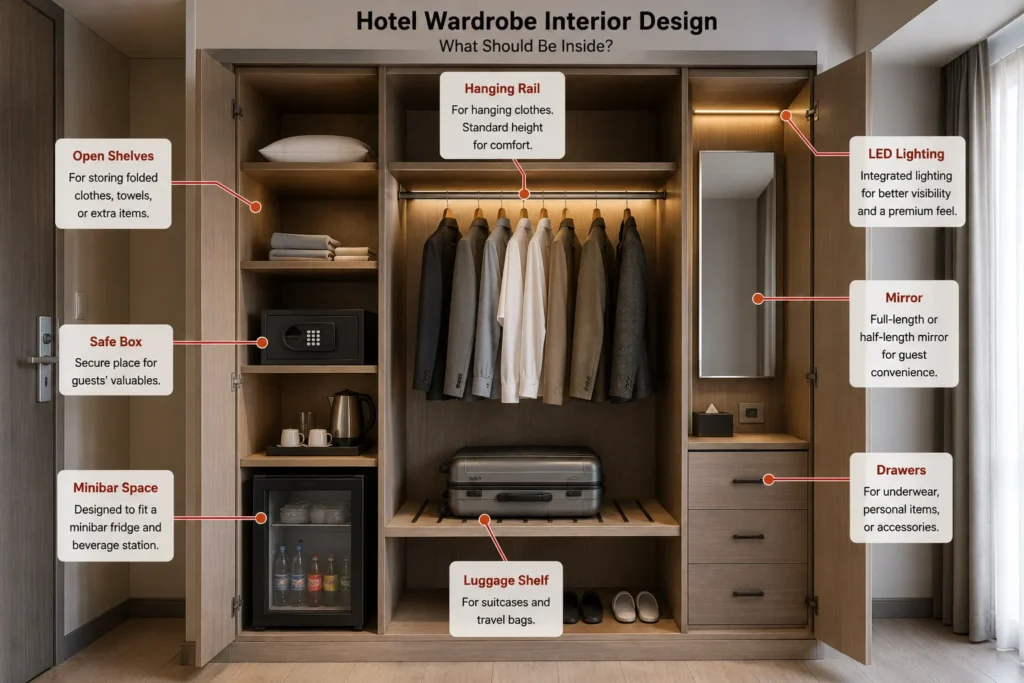
The outside of the wardrobe creates the first impression, but the inside creates the real guest experience. A beautiful wardrobe with poor storage is like a nice suitcase with no compartments. It looks good at first, but it quickly becomes frustrating.
Good hotel wardrobe design should make the interior storage feel simple, clear, and easy to use. Guests should know where to hang clothes, place luggage, store valuables, and find daily-use items without thinking too much.
Hanging Rail
A hanging rail is essential in most hotel wardrobes. Business guests need it for shirts, jackets, coats, and dresses. Resort guests may use it for light clothing, robes, or vacation wear.
The rail should be easy to reach and strong enough for repeated use. Avoid placing it too high. Guests should not need to stretch just to hang a jacket.
Open Shelves
Open shelves are useful for folded clothes, bags, extra pillows, blankets, and hotel amenities. They are also easy for housekeeping teams to clean and inspect.
In economy hotels, shelves may replace drawers to reduce cost and maintenance. In resort rooms, larger shelves can help guests store beach bags, casual clothing, robes, or towels.
Drawers
Drawers add comfort, but they also add cost. They need runners, handles, alignment, and ongoing maintenance.
For short-stay hotels, drawers may not be necessary. For serviced apartments, extended-stay hotels, and long-stay rooms, they are much more useful. Use drawers where guests truly need separated storage.
Luggage Rack or Luggage Shelf
Guests need a proper place to open a suitcase. If there is no luggage rack, they may use the bed, desk, or floor. None of these is ideal.
A wardrobe can include a built-in luggage shelf, or it can connect with a separate luggage bench. This is especially useful in compact guest rooms where every piece of furniture needs to do more than one job.
Safe Box Space
Many business, upscale, and luxury hotels include a safe box inside the wardrobe. The safe should be easy to find, comfortable to reach, and supported by the cabinet structure.
Safe box dimensions must be confirmed before production. If the safe is added too late, the cabinet may need design changes, extra support, or site adjustment.
Minibar Integration
Some hotels combine the wardrobe with a minibar cabinet. This can save space and create a clean furniture wall in the guest room.
But minibar integration needs planning. It requires ventilation, power access, service access, and heat management. Do not treat the minibar as just another shelf. It has technical needs that affect cabinet design.
Mirror
A full-length mirror improves the room experience and helps save wall space. It can be placed on a wardrobe door, side panel, or nearby wall.
Mirror placement should consider lighting, door movement, guest privacy, and the overall room layout. A mirror is helpful only when guests can use it comfortably.
LED Lighting
Interior LED lighting makes wardrobes easier to use, especially in deep or dark cabinet interiors. Motion-sensor lights can also create a more premium feeling.
Electrical coordination should happen before production. Late wiring changes can delay installation and create avoidable site problems.
| Interior Component | Why It Matters | Best For |
|---|---|---|
| Hanging rail | Stores shirts, jackets, coats, and dresses | Business hotels and standard rooms |
| Open shelves | Stores clothes, bags, pillows, and amenities | Economy hotels, resorts, and compact rooms |
| Drawers | Adds separated storage for longer stays | Serviced apartments and extended-stay rooms |
| Luggage shelf | Keeps suitcases off the bed or floor | Compact rooms, resorts, and standard rooms |
| Safe box space | Gives guests a secure place for valuables | Business, upscale, and luxury hotels |
| Minibar space | Combines storage and refreshment functions | Business, resort, and full-service hotels |
| Mirror | Improves convenience and saves wall space | Most hotel guest rooms |
| LED lighting | Makes deep or dark wardrobes easier to use | Upscale rooms and premium projects |
Sliding Door vs Hinged Door vs Open Wardrobe

In hotel wardrobe design, choosing the door type is not just a style decision. It affects door clearance, guest movement, storage access, maintenance, and how spacious the room feels.
If the guest room is narrow, a sliding door wardrobe may solve the clearance problem. If the room has enough space, a hinged door wardrobe gives better access to the full interior. For boutique or lifestyle hotels, an open wardrobe can make the room feel lighter and more casual.
| Wardrobe Type | Best For | Advantages | Limitations |
|---|---|---|---|
| Sliding door wardrobe | Compact rooms | Saves space; looks modern | One-side access |
| Hinged door wardrobe | Standard rooms and suites | Full access; simple hardware | Needs swing clearance |
| Open wardrobe | Boutique and lifestyle hotels | Light, modern, easy to use | Less privacy |
| Walk-in wardrobe | Luxury suites and villas | Premium storage experience | Needs more space and budget |
The best choice is not always the most expensive one. It is the one that fits the room layout, supports the guest experience, and works well for daily hotel operation.
Hotel Wardrobe Design by Hotel Type
Not every hotel room needs the same wardrobe. A budget hotel, a business hotel, and a luxury resort all serve different guests. So why should their wardrobes follow the same logic?
The right hotel wardrobe design should match the hotel category, guest profile, room size, service model, and brand positioning.
| Hotel Type | Design Priority | Recommended Features |
|---|---|---|
| Budget hotel | Cost and durability | Compact layout, laminate finish, simple shelves |
| Business hotel | Function and efficiency | Hanging rail, safe box, mirror, practical storage |
| Boutique hotel | Design identity | Open layout, custom details, unique finish |
| Resort hotel | Comfort and luggage space | Larger shelves, robe hooks, moisture-resistant finish |
| Serviced apartment | Long-stay storage | More drawers, shelves, and hanging space |
| Luxury suite | Premium experience | Walk-in layout, veneer, lighting, custom hardware |
Budget Hotels
Budget hotel wardrobes should be simple, strong, and easy to clean. The goal is not to add every possible feature. The goal is to provide reliable storage at a controlled cost.
Laminate or melamine finishes are common choices because they are practical, durable, and easy to maintain. In many budget rooms, a hanging rail, a few shelves, and a compact luggage area may be enough.
Business Hotels
Business hotel wardrobes should support a fast and efficient routine. Guests may check in late, hang a jacket, store valuables, and leave early the next morning.
That’s why practical hanging space, a safe box, a mirror, and easy-to-find storage zones matter. The design should feel clear and efficient, not decorative or complicated.
Boutique Hotels
Boutique hotels often use wardrobe design as part of the room identity. Open wardrobes, mixed materials, metal frames, decorative handles, and custom finishes can work well.
Still, function should lead the design. A creative wardrobe should not become a confusing wardrobe. Guests should understand how to use it at first glance.
Resort Hotels
Resort guests often bring larger bags, casual clothing, hats, beachwear, and extra personal items. They may also stay longer than business guests.
That’s why resort wardrobes often need more luggage space, open shelves, robe hooks, and moisture-resistant materials. This is especially important in coastal, tropical, or humid locations.
Serviced Apartments
Serviced apartments and extended-stay rooms need more storage than standard hotel rooms. Guests may unpack fully and use the wardrobe like a small home closet.
More drawers, shelves, hanging space, and divided zones can make the room feel more comfortable for longer stays.
Luxury Suites
Luxury wardrobes should feel effortless and refined. Premium veneer, lacquer, leather details, metal trims, LED lighting, and custom hardware can all help create a high-end experience.
But luxury is not only about expensive materials. It is also about quiet operation, perfect alignment, smooth hardware, and a layout that feels natural every day.
Materials and Finishes for Hotel Wardrobes
In hotel wardrobe design, material choice affects cost, durability, maintenance, brand feel, and long-term performance. It can also affect indoor air quality and project compliance.
For hotel projects in the United States, composite wood products should meet TSCA Title VI requirements when applicable. This includes hardwood plywood, MDF, particleboard, and finished goods that contain these products. So material selection is not only about appearance. It is also about standards, documentation, and project risk.

| Material / Finish | Best For | Main Benefit | Key Consideration |
|---|---|---|---|
| Laminate | Economy and midscale hotels | Durable, cost-effective, easy to clean | Less premium than veneer |
| Melamine | Interior panels and shelves | Practical and budget-friendly | Best for less visible areas |
| Veneer | Upscale hotels, resorts, and suites | Natural wood look and premium feel | Needs color and grain control |
| Lacquer | Boutique and luxury rooms | Smooth, modern custom finish | More sensitive to scratches |
| MDF | Painted or lacquered surfaces | Smooth surface for finishing | Moisture resistance must be specified |
| Plywood | Structural parts and humid locations | Good stability and strength | Higher cost than basic boards |
| Particleboard | Cost-sensitive projects | Affordable substrate option | Needs proper specification and protection |
Laminate and Melamine
Laminate and melamine are practical choices for many hotel wardrobes. They are easy to clean, cost-effective, and suitable for high-traffic rooms.
Laminate is often used on visible surfaces when durability and consistency matter. Melamine is often used for internal panels, shelves, and less visible cabinet areas.
Veneer and Lacquer
Veneer and lacquer create a more premium look. Veneer gives a natural wood appearance, while lacquer creates a smooth and modern finish.
Both need better quality control during production, packing, and installation. Color, grain, surface protection, and touch-up planning all matter more in premium projects.
MDF, Plywood, and Particleboard
MDF, plywood, and particleboard are substrates. They sit under the surface finish and affect strength, stability, cost, and moisture performance.
MDF works well for smooth painted or lacquered surfaces. Plywood is useful for stronger structures or humid locations. Particleboard can work in cost-sensitive projects when it is specified and protected properly.
Hardware and Accessories
Hardware is not a finish, but it can decide how the wardrobe feels after years of use. Hinges, sliding tracks, handles, drawer runners, hanging rails, and soft-close systems carry daily stress.
Good hardware reduces noise, improves guest experience, and lowers maintenance problems. Think of hardware like the joints in a body. If they fail, the whole wardrobe feels broken.
Design Features That Improve Guest Experience
Small details often decide whether a hotel wardrobe feels easy or annoying to use. Guests may not notice every hinge, light, or shelf. But they will feel the difference when everything works smoothly.
Soft-Close Hinges and Tracks
Soft-close hardware reduces noise and protects the wardrobe from daily impact. It gives guests a quieter experience and helps the cabinet feel better built.
Full-Length Mirror
A full-length mirror improves convenience and saves wall space. Place it where guests can use it easily, without poor lighting or awkward door movement.
Interior LED Lighting
LED lighting helps guests see inside deep or dark wardrobes. Paired with motion sensors, it can turn on automatically when the wardrobe is opened.
Safe Box Integration
A safe box should be visible, reachable, and supported by the cabinet structure. Its size and position should be confirmed before production starts.
Luggage Storage
A built-in luggage shelf keeps suitcases off the bed, desk, and floor. It gives guests a cleaner, easier place to unpack after check-in.
Ventilation and Easy-Clean Surfaces
Ventilation helps reduce trapped moisture inside closed wardrobes. Easy-clean finishes also help the wardrobe stay fresh after years of hotel use.
These features don’t make the wardrobe complicated. They simply make it easier, quieter, cleaner, and more comfortable to use.
Common Hotel Wardrobe Design Mistakes
Most hotel wardrobe design mistakes are avoidable. They usually happen when the design looks good on paper but ignores real hotel use.
A wardrobe may look fine in a rendering. But will the door open smoothly? Will hangers fit? Can guests place luggage somewhere? Can housekeeping clean it fast? These are the questions that prevent costly mistakes.
1. The Wardrobe Is Too Shallow
This is one of the most common hotel wardrobe design mistakes. If hangers don’t fit properly, clothes sit at an angle and guests notice the problem right away.
Always confirm the internal depth before production, not just the outside cabinet size.
2. There Is No Luggage Space
A guest room without luggage space feels incomplete. Guests need a proper place to open and store suitcases.
If the room is compact, combine luggage storage with the wardrobe. A built-in luggage shelf or connected luggage bench can solve the problem without adding extra furniture.
3. Door Clearance Is Poor
Wardrobe doors should not hit beds, walls, bathroom doors, or entry doors. This sounds obvious, but it is easy to miss in early drawings.
Check every door swing in the room layout before approving shop drawings. If clearance is tight, sliding doors or open wardrobes may work better.
4. Hardware Is Too Weak
Hotels are not gentle environments. Hinges, sliding tracks, handles, and drawer runners are used again and again.
Cheap hardware can fail quickly and create maintenance issues. Durable hardware may cost more at the start, but it usually saves money over time.
5. The Interior Is Too Dark
A dark wardrobe feels inconvenient, especially when the cabinet is deep or finished in darker colors.
Use light internal finishes, open sections, mirror panels, or LED lighting to improve visibility. Guests should not need to use their phone flashlight to find their clothes.
6. The Material Does Not Match the Environment
A coastal resort needs different material planning than an urban business hotel. Humidity, cleaning chemicals, luggage impact, sunlight, and daily use all matter.
Choose finishes and substrates based on the real environment, not only the design rendering.
7. Safe Box or Minibar Planning Happens Too Late
Safe boxes and minibars are not simple add-ons. They need dimensions, support, power, ventilation, and service access.
Plan them before shop drawings are approved. Late changes can affect cabinet structure, wiring, production, and installation.
8. Finishes Are Inconsistent Across Rooms
Large hotel projects need finish consistency across many rooms. A small color difference may not matter in one room, but it becomes obvious across a full floor.
Approve finish samples before mass production. During production, check color, grain, edge banding, and batch consistency.
9. Site Measurement Is Ignored
Drawings are important, but site conditions are real. Walls may not be perfectly straight. Renovation projects may have unexpected dimensions.
Measure before final production, especially for built-in wardrobes and renovation projects. This helps avoid gaps, poor alignment, and costly site adjustments.
How to Specify Hotel Wardrobes for Manufacturing
A good hotel wardrobe design must become a buildable product. This is where many projects lose time. The design may look clear in a rendering, but the manufacturer still needs exact details to quote, produce, pack, deliver, and install it correctly.
Clear specifications reduce guesswork. They also help avoid wrong dimensions, mismatched finishes, weak hardware, site delays, and expensive rework.

Room Type Schedule
Start with a room type schedule. This document should list each room type, quantity, wardrobe size, door type, finish, and accessory requirement.
A king room may need one standard wardrobe. A suite may need a larger unit. An accessible room may need adjusted storage height or different reach requirements. Don’t assume all rooms are the same. Small differences can affect drawings, production, packing, and installation.
Shop Drawings
Shop drawings turn the design concept into production details. They should include plan views, elevations, sections, internal layouts, hardware positions, and installation details.
They should also show door opening direction, LED locations, safe box space, minibar ventilation, wall connection details, and any left-hand or right-hand versions. The clearer the shop drawings are, the fewer surprises appear on site.
Material and Finish Samples
Samples should be approved before production. This includes laminate, veneer, lacquer, melamine, edge banding, handles, metal trims, internal panels, and visible hardware.
For wood-based materials, sustainability and emissions may also matter. FSC certification can support responsible forest management, while low-emission certifications such as UL GREENGUARD can support indoor air quality goals. If these standards are required, they should be confirmed before material sourcing begins.
Hardware Specifications
Do not leave hardware as a vague note. List every key hardware item, including hinge type, sliding track system, handle model, drawer runner, hanging rail, LED sensor, and soft-close requirement.
Vague hardware specifications create inconsistent results. One room may feel smooth, while another feels cheap or noisy. In a hotel project, that inconsistency becomes a maintenance problem.
Mock-Up Room Approval
A mock-up room is one of the best ways to test the wardrobe before mass production. It lets the team check size, clearance, finish, lighting, safe box position, minibar access, and guest usability in a real room setting.
A small issue in one mock-up is easy to fix. The same issue across 300 rooms can become expensive. That’s why mock-up approval should happen before bulk production starts.
Production and Quality Control
During production, quality control should check cutting accuracy, edge banding, finish consistency, hardware installation, pre-assembly, and packaging.
Wardrobes should also be protected before shipment. Corners, doors, mirrors, lacquered surfaces, veneer panels, and other visible parts need extra care. Good production is not only about making the product. It is also about protecting it until installation.
Delivery and Installation
Wardrobe installation should coordinate with flooring, wall panels, electrical work, lighting, and final cleaning. A well-made wardrobe can still look poor if installation is rushed or poorly coordinated.
Before handover, check alignment, door movement, gaps, lighting, safe box fit, minibar access, surface protection, and final cleaning. This final step helps turn good manufacturing into a finished guest room.
Hotel Wardrobe Design and Production Checklist
Use this hotel wardrobe design checklist before final approval and production:
- Room layout reviewed
- Guest profile defined
- Hotel category confirmed
- Wardrobe type selected
- Door type selected
- Door clearance checked
- Hanging space included
- Shelf layout confirmed
- Luggage space included
- Safe box location confirmed, if required
- Minibar integration confirmed, if required
- Mirror location confirmed
- LED lighting confirmed
- Ventilation considered
- Material and finish selected
- Hardware selected
- Shop drawings approved
- Finish samples approved
- Mock-up room approved
- Packaging plan confirmed
- Installation sequence confirmed
A checklist may look simple, but it protects the project. It turns a design idea into a hotel wardrobe that works in the real guest room.
When every detail is confirmed early, the project moves with fewer surprises. The wardrobe fits better, production runs smoother, and the final guest room feels more complete.
Why Work with a Custom Hotel Wardrobe Manufacturer
Hotel wardrobes are not one-size-fits-all products. Different room types need different dimensions. Different brands need different finishes. Different sites need different installation details.
That’s why a custom hotel wardrobe manufacturer can help turn design intent into production-ready furniture. For teams that also want to benchmark North American supplier options, this list of closet manufacturers in America can provide useful references for storage systems, materials, customization, and production capabilities. The right manufacturer can support shop drawings, engineering details, material sourcing, finish samples, mock-up production, bulk manufacturing, packaging, shipping, and installation coordination.
For hotel developers, designers, and fit-out contractors, this reduces guesswork and project risk. It also helps keep wardrobe quality, finish, hardware, and installation details consistent across every room.
Volant FIT-OUT supports custom hotel wardrobes, fixed furniture, hotel room furniture packages, FF&E items, and fit-out solutions for hospitality projects. Whether you need built-in wardrobes, open wardrobes, luggage storage, minibar cabinets, or complete guest room furniture, the goal is the same: create rooms that look good, work well, and last.
Conclusion
Hotel wardrobe design is about more than storage. It affects guest comfort, room flow, housekeeping efficiency, maintenance, and brand perception.
A good wardrobe feels natural. Guests open it, and everything makes sense. There is space for clothes, luggage, valuables, lighting, and daily use. For hotel teams, the best wardrobe is also easy to produce, install, clean, and maintain.
That’s why hotel wardrobe design should not be treated as a small detail. It should be planned as part of the complete guest room system.
If you are planning a hotel guest room project, contact Volant to discuss custom hotel wardrobes, room-type requirements, brand standards, and complete hotel room furniture packages.
FAQs
What is hotel wardrobe design?
Hotel wardrobe design is the planning of wardrobe storage inside a hotel guest room. It includes size, layout, doors, materials, lighting, hardware, and interior storage. A good hotel wardrobe should fit the room, support guest use, and be easy for housekeeping to maintain.
What is the standard size of a hotel wardrobe?
There is no single standard size for every hotel wardrobe. Many hotel wardrobes use a depth of about 600–650 mm, a width of about 900–1200 mm, and a height of about 2000–2400 mm. Final dimensions should depend on room size, brand standards, and site measurements.
What should be inside a hotel wardrobe?
A hotel wardrobe usually includes hanging space, open shelves, luggage storage, and sometimes drawers. Business and upscale hotels may also include a safe box, mirror, minibar space, or LED lighting. The best interior layout depends on the guest profile and room type.
Which wardrobe type is best for small hotel rooms?
Sliding door wardrobes and open wardrobes often work well in small hotel rooms. Sliding doors save swing clearance, while open wardrobes can make the room feel lighter. Built-in wardrobes are also useful because they reduce visual clutter and fit neatly into the room layout.
What materials are best for hotel wardrobes?
Laminate is practical for economy and midscale hotels because it is durable and easy to clean. Veneer feels more premium and works well in resorts and upscale rooms. Melamine is often used for internal panels, while lacquer, metal, glass, and mirror accents can support more modern designs.
What are common hotel wardrobe design mistakes?
Common mistakes include making the wardrobe too shallow, forgetting luggage space, ignoring door clearance, using weak hardware, and adding safe boxes or minibars too late. These issues can affect guest comfort, housekeeping, installation, and long-term maintenance.