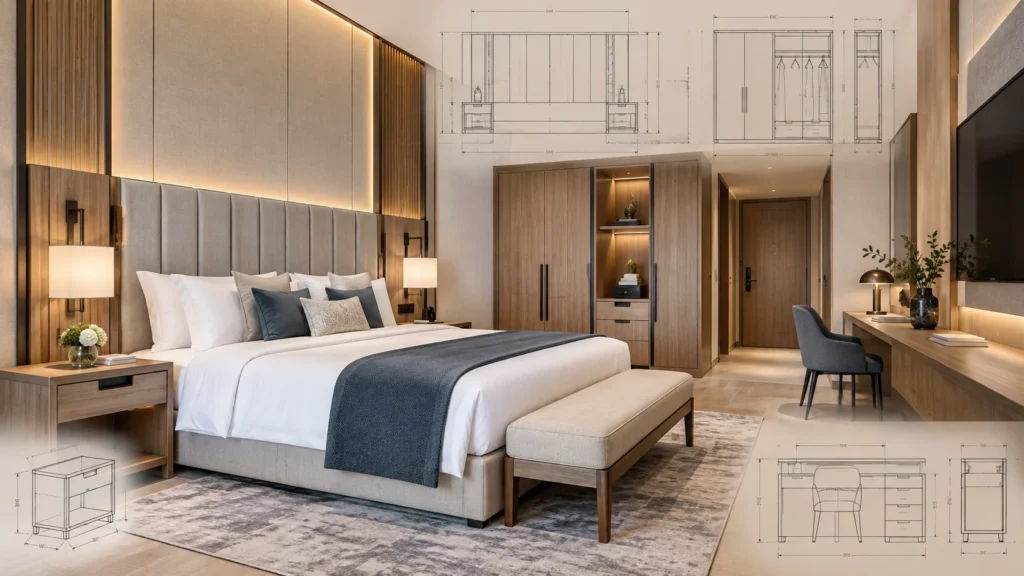
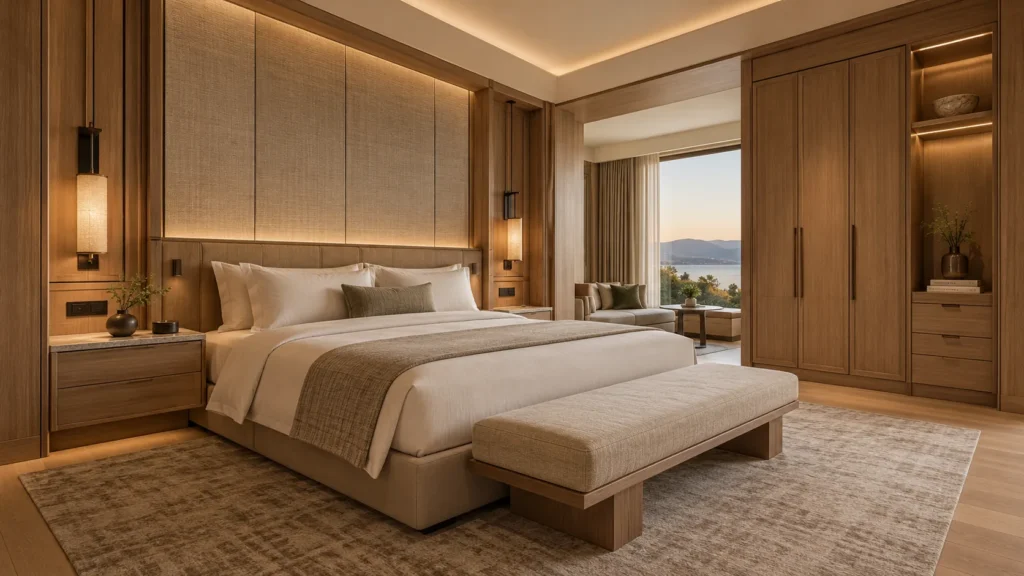
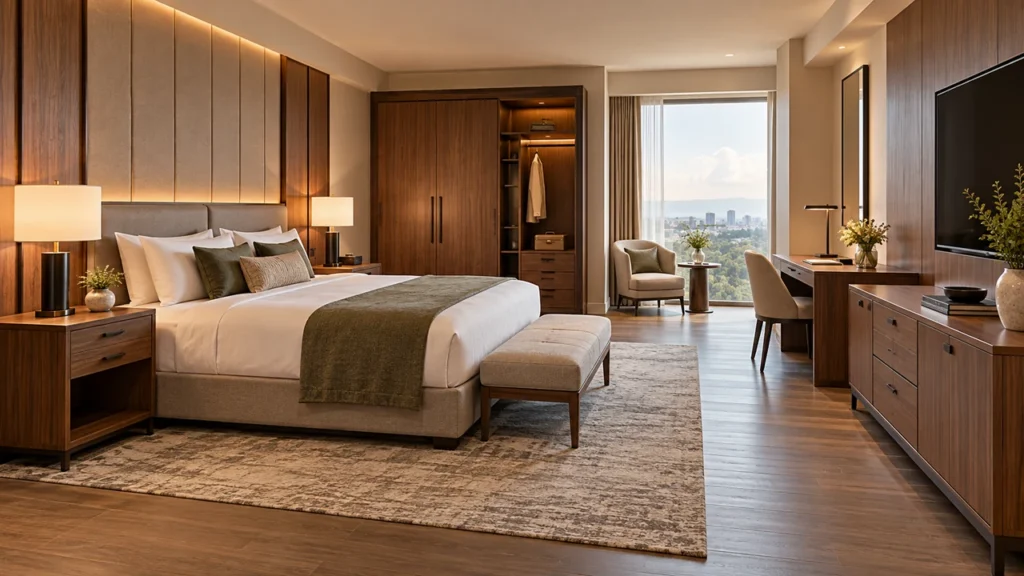
A hotel wardrobe may look like a simple cabinet, but the wardrobe materials and finishes behind it affect almost everything. Will the surface scratch easily? Will the shelves stay stable? Will the finish stay consistent across 300 rooms? Can housekeeping clean it quickly?
That’s why choosing the right wardrobe material matters in hotel projects. For custom hotel wardrobes, material planning should start before shop drawings and sample approval. It’s not only about what looks good on day one. It’s about what still works after years of guest use, luggage impact, door movement, humidity, and daily cleaning.
Wardrobe finishes matter just as much. A finish creates the first visual impression. It can make a guest room feel clean, warm, modern, natural, or premium. But the wrong finish can also make maintenance harder.
In this guide, we’ll look at common hotel wardrobe materials and wardrobe finishes, including laminate, veneer, MDF, plywood, melamine, lacquer, edge banding, and more. We’ll also explain where each material works best in real hotel wardrobe manufacturing.
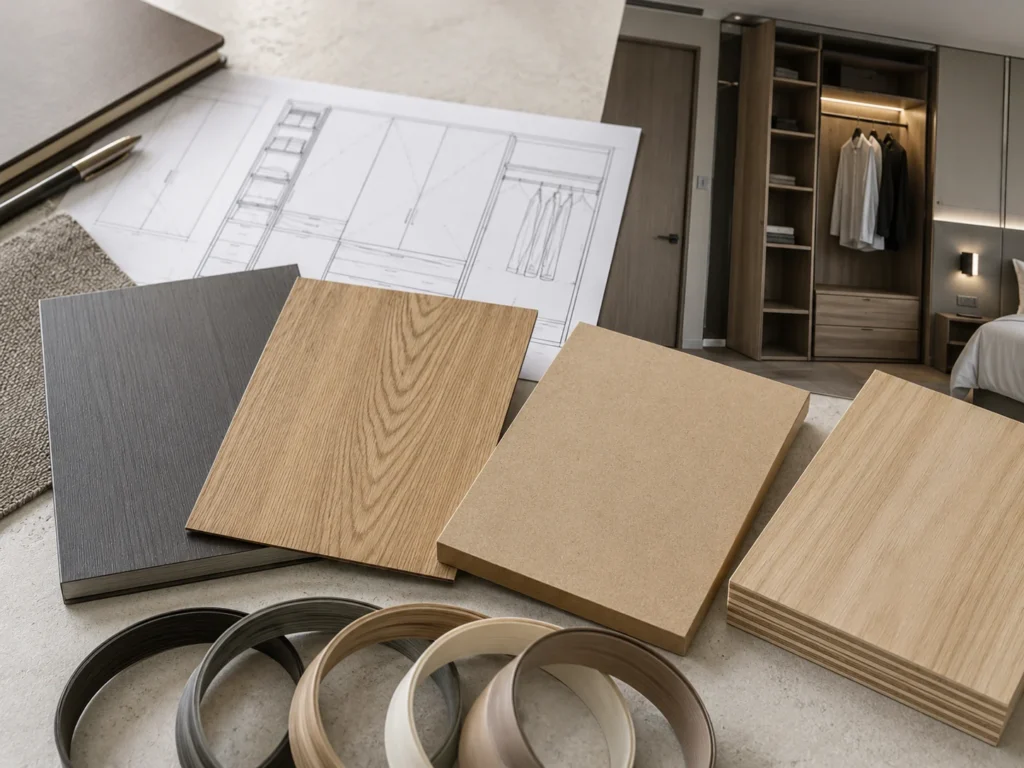
Why Wardrobe Material Matters in Hotel Projects
Hotel wardrobe materials live a harder life than residential wardrobe materials. A home wardrobe may serve one family for years, while a hotel wardrobe serves many different guests every week.
Doors open and close often. Luggage hits shelves. Hangers scratch panels. Housekeeping wipes surfaces again and again. So wardrobe material selection affects more than appearance, and wardrobe finishes affect more than style. Together, they affect durability, cleaning, maintenance, replacement cost, and guest perception.
A poor material choice can create small problems fast. Edges may peel, shelves may sag, drawer fronts may chip, door panels may warp, and finishes may look inconsistent from one room to another.
These issues may seem small in one room. But in a hotel project with hundreds of rooms, small problems become expensive. Good material planning helps protect the project and keeps hotel owners, designers, procurement teams, and manufacturers aligned before production starts.
First, Understand Substrate vs Finish

Before comparing laminate, veneer, MDF, and plywood, it helps to separate two ideas: wardrobe materials and wardrobe finishes.
A hotel wardrobe is usually not made from one single wardrobe material. It’s more like a layered system. One part gives the wardrobe strength. Another part creates the visible look and feel.
A typical hotel wardrobe may include:
- A substrate
- A surface finish
- Edge banding
- Hardware
- Installation details
Each part has a different job. The substrate supports the structure. The wardrobe finishes create the style. Edge banding protects exposed edges. Hardware keeps the wardrobe working every day.
What Is a Wardrobe Substrate?
The substrate is the structural board under the visible surface. Guests may not see it, but it decides how strong, stable, and durable the wardrobe feels.
Common substrates include MDF, plywood, particleboard, and other engineered wood panels. The substrate affects strength, weight, screw holding, stability, and moisture performance.
Think of it like the bones of the wardrobe. If the bones are weak, the beautiful surface will not save the product.
What Are Wardrobe Finishes?
Wardrobe finishes are the visible surfaces that define the look, touch, and maintenance level of a hotel wardrobe. They create the first impression when guests enter the room or open the wardrobe.
Common wardrobe finishes include laminate, veneer, melamine, lacquer, mirror, glass, and metal trims. The finish affects appearance, cleaning, scratch resistance, brand feel, and maintenance.
Think of the finish as the clothing of the wardrobe. It creates the style, but it still needs the right structure underneath.
Why This Difference Matters
Laminate and veneer are often applied over MDF, plywood, or particleboard. MDF and plywood are usually substrates, not final decorative surfaces by themselves.
That means the best wardrobe material choice is often a combination. For example, a hotel may choose plywood for a strong luggage shelf, MDF for a lacquered door panel, melamine for internal panels, and veneer for premium visible surfaces.
This is where good hotel wardrobe specification begins. The project team should choose the right substrate, the right finish, and the right detail for each wardrobe part. If you need to plan the full wardrobe system, including layouts, dimensions, door types, and manufacturing details, see our Hotel Wardrobe Design Guide for Guest Rooms.
Laminate for Hotel Wardrobes

Among common hotel wardrobe finishes, laminate is often chosen for durability, easy cleaning, and cost control. It can imitate wood grain, stone, fabric, or solid colors, giving designers many options while keeping costs under control.
For many economy, midscale, and business hotels, laminate is a smart choice. It works well in high-traffic rooms where surfaces need to be durable, easy to clean, and consistent across many rooms.
Laminate can be used for wardrobe doors, exterior panels, interior panels, shelves, luggage platforms, and furniture walls. The final performance still depends on the substrate, edge banding, and hardware behind it.
Advantages of Laminate Wardrobe Finishes
Laminate is popular because it solves many hotel project problems at once. It offers good scratch resistance, easy cleaning, wide color options, and better cost control than many premium finishes.
It also helps keep the wardrobe finish stable from room to room. That matters in large hotel projects where the same material may be repeated across dozens or hundreds of guest rooms.
Limitations of Laminate
Laminate is practical, but it’s not perfect. Low-quality laminate can look flat or cheap. Poor edge banding can reduce durability. If the laminate pattern doesn’t match the hotel brand, the room may feel less refined.
Laminate may also feel less natural than veneer. That matters in luxury hotels, resorts, or boutique rooms where warmth and material depth are important.
The key is specification. A good laminate wardrobe should use the right pattern, proper substrate, clean edges, and durable hardware.
Best Uses for Laminate
Laminate works best in hotel wardrobe parts that need durability, easy cleaning, and cost control, such as:
- Budget and midscale hotel wardrobes
- Business hotel guest rooms
- Interior panels and open shelves
- Luggage shelves and high-use surfaces
- Wardrobe and TV cabinet combinations
If the project needs a practical wardrobe finish for many rooms, laminate should be on the shortlist.
Veneer for Hotel Wardrobes

Veneer is one of the most popular wardrobe finishes for hotels that need a warmer and more natural wood appearance. It is often used in upscale hotels, resorts, villas, boutique hotels, and luxury suites.
It can make a guest room feel more refined without using solid wood for every panel. A veneer wardrobe can also connect beautifully with wall panels, headboards, bedside tables, and TV cabinets, creating a more coordinated and premium guest room look.
Advantages of Veneer Wardrobe Finishes
Veneer is valued for its real wood texture, warm visual depth, and premium brand perception. It helps a wardrobe feel softer and more natural than many synthetic finishes.
For resort rooms and luxury suites, veneer can create a calm and upscale atmosphere. It works especially well when the hotel wants the wardrobe to feel connected with the rest of the guest room furniture.
Limitations of Veneer
Veneer needs more careful control than many other wardrobe finishes. Color and grain can vary. That variation can be beautiful, but it must be managed across many rooms.
If veneer batches are not controlled, one room may look different from another. Poor surface protection can also make veneer more sensitive to scratches, moisture, and cleaning chemicals.
Cost is another factor. Veneer usually costs more than laminate and requires stronger sample approval, finishing control, and quality inspection.
Best Uses for Veneer
Veneer works best in hotel wardrobe parts that need warmth, natural texture, and a premium look, such as:
- Luxury hotel wardrobes
- Resort and villa wardrobes
- Boutique guest rooms
- Exterior wardrobe door panels
- Wall panel integrated wardrobes
- Premium drawer fronts and visible surfaces
Use veneer when the hotel brand needs a warmer, more natural, and more refined room experience.
MDF for Hotel Wardrobes
MDF is a common engineered wood substrate used behind many hotel wardrobe finishes. It has a smooth and consistent surface, which makes it useful for painted, lacquered, or routed wardrobe panels.
In hotel wardrobes, MDF is often used for doors, drawer fronts, and decorative panels that need a clean modern finish. It is not usually selected because it looks beautiful by itself. It is selected because it supports certain wardrobe finishes well.
Advantages of MDF
MDF is useful when a hotel wardrobe needs a smooth surface and consistent machining. It can support lacquer, paint, routed details, and clean flat panels without strong natural grain.
It also helps control cost in many hotel furniture projects. For boutique hotels or modern business hotels, MDF can work well when the design needs smooth panels or painted finishes.
Limitations of MDF
MDF also has limits. It can be heavy, and raw edges need proper sealing. It is not the best choice for wet or high-moisture areas unless specified correctly.
It may also be less suitable for heavy-load shelves, luggage platforms, or places that need strong screw holding. This does not mean MDF is bad. It means MDF should be used in the right place.
Best Uses for MDF
MDF works best in hotel wardrobe parts that need smooth surfaces and decorative finishes, such as:
- Lacquered wardrobe doors
- Painted panels and drawer fronts
- Routed or shaped decorative panels
- Smooth modern wardrobe surfaces
- Dry interior applications with proper sealing
Use MDF when a smooth finish matters more than heavy structural performance.
Plywood for Hotel Wardrobes
Plywood is another common engineered wood substrate used in hotel wardrobes. It is made with layers of thin wood bonded together, which gives it good strength and stability.
In hotel wardrobes, plywood is often useful where the cabinet needs stronger support. It can be a good choice for parts that carry weight, receive impact, or need better screw holding.
Advantages of Plywood
Plywood is often chosen for performance. It offers good structural strength, screw holding, and stability in demanding areas.
It can provide stronger support for shelves, luggage platforms, cabinet structures, and reinforced compartments. A luggage shelf is a good example. Suitcases can be heavy, and guests may place them down quickly, so the shelf needs to feel solid. For more planning details about hanging space, shelves, and luggage storage, see our Hotel Wardrobe Interior Design Guide.
When specified correctly, plywood can also perform well in some humid or demanding hotel locations. This makes it useful for resorts, serviced apartments, and long-stay rooms where durability matters.
Limitations of Plywood
Plywood usually costs more than MDF or particleboard. Surface quality also depends on grade, so some plywood needs laminate, veneer, lacquer, or edge treatment to look polished.
It is not always necessary for every wardrobe part. Using plywood everywhere may increase cost without improving the guest experience.
Best Uses for Plywood
Plywood works best in hotel wardrobe parts that need strength, support, and long-term stability, such as:
- Strong shelves and cabinet structures
- Built-in luggage platforms
- Reinforced safe box compartments
- Resort or humid-area wardrobes
- Long-stay wardrobe interiors
Use plywood where structural performance matters more than a perfectly smooth decorative surface.
Other Common Wardrobe Materials and Finishes
Laminate, veneer, MDF, and plywood are the main wardrobe materials and wardrobe finishes discussed in this guide. But hotel wardrobe production may also use other wardrobe finishes, surface details, and support materials.
These options usually play a supporting role. They can improve appearance, reduce cost, protect edges, or help the wardrobe match the hotel brand.
Melamine
Best use:
Internal panels, shelves, and cabinet interiors.
Note:
Practical, cost-effective, and easy to clean. Better for interiors than premium visible surfaces.
Particleboard
Best use:
Cost-sensitive wardrobe parts.
Note:
Should be laminated or finished well, with strong edge banding. Avoid high-moisture or high-load areas unless properly specified.
Lacquer
Best use:
Smooth door panels, drawer fronts, boutique rooms, and luxury rooms.
Note:
Works well over MDF, but needs good finishing and maintenance planning.
Mirror and Glass
Best use:
Door inserts, accent panels, and compact hotel rooms.
Note:
Can make rooms feel brighter and larger. Use safety backing, proper hardware, and careful installation details.
Metal Trims and Handles
Best use:
Handles, rails, trims, boutique details, and luxury accents.
Note:
Adds a modern or premium touch, but should be durable enough for daily hotel use.
Edge Banding
Best use:
Exposed panel edges on laminate, melamine, MDF, and particleboard.
Note:
Protects edges and improves visual quality. Poor edge banding can make furniture fail early.
These details may look small, but they affect how the wardrobe feels, wears, and survives daily hotel use.
Laminate vs Veneer: Which Wardrobe Finish Is Better?
There is no single winner. Laminate is usually better for durability, cleaning, and cost control. Veneer is better when the project needs natural warmth and a premium guest experience.
| Factor | Laminate | Veneer |
|---|---|---|
| Appearance | Clean, consistent, many patterns | Natural, warm, premium |
| Cost | More budget-friendly | Usually higher |
| Durability | Good for high-traffic use | Depends on finish protection |
| Maintenance | Easy to clean | Needs more care |
| Best for | Budget, business, midscale hotels | Resorts, upscale rooms, luxury suites |
| Consistency | Easier to keep consistent across many rooms | Needs grain and color control |
For a business hotel, laminate may be the better choice. For a resort suite, veneer may create the right feeling.
The best wardrobe finishes should match the hotel’s brand, maintenance level, and project budget. That is why wardrobe finishes should be selected by hotel type, not just by appearance.
MDF vs Plywood: Which Wardrobe Substrate Is Better?

MDF and plywood are not a simple good-or-bad choice. MDF works well when a smooth decorative surface matters. Plywood works better when strength, screw holding, or structural support matters.
| Factor | MDF | Plywood |
|---|---|---|
| Surface | Very smooth | Depends on grade |
| Strength | Good for many panels | Stronger for structural use |
| Weight | Can be heavy | Often strong for its weight |
| Moisture performance | Needs careful specification | Often better when specified correctly |
| Best for | Lacquered doors, decorative panels | Shelves, luggage platforms, cabinet structures |
| Cost | Often lower | Often higher |
In many hotel wardrobes, both materials can be used together. For example, MDF may be used for lacquered door panels, while plywood may be used for shelves and luggage platforms.
That combination can be more practical than choosing one wardrobe material for every part of the hotel wardrobe.
Best Wardrobe Materials and Finishes by Hotel Type
Different hotels need different wardrobe material and finish choices. A budget hotel does not need the same wardrobe finishes as a luxury suite. A coastal resort may need different material thinking than an urban business hotel.
| Hotel Type | Recommended Wardrobe Materials and Finishes |
|---|---|
| Budget hotel | Laminate, melamine, cost-effective MDF or particleboard substrate |
| Business hotel | Durable laminate, MDF or plywood based on use |
| Boutique hotel | Lacquered MDF, veneer, metal trims, mixed finishes |
| Resort hotel | Veneer, textured laminate, moisture-aware plywood |
| Serviced apartment | Durable laminate, stronger shelves, plywood where needed |
| Luxury suite | Veneer, lacquer, premium hardware, controlled finish samples |
The best wardrobe material depends on hotel positioning, guest traffic, stay length, humidity, maintenance level, and budget.
Start with the hotel type. Then choose the material and finish by wardrobe part, especially when planning complete hotel room furniture packages.
Where Each Material Works Best in a Hotel Wardrobe
This is where wardrobe materials and wardrobe finishes become practical. A hotel wardrobe has many parts, and each part may need a different substrate, finish, or edge detail.
| Wardrobe Part | Recommended Options | Why It Works |
|---|---|---|
| Exterior door panels | Laminate, veneer, lacquered MDF | Controls appearance and brand feel |
| Interior panels | Melamine, laminate | Easy to clean and cost-effective |
| Hanging section | Laminate or melamine panels with strong rail support | Handles daily use |
| Open shelves | Plywood, MDF, melamine board | Depends on load, finish, and budget |
| Luggage shelf | Plywood or reinforced substrate | Needs impact and load resistance |
| Drawer fronts | Laminate, veneer, lacquered MDF | Creates a visible finish area |
| Drawer boxes | Plywood or durable board | Supports repeated use |
| Back panels | Thin MDF, plywood, or project-specified back panel | Controls structure and cost |
| Wardrobes in humid locations | Moisture-aware plywood or treated board | Supports better long-term performance |
This is why “best wardrobe material” is not one answer. It depends on where the material is used, how the wardrobe works, and what the hotel expects from the room.
Compliance, Emissions, and Sustainability Considerations
For hotel projects, wardrobe material selection may also involve compliance, emissions, and documentation. These details are especially important when composite wood products are used in guest room furniture.
For U.S. projects, composite wood products may need TSCA Title VI review when applicable. This can include hardwood plywood, MDF, particleboard, and finished goods that contain these products.
If responsible wood sourcing is part of the project standard, FSC-certified materials may also be considered. For indoor air quality goals, UL GREENGUARD-certified products may support low-emission material selection.
Project teams should confirm local requirements, hotel brand standards, and material documentation before production. This helps avoid approval delays and keeps the wardrobe specification clear.
Manufacturing Tips Before Final Material Selection
Wardrobe materials and finishes may look good in a small sample. But will they still look good in a real guest room, under real lighting, and across many rooms?
Before final selection, the project team should review:
- Material samples
- Finish samples
- Substrate thickness
- Edge banding details
- Hardware grade
- Color, grain, and batch consistency
- Shop drawings
- Cleaning requirements
- Packaging protection
- Mock-up room performance
Material and finish decisions should also be coordinated with panel thickness, internal clear space, equipment compartments, and installation tolerances. See our hotel wardrobe dimensions guide for the related dimensional and shop drawing checks.
Finish samples should be checked under project lighting. A surface may look warm in a showroom but too dark inside a hotel room. Edge banding should also be reviewed early because it affects both durability and appearance.
A mock-up room is useful before bulk production. It lets the team test the wardrobe material, wardrobe finishes, hardware, and cleaning performance before the same decision is repeated across many rooms.
Good manufacturing planning reduces rework. It also helps keep the final wardrobe consistent across the hotel.
Hotel Wardrobe Material Selection Checklist
Use this wardrobe materials and finishes checklist before material approval and bulk production:
- Hotel type confirmed
- Guest profile reviewed
- Room humidity considered
- Wardrobe substrate selected
- Wardrobe finishes selected
- Laminate or veneer confirmed
- MDF or plywood application confirmed
- Edge banding details confirmed
- Hardware grade confirmed
- Finish samples approved
- Material documentation reviewed
- TSCA Title VI reviewed, if required
- FSC or UL GREENGUARD documentation reviewed, if required
- Mock-up room checked
- Bulk production standard confirmed
A checklist may look simple, but it helps prevent costly material mistakes before production begins.
Conclusion
The best wardrobe material is not always the most expensive one, and the best wardrobe finishes are not always the most decorative. Laminate works well for practical durability and cost control, while veneer adds natural warmth and a premium feeling. MDF supports smooth decorative finishes, and plywood provides strength for shelves, structures, and luggage platforms.
Wardrobe finishes should match both the hotel brand and the maintenance reality. A finish that looks beautiful but fails quickly is not a good project choice.
For hotel wardrobes, the best result usually comes from the right combination of substrate, finish, edge detail, hardware, and manufacturing control.
If you’re planning a hotel guest room project, contact Volant to discuss custom hotel wardrobes, material samples, wardrobe finishes, room-type requirements, and complete hotel room furniture packages.