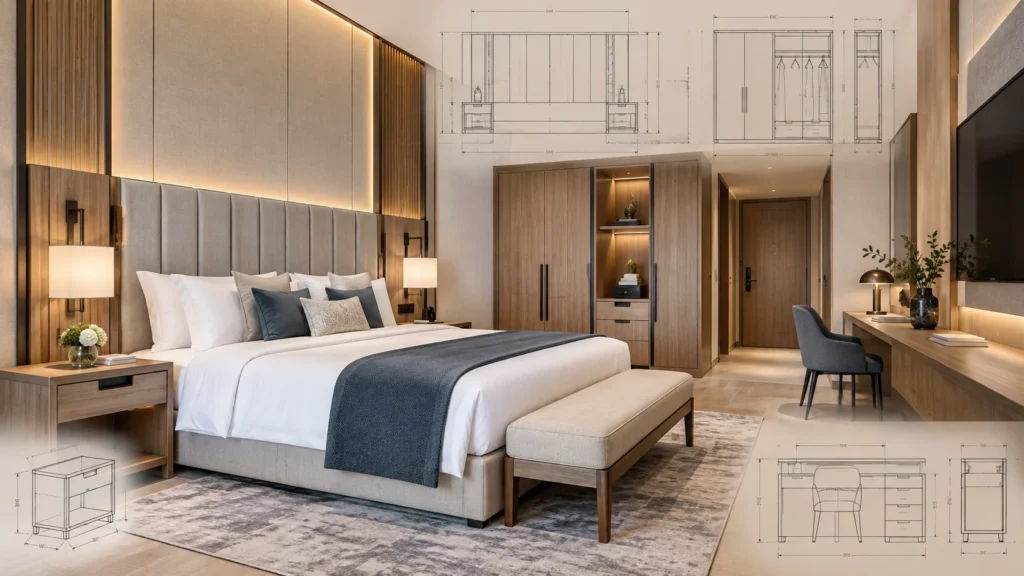
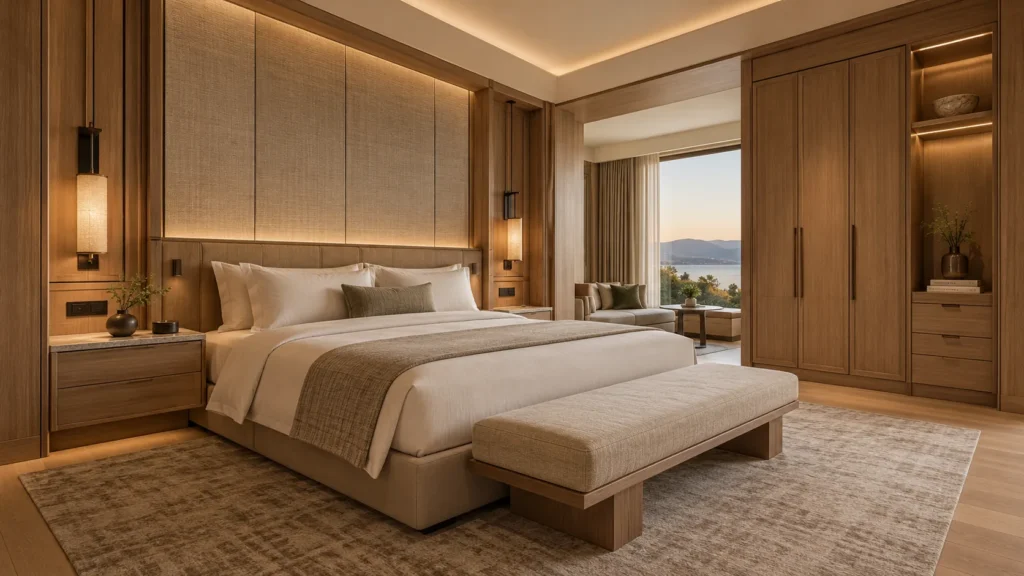
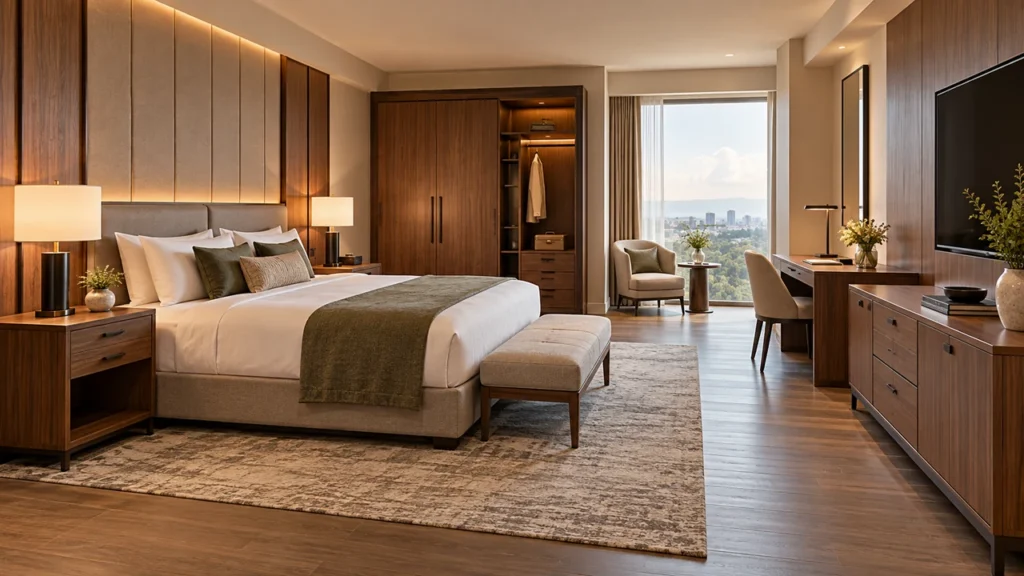
Hotel wardrobe interior design may look simple from the outside, but the real test begins when a guest opens the door. Good wardrobe interior design should make every storage zone feel clear, useful, and easy to reach.
Can guests hang a jacket without squeezing it? Is there a shelf for folded clothes? Is there a clear place for luggage? Can housekeeping check and clean the space quickly?
That’s why wardrobe interior design matters in hotel guest rooms. The inside of the wardrobe shapes how guests unpack, store valuables, use amenities, and move through the room.
A beautiful wardrobe with a poor interior layout is like a nice suitcase with no compartments. It looks good, but it doesn’t work well.
This wardrobe interior design guide focuses on the inside of hotel wardrobes. We’ll look at hanging space, shelves, luggage storage, drawers, safe boxes, minibar space, lighting, and layout planning for different hotel types.

Why Hotel Wardrobe Interior Design Matters
Good hotel wardrobe interior design is not about adding more compartments. It’s about making every storage zone clear, reachable, and useful.
Guests don’t want to think too hard after check-in. They want to hang clothes, open luggage, place valuables, and find daily items without guessing.
A smart wardrobe interior design also helps the hotel team. Housekeeping can inspect shelves faster. Maintenance can access hardware more easily. Procurement teams can control cost by choosing the right features for each room type.
For hotel developers and designers, the wardrobe interior also affects room flow. If luggage has no proper place, guests may put suitcases on the bed, desk, or floor. That creates clutter and makes the room harder to use.
So the goal is simple: make storage obvious.
What Should Be Inside a Hotel Wardrobe?

Most hotel wardrobes work best when the interior is divided into a few clear zones. The exact mix depends on the hotel type, room size, guest profile, and length of stay.
A practical hotel wardrobe interior usually starts with three core zones:
- Hanging space for shirts, jackets, dresses, and robes
- Open shelves for folded clothes, bags, pillows, or amenities
- Luggage storage for suitcases and travel bags
Depending on the room type and service level, it may also include:
- Drawers, if guests need longer-stay storage
- Safe box space, if required by the hotel brand
- Minibar space, if required by the room concept
- Mirror
- LED lighting
- Hooks or small accessory storage
For a broader overview of layouts, dimensions, materials, and door types, see our Hotel Wardrobe Design Guide for Guest Rooms.
The best wardrobe interior design starts with guest behavior, not just cabinet size.
Hanging Space: How Much Does a Hotel Wardrobe Need?

Hanging space is one of the most important parts of hotel wardrobe interior design. Business guests may need it for shirts, jackets, suits, and dresses. Resort guests may use it for robes, light clothing, or travel outfits.
The hanging rail should be easy to reach. It should also have enough depth for clothes to hang naturally. If the wardrobe is too shallow, hangers sit at an angle, clothes get squeezed, and guests notice the problem quickly.
For many hotel projects, wardrobe depth needs to allow standard hangers. Still, final dimensions should always follow the room layout, brand standard, and site condition. For practical reference ranges covering wardrobe depth, hanging height, shelf depth, luggage platform height, and internal clear space, see our guide to hotel wardrobe dimensions.
The hanging area should also match the room type. A compact hotel room may only need a short hanging zone. A serviced apartment or suite may need a wider section for longer stays.
Here’s the simple rule: don’t design hanging space only by available wall width. Design it around what guests actually bring.
Open Shelves: Simple Storage Guests Can See

Open shelves are useful because they’re easy to see, easy to reach, and easy to clean. Guests can use them for folded clothes, bags, shoes, pillows, robes, or amenities, while housekeeping teams can inspect them quickly between stays.
In many hotel rooms, open shelves are more practical than drawers. They have fewer moving parts, require less maintenance, and help guests find items faster. For economy and midscale hotels, simple shelves can reduce cost and maintenance. For resorts and serviced apartments, larger shelves may support bags, folded clothes, robes, and longer stays.
But shelf planning still matters. If a shelf is too deep, items get pushed to the back. If it’s too high, guests may not use it. If there are too many small shelves, the wardrobe can feel busy.
A good shelf layout should feel calm and clear. Each shelf should have a job. In good wardrobe interior design, shelves should not just fill space. They should make storage easier to see and easier to use.
Luggage Storage: The Feature Hotels Should Not Ignore

Luggage storage is often the most overlooked part of wardrobe interior design. Guests always need a place to open a suitcase. If the room doesn’t provide one, they’ll create their own solution, usually on the bed, desk, chair, or floor. None of these options is ideal.
A built-in luggage shelf keeps suitcases off the bed and floor. It also makes the room feel more organized. In compact rooms, the luggage shelf can be integrated into the wardrobe base. In larger rooms, it can connect with a luggage bench beside the wardrobe. This makes luggage storage part of the wider guest room furniture plan, not just a small wardrobe detail.
The key is not only where the suitcase sits. It’s also what happens when the suitcase opens. Does it block the walkway? Does it hit the wardrobe door? Does it make the entry area feel tight?
This is where hotel wardrobe layout and room flow meet. A luggage shelf should support the suitcase without hurting movement. It should feel like part of the room, not an afterthought.
For resort rooms, luggage storage may need to be larger because guests often bring bigger bags and more casual items. For business hotels, a compact shelf may be enough if it’s easy to access. Luggage storage is a small feature with a big effect.
Drawers, Safe Boxes, and Minibar Space
Drawers, safe boxes, and minibar space can improve wardrobe function, but they’re not always required. They should be added based on the hotel type, room size, guest profile, and service model.
Drawers can make a wardrobe feel more comfortable, especially in serviced apartments, extended-stay rooms, and suites. Guests may unpack fully and need divided storage. For short-stay hotels, open shelves may be easier to clean and maintain.
If drawers are included, the hardware should be strong and smooth. Drawer runners, handles, and internal finishes should be specified for frequent hotel use.
Safe box space also needs early planning. The safe should be visible, supported by the cabinet structure, and comfortable to reach. If it’s too low, too high, or hidden too deeply, guests may avoid using it.
Minibar space requires careful coordination. A minibar is not just another shelf. It may need power, ventilation, heat management, and service access.
If these details are added too late, the wardrobe interior may look neat but work poorly.
Open, Closed, and Hybrid Wardrobe Interior Designs
Open, closed, and hybrid wardrobe interior design choices all have value. The right choice depends on room size, hotel brand, guest profile, and how much visual order the hotel wants to maintain.
Open Interior
Open interiors feel lighter and make items easier to see. They work well in boutique hotels, lifestyle hotels, compact rooms, and resort rooms where a relaxed look feels natural.
Best for:
Boutique hotels, lifestyle hotels, compact rooms, and resort rooms.
Main benefit:
Feels lighter and makes clothing, luggage, and shelves easier to see.
Closed Interior
Closed interiors hide visual clutter and make the room look quieter. They’re often better for business hotels, upscale rooms, and projects that want a cleaner, more controlled guest room appearance.
Best for:
Business hotels, upscale rooms, and rooms that need a cleaner look.
Main benefit:
Hides visual clutter and creates a quieter, more controlled room appearance.
Hybrid Interior
Many hotel projects use a hybrid wardrobe layout, such as an open luggage shelf, an open hanging rail, and a closed upper cabinet. This keeps daily-use items visible while hiding extra storage.
Best for:
Most hotel projects with mixed storage needs and different guest profiles.
Main benefit:
Keeps daily-use items visible while hiding extra storage and amenities.
The best choice is not always fully open or fully closed. It’s the one that fits the room, the brand, and the way guests actually use the space.
Hotel Wardrobe Interior Layout by Hotel Type
Different hotels need different wardrobe interior design solutions. A budget hotel, a business hotel, a resort room, and a serviced apartment do not serve guests in the same way. So their wardrobes should not use the same storage logic.
A budget hotel should keep the layout simple, durable, and easy to clean. A business hotel should make hanging space, safe storage, and luggage access easy. A resort room may need larger shelves for bags, robes, and casual clothing. A serviced apartment should support longer stays with more drawers, shelves, and hanging space.
| Hotel Type | Interior Layout Priority |
|---|---|
| Budget hotel | Hanging rail, simple shelves, luggage platform |
| Business hotel | Hanging rail, safe box, mirror, luggage shelf |
| Boutique hotel | Open shelves, visible rail, luggage base |
| Resort hotel | Larger shelves, robe space, luggage storage |
| Serviced apartment | Drawers, more shelves, larger hanging zone |
| Luxury suite | LED lighting, drawers, premium shelves, luggage area |
This table is not a fixed rule. It’s a planning guide. Every project still needs room-by-room review. A king room, twin room, suite, accessible room, and serviced apartment may all need different storage details.
For accessible rooms or U.S. hotel projects, reach range, clear floor space, and operable parts should be reviewed against applicable accessibility standards.

Small Hotel Room Wardrobe Interior Ideas
Small hotel rooms need smart storage more than large rooms do. In compact rooms, wardrobe interior design should work like a compact toolkit. Every rail, shelf, and platform needs a clear job.
Open shelves can reduce visual bulk, while sliding doors or open interiors can reduce door clearance issues. A built-in luggage platform can also save guests from using the bed or floor.
Light internal finishes can help too. Deep, dark wardrobes can feel smaller and harder to use, especially when the cabinet is enclosed. LED lighting may improve visibility when the wardrobe is deep or placed near a darker entry area.
Avoid overcomplicating small wardrobes. Too many drawers, doors, and hidden corners can make the room feel tight. Simple usually works better.
Common Hotel Wardrobe Interior Design Mistakes
Most wardrobe interior design problems are easy to avoid. They usually happen when the layout looks fine in a drawing but ignores how guests and housekeeping teams use the room.
1. Forgetting Luggage Storage
This is one of the most common mistakes. Guests need a clear place for suitcases. Without it, the room becomes messy fast, and luggage often ends up on the bed, desk, chair, or floor.
2. Making the Hanging Area Too Shallow
Hangers should not sit at an angle. Clothes should hang naturally. If the wardrobe is too shallow, guests notice the problem as soon as they try to hang a jacket or dress.
3. Designing Shelves That Are Too Deep or Too High
Shelves can also cause problems. If they’re too deep, guests can’t see items at the back. If they’re too high, they may not be useful.
A good shelf layout should be visible, reachable, and easy to clean.
4. Adding Too Many Drawers in Short-Stay Rooms
Too many drawers can be a problem in short-stay rooms. Drawers add cost, hardware, and maintenance. Use them where guests truly need divided storage, such as serviced apartments or extended-stay rooms.
5. Adding Safe Boxes or Minibars Too Late
Safe boxes and minibars should never be added as late details. They need dimensions, cabinet support, ventilation, power, and service access planning.
If they’re added too late, the wardrobe interior may look neat but work poorly.
6. Making the Interior Too Dark
Dark interiors are another common problem. Guests should be able to see inside the wardrobe easily, especially in deep cabinets or rooms with limited entry lighting.
Light internal finishes or LED lighting can make the interior easier to use.
A good wardrobe interior should feel simple, visible, and easy to use.
Customizing Hotel Wardrobe Interiors for Manufacturing
A good wardrobe interior design should not only work in a drawing. It should be coordinated with hotel fit-out manufacturing so it is buildable, repeatable, and easy to install across many rooms.
For hotel projects, the wardrobe interior layout should be confirmed by room type. The project team should review the room type schedule, hanging rail strength, shelf thickness, drawer runners, safe box size, minibar ventilation, LED wiring, finish samples, and material documentation when required. For projects using composite wood products, TSCA Title VI requirements should also be reviewed.
Shop drawings should show the internal layout clearly. They should also show hardware locations, electrical needs, door movement, wall connections, and service access.
A hotel mock-up room is useful before bulk production. It lets the team test storage zones, reach height, luggage access, lighting, and guest usability before the same detail is repeated across many rooms.
This process helps reduce rework. It also keeps the wardrobe interior consistent across the full project.
At Volant, custom hotel wardrobes are not only about appearance. They’re about turning guest room storage into a practical, durable, and production-ready furniture system.
Hotel Wardrobe Interior Design Checklist
Use this wardrobe interior design checklist before final approval and production:
- Hanging rail included
- Hanging rail height confirmed
- Wardrobe depth checked for hangers
- Shelf layout confirmed
- Luggage storage included
- Drawer quantity confirmed by room type
- Safe box location confirmed, if required
- Minibar space planned, if required
- LED lighting considered, if required
- Interior finish selected
- Hardware selected
- Housekeeping access reviewed
- Room type differences confirmed
- Shop drawings approved
- Mock-up checked before production
A checklist may look simple, but it protects the project. It helps prevent small storage problems from becoming expensive site issues.
Conclusion
Hotel wardrobe interior design should make storage clear and easy. Hanging space, shelves, and luggage storage are the core zones. Drawers, safe boxes, minibar space, mirrors, and LED lighting can improve the experience when planned correctly.
A good wardrobe interior supports guests, housekeeping, maintenance, and production. It doesn’t need to be complicated. It just needs to make sense.
If you’re planning a hotel guest room project, contact Volant to discuss custom hotel wardrobes, wardrobe interior layouts, room-type requirements, and complete hotel room furniture packages.
FAQs
What should be inside a hotel wardrobe?
A practical hotel wardrobe should include hanging space, open shelves, and luggage storage. Depending on the room type, it may also include drawers, a safe box, minibar space, a mirror, hooks, or LED lighting.
How much hanging space does a hotel wardrobe need?
The amount of hanging space depends on the hotel type, room size, and guest profile. Business hotels often need space for shirts, jackets, and suits. Resort rooms may need space for robes, dresses, and casual clothing.
Why is luggage storage important in hotel wardrobe interior design?
Guests need a clear place to open and store a suitcase. A built-in luggage shelf keeps luggage off the bed, desk, chair, and floor. It also helps the room feel cleaner and easier to use.
Are drawers necessary in hotel wardrobes?
Not always. Drawers are useful for serviced apartments, extended-stay rooms, and suites. For short-stay hotel rooms, open shelves are often easier to clean, inspect, and maintain.
What is the best wardrobe interior layout for small hotel rooms?
Small hotel rooms usually work best with simple storage zones. A compact layout may include a short hanging rail, open shelves, and a built-in luggage platform. Avoid too many drawers, doors, or hidden compartments.