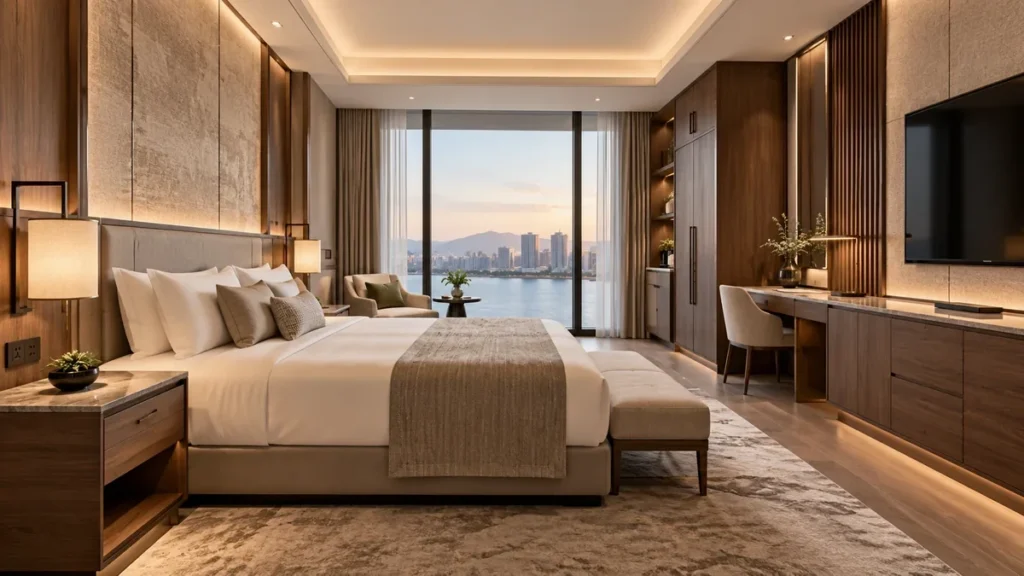
A great hotel headboard does more than just sit behind a bed. It sets the mood, protects the wall, adds comfort for guests, and brings useful functions into one place. In modern hotel rooms, the headboard wall often works like a small control center. It can include lighting, power outlets, USB ports, acoustic panels, wall finishes, and brand details.
So, what makes an effective headboard wall design? It should not only look good in photos. It also needs to be durable, easy to clean, safe to use, and simple to repair.
Think of it as the dashboard of a hotel room:
- Guests use it every day.
- Housekeeping works around it every day.
- When repairs are needed, maintenance teams can access key parts easily.
In this guide, we will cover hotel headboard materials, lighting options, power and USB integration, installation details, and common design mistakes. You will also learn how to choose the right headboard wall design for different hotel types.
What Is a Hotel Headboard Wall
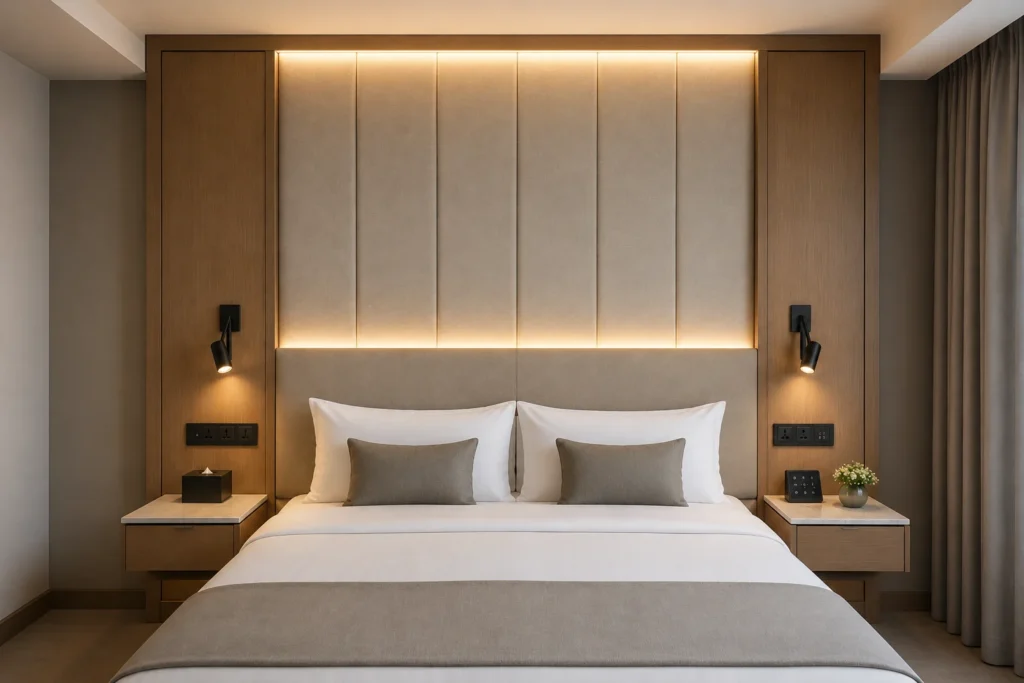
A hotel headboard wall is the designed wall area behind the bed. It may be a simple padded panel, or it may be a complete wall system with built-in lighting, power, storage, and decorative finishes.
A complete headboard wall may include:
- Upholstered headboard panels
- Wood, laminate, stone, or metal wall finishes
- Bedside reading lights
- LED backlighting
- Power outlets and USB charging ports
- Switches and control panels
- Acoustic materials
- Wall-mounted nightstands
- Decorative trims or brand details

A standard bed headboard is furniture. A headboard wall is more like architecture. It connects furniture, lighting, power, comfort, and guest experience into one design.
That’s why a hotel headboard should be planned early. It affects electrical layouts, wall framing, lighting positions, guest comfort, and long-term room maintenance.
Why Headboard Wall Design Matters
The bed is the center of most hotel rooms. So, the wall behind it has a big role to play.
A well-planned headboard wall design helps the room feel complete. It gives the bed area a clear visual anchor. Without it, the space can feel plain and unfinished.
It also improves daily comfort. Guests want to read, charge their phones, use a laptop, and turn off the lights without getting out of bed. A smart hotel headboard makes these small actions easier.
For hotel owners, the benefits go deeper. A durable headboard wall can reduce wall damage, keep cables out of sight, and lower repair time when panels are modular.
Accessibility also matters. In U.S. projects, controls should be placed within accessible reach ranges when required. The ADA Standards include reach-range rules for operable parts, including controls.
Good design is not just beautiful. It is useful, safe, and easy to live with.
Popular Hotel Headboard Wall Design Styles
There are many ways to design a hotel headboard wall. Some hotels prefer soft upholstered panels for comfort. Others use wood slats, laminate panels, stone finishes, or LED backlighting to create a more striking visual effect.
The right style depends on your hotel brand, room size, budget, and maintenance needs. A luxury hotel may choose leather, wood veneer, or stone. A business hotel may focus on durable panels, reading lights, and built-in outlets. A resort may use warm wood, woven textures, and soft lighting.
Instead of choosing a design only because it looks good, think about daily use. Is it easy to clean? Can damaged panels be replaced? Are lights and outlets easy to repair? A good headboard wall design should look beautiful and work well for years.
Want more hotel headboard wall design ideas? Read our 15 Hotel Headboard Wall Design Ideas for Modern Guest Rooms.
Best Materials for Hotel Headboard Walls

Choosing the right material is one of the most important parts of hotel headboard design. The material affects comfort, durability, cleaning, safety, and long-term maintenance.
Here’s a quick guide to help you compare common headboard wall materials.
| Material | Best For | Main Benefits | What to Watch |
|---|---|---|---|
| Upholstered fabric | Luxury and boutique rooms | Soft, comfortable, warm | Stains and cleaning |
| Faux leather | Business hotels | Easy to wipe, premium look | Cracking or peeling |
| Wood veneer | Lifestyle hotels | Natural and elegant | Cost and maintenance |
| Laminate / HPL | Chain hotels and renovations | Durable and cost-effective | Edge quality |
| Painted or laminated MDF | Custom designs | Flexible shapes and finishes | Moisture protection |
| Metal trim | Modern rooms | Clean decorative accents | Scratches and fingerprints |
| Stone / porcelain | Luxury suites | High visual impact | Weight and cost |
| Acoustic panels | Urban hotels | Better sound comfort | Fire rating and cleaning requirements |
Indoor air quality should not be ignored, especially in enclosed guest rooms. According to the EPA, indoor levels of several organic pollutants can average two to five times higher than outdoor levels. This makes low-emission materials a smart choice for hotel interiors.
How to Choose the Right Hotel Headboard Material
Choosing the right hotel headboard material starts with your hotel type, room style, and daily use.
- For luxury hotels, consider leather, wood veneer, stone, or custom upholstery.
- For business hotels, choose HPL, soft panels, and built-in charging features.
- For budget hotels, use simple laminate panels with strong edges.
Next, think about daily operations.
Ask these questions:
- Can housekeeping clean it quickly?
- Can one damaged panel be replaced?
- Will the surface resist stains and scratches?
- Does the material meet local fire rules?
- Can lights and outlets be repaired later?
Fire safety is also a key part of material selection. For example, NFPA 286 is used to evaluate how interior finish materials contribute to room fire growth under specific fire exposure conditions.
Always confirm local code requirements with your project team. Rules can vary by city, building type, and hotel brand.
Hotel Headboard Lighting Design

Lighting can make or break a hotel room.
Too little light feels flat. Too much light feels harsh. The right balance feels warm, calm, and useful. A good hotel headboard lighting plan should combine task lighting, ambient lighting, and easy bedside control.
Reading Lights
Reading lights should be easy to reach and simple to adjust. They should focus light on the book, not across the whole bed.
Business hotels, long-stay rooms, and guest rooms with work areas.
Use adjustable wall-mounted lights or recessed headboard lights for a clean look.
LED Backlighting
LED backlighting creates a soft hotel glow. It works behind panels, inside niches, or around a full-height headboard wall.
Modern hotels, boutique hotels, and premium rooms.
Use warm light, add diffusers, and keep LED drivers accessible for repairs.
Wall Sconces
Wall sconces add style and personality. They work well in boutique hotels, luxury rooms, and suites.
Boutique hotels, luxury rooms, and suites.
Match the size to the bed and room. A tiny sconce can look lost.
Dimmers and Controls
Dimmers make the room more flexible. Guests can move from work mode to sleep mode with one touch.
Business hotels, luxury hotels, and smart hotel rooms.
Keep controls clear and easy to use. Guests should understand them at a glance.
The WELL Building Standard connects lighting design with visual comfort, sleep quality, and circadian health. For professional hotel projects, lighting should also follow accepted lighting design practices. IES standards cover lighting principles, light sources, controls, commissioning, and maintenance.
Power Outlets, USB Ports, and Smart Features
A modern hotel headboard should support the way guests travel, work, and relax today.
Most guests arrive with phones, laptops, watches, earbuds, and other devices. One outlet behind the nightstand is no longer enough.
Useful features may include:
- Power outlets on both sides of the bed
- USB-A and USB-C charging ports
- Reading light switches
- Master light controls
- Curtain or shade controls
- Wireless charging
- Integrated room control panels
Keep the layout simple. Guests should not need a manual to turn off the lights.
Also, avoid blocking outlets with fixed furniture. In accessible rooms, power outlets, switches, and controls should stay easy to reach and use. The ADA Checklist for New Lodging Facilities also emphasizes that hotel facilities should be usable by guests with disabilities.
Smart features are helpful only when they feel simple. If a control panel confuses guests, it fails.
Hotel Headboard Wall Installation Details

A beautiful headboard wall design can still fail on site. Installation details protect the final result.
Measure the Room
Start with accurate measurements. Check wall width, ceiling height, bed centerline, and nightstand locations.
Also check existing outlets, switches, pipes, and HVAC elements before the headboard wall design moves forward.
Prepare Shop Drawings
Shop drawings are essential for hotel projects. They show panel sizes, seams, outlets, lights, and fixing points.
Do not skip the mockup. A sample room can catch problems before mass production.
Plan Electrical Rough-In
Coordinate power, USB, lighting, and low-voltage systems early.
Mark every outlet and switch. Confirm heights with the designer, contractor, and hotel brand.
Keep power and low-voltage wiring clearly separated and organized. This helps safety and future maintenance.
Build the Wall Substrate
The substrate must be flat and strong.
Light panels may need plywood backing. Heavy stone or porcelain may need metal framing. Soft panels may need a clean fixing system.
A poor substrate creates uneven seams. It can also make panels loosen over time.
Install Headboard Wall Panels
Install panels from a clear control line. Keep seams straight. Protect finished surfaces during work.
Common fixing methods include:
- French cleats
- Z-clips
- Hidden screws
- Modular brackets
- Adhesive plus mechanical fixing
For hotels, removable fixing is often better. It supports repairs without destroying the wall.
Install Lighting and Controls
Install lights after the main panels are secured. Test every fixture before closing access points.
Check brightness, glare, dimming, and switch logic. Then check again after final cleaning.
Final Inspection
Inspect the full headboard wall before handover.
Check:
- Panel alignment
- Open seams
- Scratches
- Loose edges
- Outlet function
- USB charging
- Light controls
- Driver access
- Cleaning condition
Take photos and record spare part details. Your future maintenance team will thank you.
Recommended Dimensions and Placement Tips
There is no single perfect size for every hotel headboard. Room size, bed type, ceiling height, and brand style all matter.
Still, a few practical guidelines can help:
Headboard Wall Width
A wider headboard wall can make the bed area feel more balanced and complete. Many hotels extend the wall treatment beyond the bed and nightstands.
Headboard Wall Height
A full-height headboard wall can feel more luxurious. But it may overpower a small room if the material is too dark or too heavy.
Outlet and Switch Placement
Bedside outlets should be easy to reach. Switches should not hide behind pillows, nightstands, or fixed furniture.
Reading Light Placement
Reading lights should be positioned around the seated guest’s upper body area. They should provide useful task light without causing glare.
Accessibility note: For accessible rooms, coordinate placement with ADA reach rules and clear floor space. Do not rely on guesswork. Confirm details with the project architect.
Headboard Wall Design Ideas by Hotel Type
Luxury Hotel Headboard Wall Design
Use rich materials and soft lighting. Good options include wood veneer, leather, stone, metal trim, and custom upholstery.
Business Hotel Headboard Wall Design
Focus on function and comfort. Guests need easy charging, reading lights, and a clean work-rest layout.
Boutique Hotel Headboard Wall Design
Make the wall memorable. Use color, pattern, local art, or custom shapes to create a stronger guest impression.
Budget Hotel Headboard Wall Design
Keep it simple and strong. Use laminate panels, easy-clean surfaces, standard parts, and durable edge details.
Resort Hotel Headboard Wall Design
Use warm and natural finishes. Wood, woven textures, soft fabrics, and gentle lighting work well.
Extended-Stay Hotel Headboard Wall Design
Focus on comfort, storage, and long-term use. Guests may stay for days or weeks, so the headboard wall should support daily routines.
Maintenance Tips for Hotel Headboard Walls
A hotel headboard wall should age well, not just look good on opening day.
Use cleanable finishes in high-touch areas. Choose removable panels around outlets, switches, USB modules, and lamps. Keep spare parts for lights, switches, charging ports, trims, and panel finishes.
Create a simple maintenance record. Include material names, finish codes, supplier details, panel sizes, and replacement instructions.
Also train housekeeping teams. The wrong cleaner can damage fabric, leather, metal, laminate, or wood finishes.
Good maintenance may not be glamorous, but it protects guest reviews, room quality, and replacement budgets.
Hotel Headboard Wall Design Checklist
Use this checklist before shop drawings, sampling, and mass production.
Design
- Does it match the hotel brand?
- Does it fit different room types?
- Does it work with king and twin beds?
- Is the wall visually balanced?
- Does it improve the guest experience?
Materials
- Is the surface durable?
- Is it easy to clean?
- Does it meet fire requirements?
- Are low-emission materials used where required?
- Can damaged parts be replaced?
Lighting
- Are reading lights easy to reach and adjust?
- Is LED glare controlled?
- Are drivers accessible for repairs?
- Are switches easy to understand?
- Does the lighting support both work and rest?
Installation
- Are shop drawings complete?
- Is the substrate strong enough?
- Are outlets coordinated with panels, beds, and nightstands?
- Are seams clean and consistent?
- Has the sample room been approved?
Conclusion
A successful hotel headboard is not just decoration. It brings comfort, lighting, power, wall protection, and brand identity into one place. A well-designed headboard wall helps guests feel at ease while helping hotels reduce damage, simplify cleaning, and support long-term maintenance.
The best headboard wall design balances beauty with function. Choose durable materials, plan lighting carefully, coordinate electrical details early, and build a mockup before mass production. When all these details work together, the bed wall becomes more than a backdrop. It becomes the heart of the guest room.
If you are planning a hotel renovation, new hotel project, or custom guest room furniture package, VOLANT FIT-OUT can help with hotel headboards, headboard wall panels, lighting-integrated furniture, and complete room fit-out solutions. Contact VOLANT FIT-OUT to discuss your next hotel headboard wall project.
FAQs
What is a headboard wall?
A headboard wall is the designed wall area behind the bed. It can be a simple upholstered panel or a full wall system with decorative finishes, lighting, power outlets, acoustic materials, and bedside controls.
What is the best material for a hotel headboard?
The best material depends on the hotel type, budget, and maintenance needs. Luxury hotels may use leather, wood veneer, stone, or custom upholstery. Business and chain hotels often choose HPL, laminate, faux leather, or modular panels because they are durable and easier to maintain.
Can a hotel headboard include lights and outlets?
Yes. Many modern hotel headboards include reading lights, LED backlighting, power outlets, USB ports, and bedside controls. These features help guests charge devices, read, and control lighting without leaving the bed.
How are hotel headboard wall panels installed?
Installation usually starts with room measurement, shop drawings, and electrical rough-in. Then the team prepares the wall substrate, installs the headboard wall panels, adds lighting and controls, and completes a final inspection before handover.
How can hotels make headboard walls easier to maintain?
Hotels can use cleanable finishes, removable panels, accessible wiring, and replaceable outlet or USB modules. It also helps to keep spare parts for lights, switches, trims, and panel finishes.