A hotel PIP, or Property Improvement Plan, is a brand-issued list of upgrades a hotel must complete to meet current brand standards and maintain or secure brand approval. For owners, it can feel like opening a renovation brief, a budget warning, and a deadline notice at the same time.
According to Hotel Online, hotels are typically expected to complete a PIP within 12 to 24 months to keep the brand flag. That timeline can put pressure on budgeting, procurement, guestroom renovation, FF&E replacement, contractor coordination, and final brand approval.
This guide explains what a hotel PIP includes, how much it can cost, how long it may take, and where owners face the biggest risks before renovation work begins.
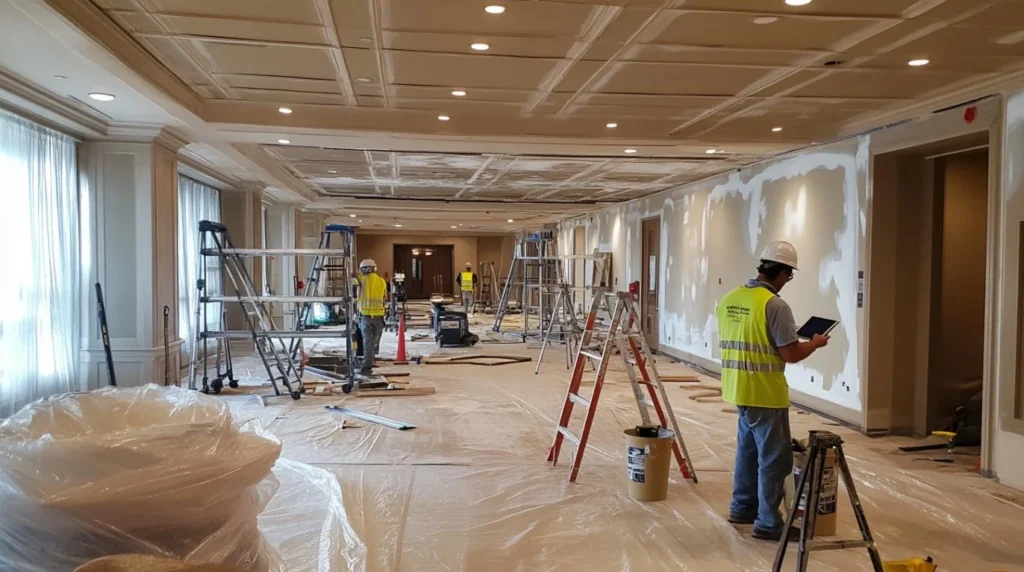
What Is a Hotel PIP
A hotel PIP is a Property Improvement Plan. In simple terms, it is a brand-issued roadmap of upgrades a hotel must complete to meet current brand standards and maintain or secure brand approval. Unlike a standard renovation, a hotel PIP is usually tied to the franchise relationship and comes with defined requirements and deadlines.
That is what sets a hotel PIP apart from a normal renovation. A standard renovation may be optional, strategic, or purely cosmetic. A hotel PIP is usually not. It is often driven by franchisors or brand managers and can include a wide range of physical, operational, and compliance-related upgrades.
What Usually Triggers a Hotel PIP
A hotel usually receives a PIP during franchise renewal, after a quality inspection, during a change of ownership, or as part of a conversion or rebrand. Brand-wide refresh cycles can also trigger one. In some cases, brands may issue a PIP earlier if a property falls behind current standards or guest satisfaction expectations.
Is a Hotel PIP Optional or Mandatory
In most franchised situations, a hotel PIP is not just a suggestion. It is usually a brand requirement tied to the franchise relationship. Owners typically need to complete the required upgrades within a defined period if they want to maintain the brand flag. That’s why many owners treat a PIP less like a wish list and more like a business obligation with a clear deadline.
What Does a Hotel PIP Usually Include
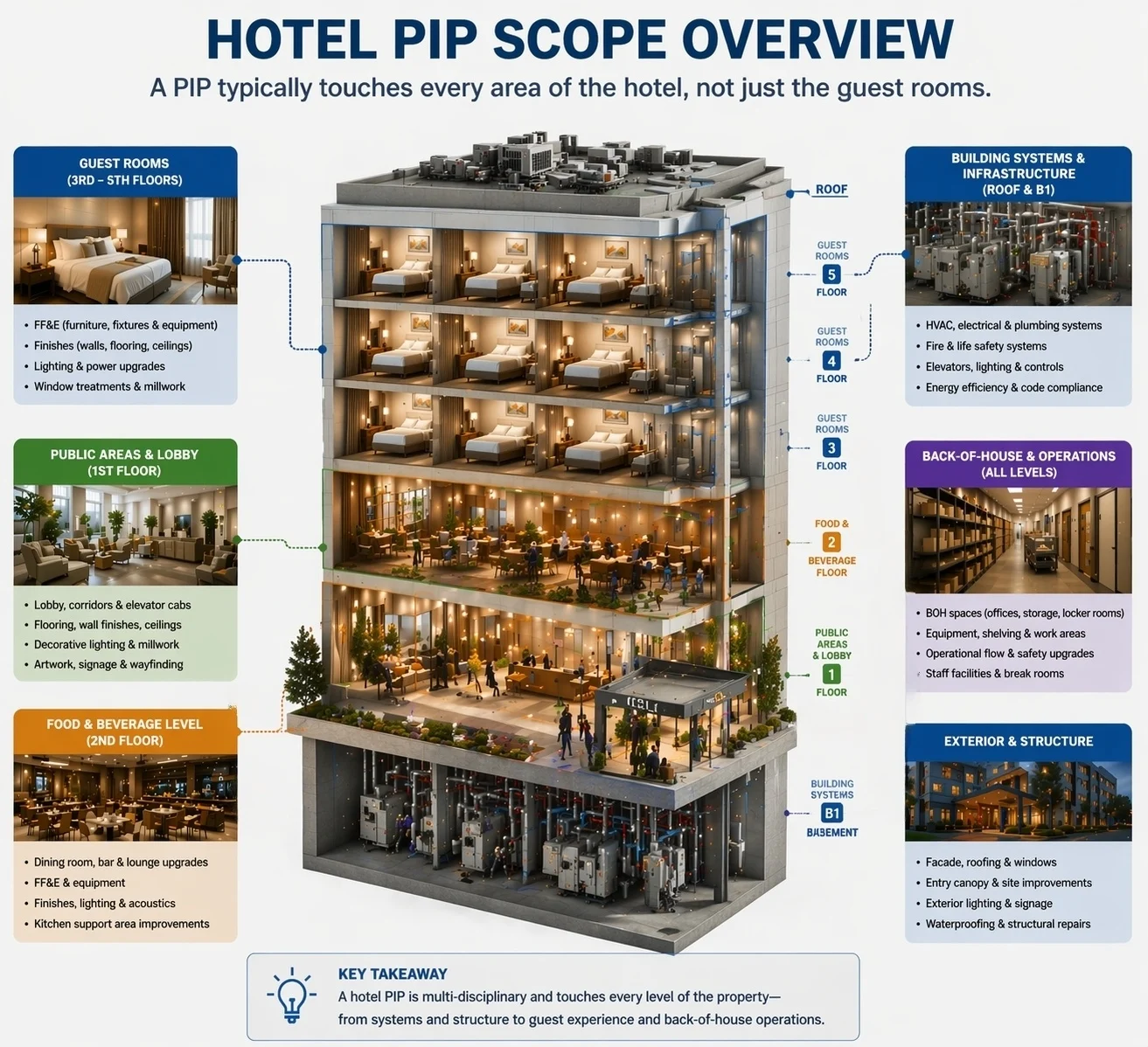
A hotel PIP can involve much more than furniture and finishes. Depending on the property, it may include exterior work, public spaces, amenities, interior upgrades, accessibility improvements, and back-of-house updates. In other words, a hotel PIP is usually a whole-property exercise, not just a room refresh.
Guest Room Scope
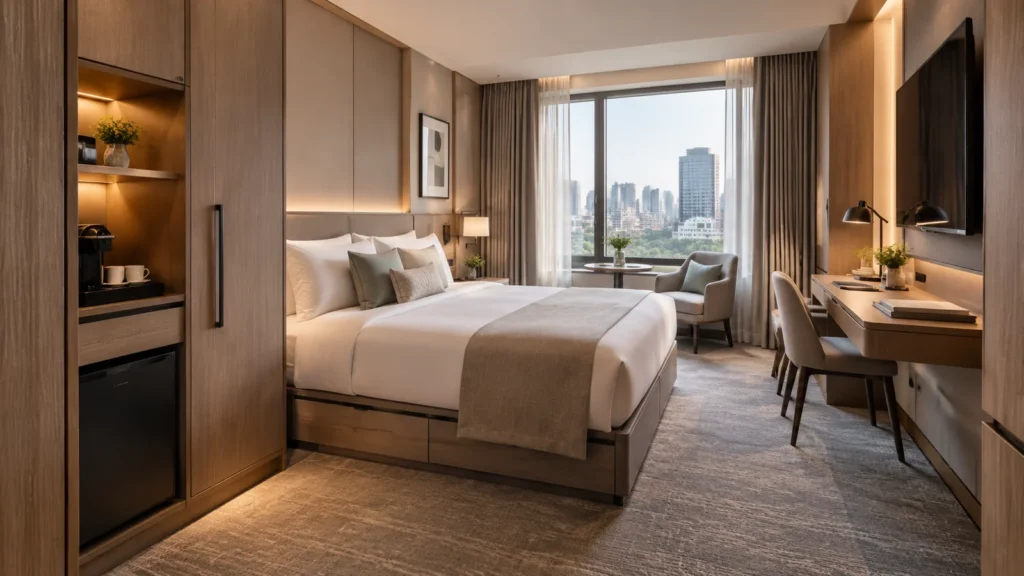
Guest rooms are often the most visible part of a hotel PIP because they shape the daily guest experience. Brands often focus on bedding, lighting, workspace comfort, technology, and room functionality. In practice, guest room scope may include casegoods, wardrobes, headboards, bathroom vanities, flooring, wall finishes, lighting, and in-room upgrades that help the space feel current again.
Public Area Scope
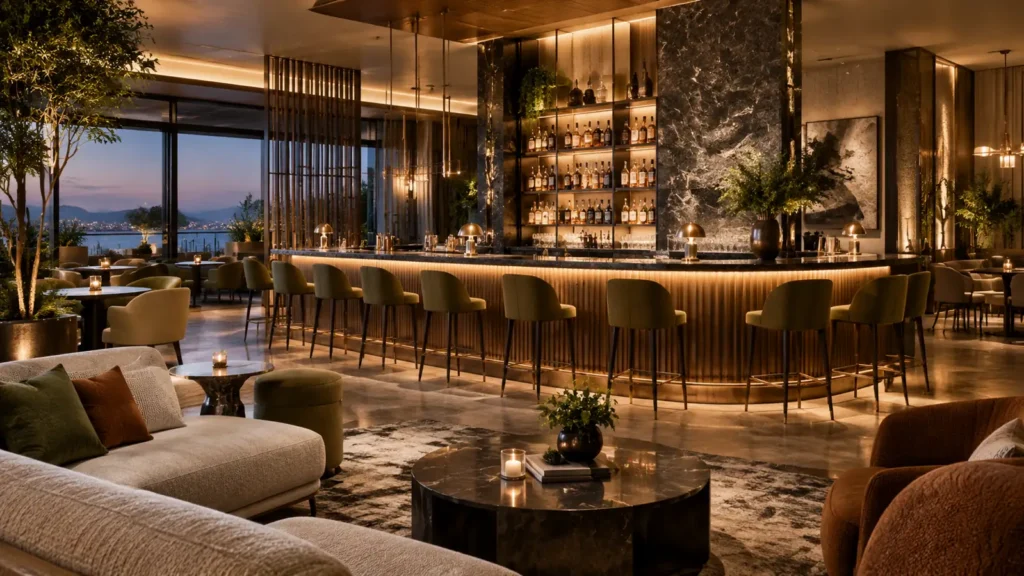
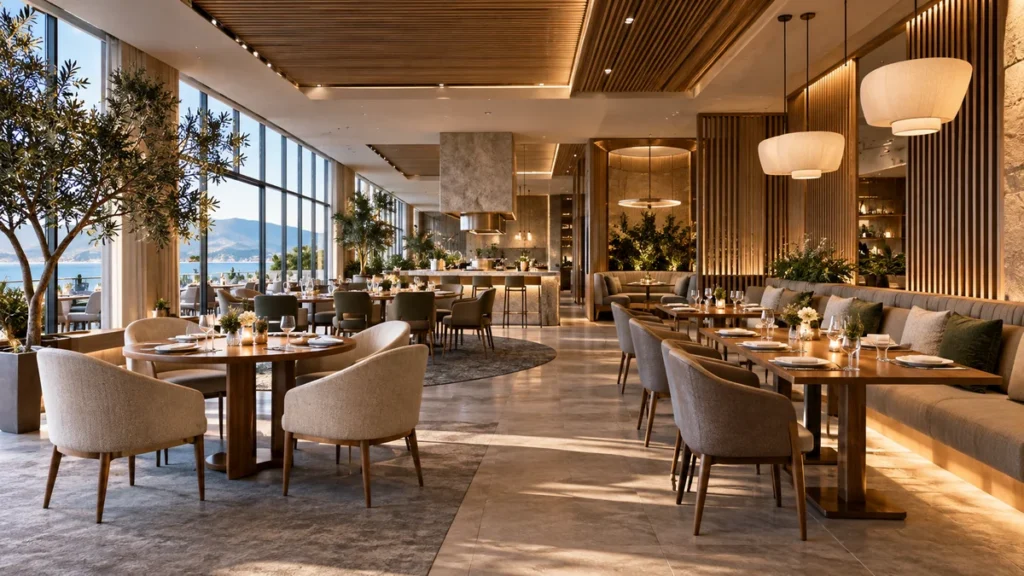
Public areas usually follow close behind. Lobby, reception, corridors, breakfast or dining areas, lounges, meeting rooms, and signage are common targets because they shape both first impressions and overall brand image. These spaces often need to feel more current, more consistent, and more aligned with the latest brand standards.
Back-of-House and Systems Scope
This is where many owners realize that the real cost is not always in what guests see. Older properties may need HVAC, plumbing, electrical, ventilation, life-safety, or accessibility-related upgrades. In many hotel PIPs, systems and compliance items can have a major impact on both budget and project complexity.
Compliance and Brand-Standard Items
A hotel PIP is also about consistency. Brands want the guest experience to feel current and recognizable across locations. That’s why compliance in a hotel PIP is not only about code requirements. It is also about meeting brand standards, review requirements, and approval expectations before purchasing and installation begin.
Cosmetic Items vs. Infrastructure Items
This distinction matters more than many owners expect. Cosmetic work includes finishes, soft goods, decorative lighting, and visual refreshes. Infrastructure work includes systems, accessibility, and hidden technical fixes. Newer hotels may need mostly surface-level updates, while older hotels may require deeper mechanical or electrical work. That is one of the fastest ways to understand why two hotel PIPs can look similar on paper but feel completely different in cost and complexity.
Hotel PIP Budget: Where the Money Really Goes
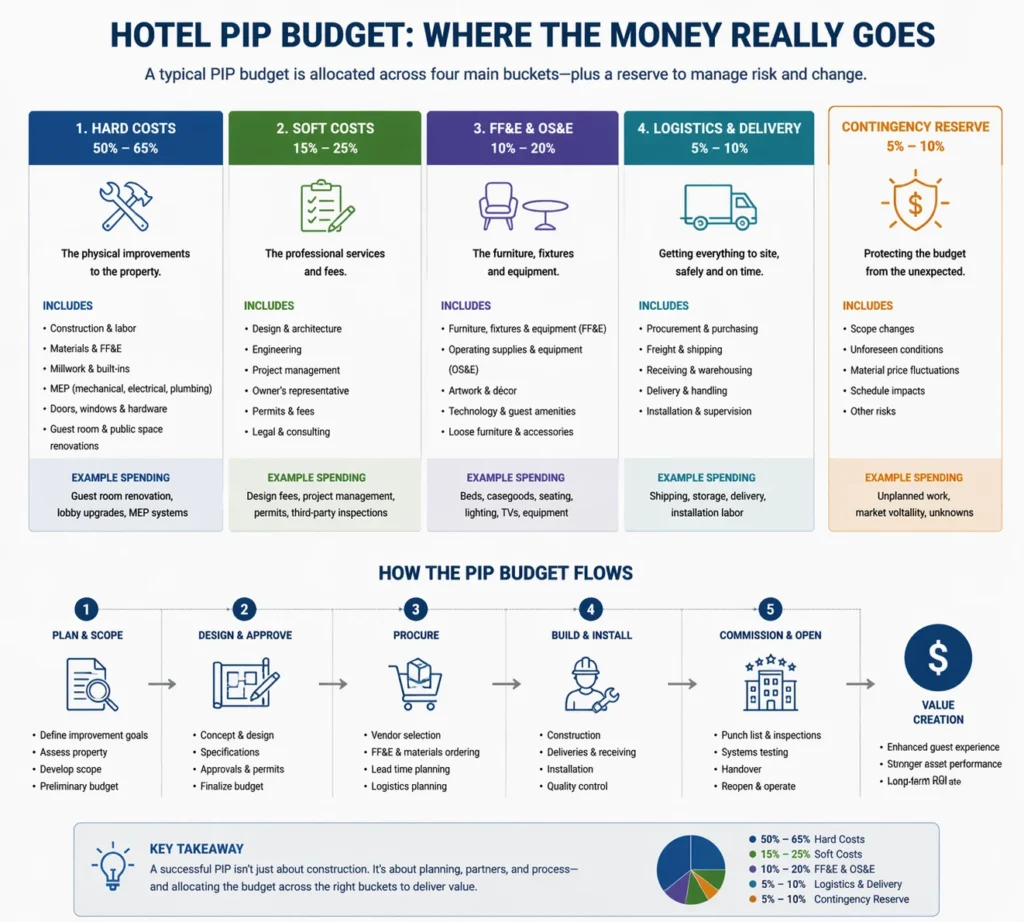
The real budget question is not just, “How much will a hotel PIP cost?” A better question is, “Where will the money actually go?” Hotel PIP costs can vary significantly depending on the property condition, brand standards, and the overall scope of work. That’s why many owners feel budget pressure early, even before construction begins.
Most hotel PIP budgets can be understood through 4 main cost buckets plus a contingency reserve:
- Hard Costs: These are the physical improvements to the property, including guest room and public space renovations, construction labor, materials, millwork, MEP systems, doors, and windows.
- Soft Costs: Professional services such as design and architecture, engineering, project management, owner representation, permits, and legal or consulting fees.
- FF&E & OS&E: Furniture, fixtures, equipment, operating supplies, artwork, décor, and guest amenities for guest rooms and public spaces.
- Logistics & Delivery: Procurement, shipping, receiving, handling, and installation supervision to ensure materials and equipment reach the site safely and on time.
- Contingency Reserve: A safety buffer to protect the budget from unforeseen conditions, scope changes, material price fluctuations, schedule impacts, and other risks.
This is how costs usually spread once design, approvals, sourcing, delivery, and installation begin moving at the same time.
If you want a deeper breakdown of hotel PIP cost buckets, hidden costs, and cost control strategies, read our guide on Hotel PIP Budget Guide: Where the Money Goes and How to Control It.
What Drives the Budget Up
Several factors can push a hotel PIP budget higher. Building age matters. Brand tier matters. Scope matters. Whether the hotel stays open during the work also matters. Older properties often carry more hidden risk behind finished surfaces, while more demanding brands usually require a higher level of consistency, quality, and compliance across the property.
Hidden Costs Owners Often Miss
This is where many hotel PIP budgets begin to drift. Common hidden costs include storage fees, out-of-service rooms, brand-required consultants, delayed approvals, and hidden building conditions that only appear after work begins. In simple terms, a hotel PIP budget is not only about what you buy. It is also about what gets delayed, revised, re-ordered, or held in storage.
How Can Owners Control Hotel PIP Cost
The smartest cost control usually happens before construction starts, not after it. Owners can reduce cost risk by reviewing the PIP line by line with the brand team, clarifying unclear items early, and requesting waivers or extensions where they make sense. That matters because the cheapest mistake is usually the one caught before ordering begins.
Hotel PIP Timeline: From Brand Notice to Final Sign-Off
A hotel PIP timeline is rarely a straight line. It moves through review, approvals, design decisions, procurement checkpoints, installation, and final closeout. While many hotel PIPs are expected to be completed within a defined brand timeline, the bigger point is simple: the pressure starts as soon as the notice arrives, and delays in one stage often affect every stage that follows.
Stage 1: Notice and Scope Review
The first step is not shopping. It is review. At this stage, owners need to meet with the brand reviewer, go through each line item, and clarify what is required, what is unclear, and what may still be negotiable.
Stage 2: Waivers, Variances, and Timeline Negotiation
This stage can protect both budget and schedule. Some hotel PIP items may be deferred, substituted, or phased if the case is strong enough. Owners may also request waivers or timeline extensions where appropriate.
Stage 3: Survey, Design, and Brand Submission
Once the scope is clearer, the project moves into site verification, design development, and brand submission. At this point, materials, product specifications, layouts, and proposed modifications usually need to be reviewed before purchasing begins.
Stage 4: Mock-Up and Approval Loop
A well-prepared mock-up helps test layout, finishes, furniture, lighting, and functionality before the work is repeated at scale. It is not just a presentation tool. It is also a risk-control step that helps owners catch issues early and reduce rework. For a deeper look at what a hotel PIP mock-up room should test before full rollout, read our Hotel PIP Mock-Up Room Guide .
Stage 5: Procurement and Production
This is the point where planning turns into purchasing and production. Long-lead items, shipping, substitutions, and supplier reliability all begin to matter more. Sequence also becomes critical as some items move immediately while others are phased later.
Stage 6: Installation, Punch List, and Final Sign-Off
Occupied hotels make this stage more complex. Mock-up approvals should already be in place before full rollout begins, and substitutions should be confirmed in writing before installation moves forward. A running punch list should also be reviewed and signed off during each phase.
The Biggest Owner Risks in a Hotel PIP
A hotel PIP rarely goes wrong in just one way. The risks usually build across approvals, budget, timing, operations, and long-term asset decisions. A hotel PIP is not just a renovation event. It is also a financial, operational, and strategic turning point for the property.

Approval, Budget, and Timeline Risks
Brand approval risk
A slow or messy approval process can push the entire hotel PIP off course. If the team does not follow exact brand requirements, delays and extra costs can appear much earlier than expected. Design approval, submission review, and final inspection are all connected, so missed decisions early often return later as larger problems.
Read our guide, How to Pass Brand Approval in a Hotel PIP Without Costly Rework, for a clearer approval path.
Budget overrun risk
Budget overruns usually start with incomplete scope, hidden conditions, and late changes. Unseen wiring, water damage, storage costs, and revenue displacement can all add pressure once the work begins. Rising market costs only make those problems harder to absorb, especially when key decisions are made too late.
Timeline delay risk
A delayed hotel PIP is often a more expensive hotel PIP. Review, waiver requests, submissions, and approvals usually happen before ordering starts. When those steps slip, procurement and installation slip with them. That’s why “we will make it up later” rarely works in a brand-led renovation process.
Operational and Compliance Risks
Revenue disruption risk
A hotel is not a warehouse. Guests still arrive. Rooms still need to sell. When phasing is weak, a hotel PIP can start damaging the very revenue stream that is funding it. Out-of-service rooms, poor handback timing, and weak guest-ready planning can quickly turn renovation pressure into operating pressure.
Compliance and liability risk
Some owners focus too much on appearance because it is easier to see. But ADA, life safety, ventilation, and other system-related requirements are often more critical. These items may not be as visible as a new guest room finish, but they carry much more risk if ignored. A pretty room does not solve a compliance gap.
Rework risk
Rework is the quiet profit killer in hotel PIP execution. Mock-ups, written approvals, and signed punch lists help catch issues before they repeat across the property. When teams skip approval discipline, they do not save time. They simply move the correction cost to a later and more expensive stage.
Strategic Risk
Sometimes the biggest question is not, “How do we finish this hotel PIP?” but, “Is this still the right investment path for the asset?” For some owners, the PIP moment is also the moment to decide whether to reinvest, reflag, hold, or sell. That’s why a hotel PIP is never only a project-management issue. It is also an asset strategy issue.
How Owners Can Reduce PIP Risk Before Construction Starts
Owners usually get better results when they reduce uncertainty before construction starts. In most hotel PIP projects, the biggest problems do not begin during installation. They begin earlier, when scope is still unclear, approvals are incomplete, or key decisions are pushed too late.
Before construction starts, owners usually need to get seven things under control:
- review each PIP item with the brand reviewer
- separate must-have items from negotiable items
- verify site conditions before finalizing scope
- build a real budget with contingency
- approve mock-ups before mass rollout
- identify long-lead items early
- phase the work around occupancy and guest impact
These steps matter because they help reduce confusion before it turns into cost, delay, or rework.
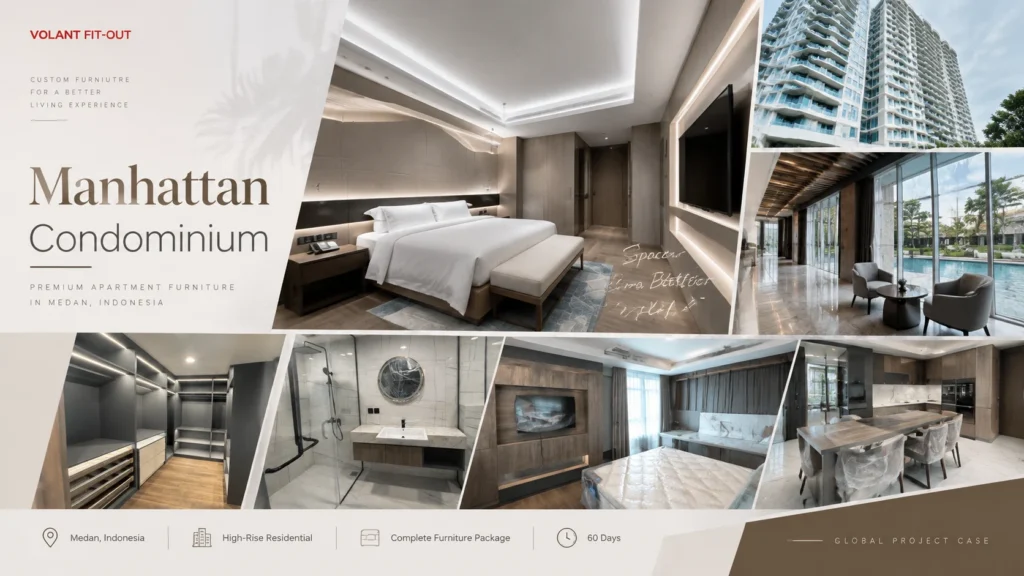
Delivery structure also matters at this stage. A hotel PIP usually involves design coordination, approvals, procurement, logistics, and installation, not just product buying. That’s why fragmented responsibility often increases handoff risk. For owners who want tighter control across those steps, a more integrated fit-out approach can be easier to manage. This is also where Volant’s model becomes relevant, because hotel PIP execution usually depends on coordination across approvals, sourcing, logistics, and installation, not just the products themselves.
Do All Hotel PIPs Require the Same Level of Work
No. The level of work can vary significantly from one property to another. Older hotels may need deeper mechanical, electrical, or compliance-related upgrades, while newer properties may only need lighter cosmetic updates. In some cases, the scope may be limited to bedding, finishes, or paint. In others, it may extend to lobby overhauls, systems work, or broader infrastructure improvements.
A select-service property, a full-service hotel, and a luxury conversion may all receive a hotel PIP, but the scope, capital pressure, and delivery path will not be the same. The same applies to a hotel that stays open during the work versus one that can shut down sections more freely. The label stays the same. The delivery reality does not.
Final Thoughts
A hotel PIP is not just a renovation checklist. It is a brand requirement, a capital decision, a timeline challenge, and a risk-management exercise at the same time. Owners who clarify scope, budget, timeline, and risk early usually make better decisions later. That does not remove the pressure, but it makes the process easier to control.
It also explains why coordination matters so much in hotel PIP execution. Approvals, mock-ups, procurement, logistics, and installation all affect each other. For owners looking for a more connected delivery process, this is where an integrated fit-out approach becomes more useful. Volant Fit-Out fits naturally into that conversation because its model is built around the same coordination points that often decide whether a hotel PIP moves smoothly or starts to drift.
If you are preparing for a hotel PIP and want to reduce risk before construction starts, contact Volant. We can help you review scope, improve coordination, and build a clearer delivery path for your project.
FAQs
What is a hotel PIP?
A hotel PIP, or Property Improvement Plan, is a brand-issued list of upgrades and renovation requirements that a hotel must complete to meet current brand standards. In most franchised situations, it is tied to the franchise relationship rather than being a purely optional renovation.
What usually triggers a hotel PIP?
A hotel PIP is commonly triggered by franchise renewal, a change of ownership, a conversion or rebrand, or a quality inspection that shows the property no longer meets brand standards. Some brands may also require one during broader brand refresh cycles.
How much does a hotel PIP usually cost?
There is no single standard number because the budget depends on the hotel’s age, brand standards, property condition, and the depth of required upgrades. In practice, costs can range widely, which is why owners usually need to focus first on where the money will go, not just the total number.
How long does a hotel PIP usually take?
Many hotel PIPs are expected to be completed within a defined brand timeline, and some current industry guidance commonly cites a 12 to 24 month window. The actual duration still depends on approvals, scope, procurement, and whether the hotel remains open during the work.
Can hotel owners negotiate PIP items or deadlines?
In many cases, yes. Owners may be able to request waivers, variances, substitutions, or timeline extensions, especially when they can justify why certain items should be deferred, phased, or handled differently.