Hotel bathroom vanity design is about much more than choosing a sink and countertop. A well-planned hotel bathroom vanity shapes the guest’s first impression, supports faster cleaning, and reduces maintenance calls over time.
Unlike a residential vanity, a hotel vanity has to work harder every day. Guests use it constantly, housekeeping cleans it repeatedly, and water, cosmetics, soap, luggage, and cleaning products all put the surface to the test.
So, how do you choose the right vanity for a hospitality project? Start with three key factors: materials, size, and durability. Then look at installation, ADA room requirements, maintenance needs, and long-term replacement costs. Let’s break it down.
What Is a Hotel Bathroom Vanity?
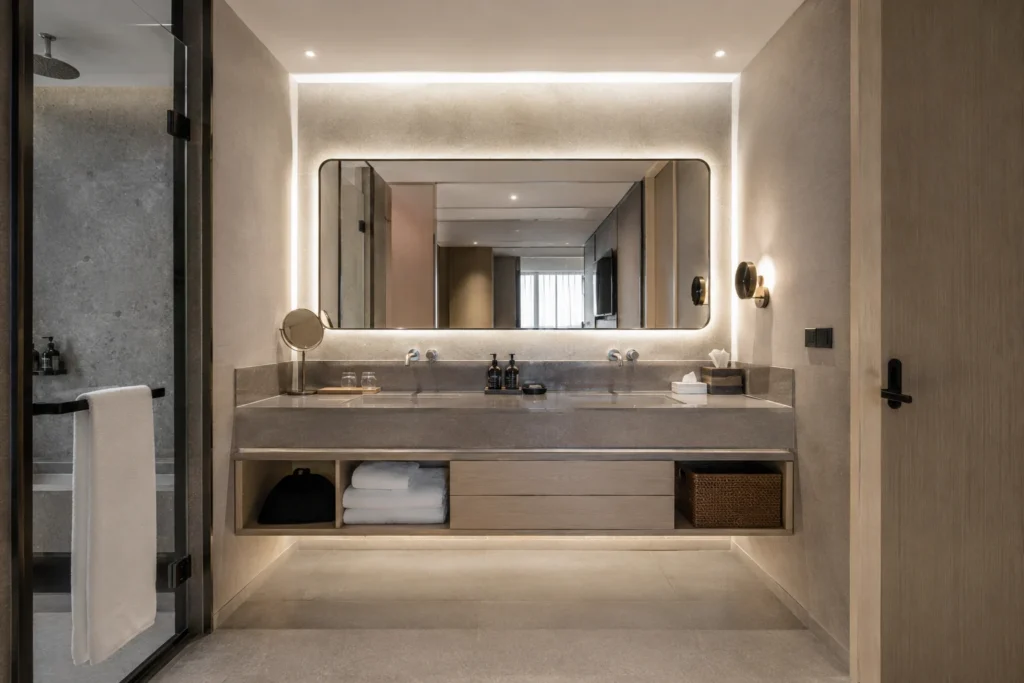
In hotel bathroom vanity design, the vanity is the complete sink, countertop, and storage area in a guest bathroom. It is where guests wash up, store daily items, and get ready for the day.
A typical hotel bathroom vanity may include:
- Vanity top or countertop
- Basin or integrated sink
- Cabinet body
- Faucet holes
- Backsplash
- Side splash
- Drawers or open shelves
- Plumbing clearance
- Wall brackets or floor supports
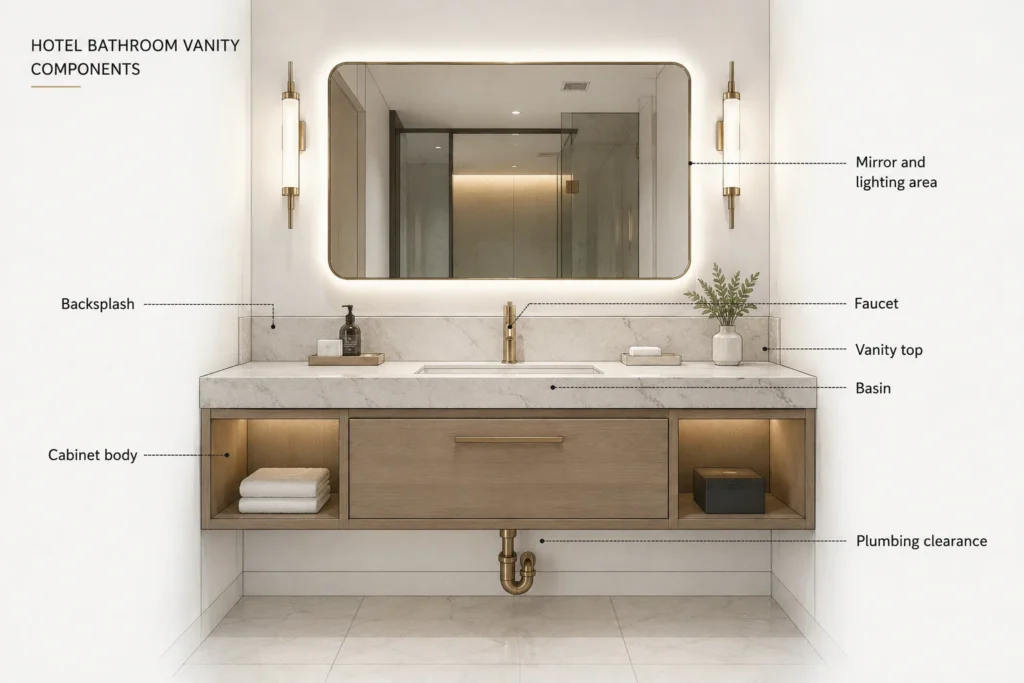
In many hotel projects, the mirror, lighting, and outlet placement are also planned around the vanity area. They are not always part of the vanity itself, but they affect how the vanity feels and works.
Many people only focus on the vanity top. That is a mistake. A beautiful countertop will not help if the cabinet swells. A strong cabinet will not help if the basin leaks. A premium sink will not help if the layout feels cramped.
A good hotel vanity works like a small system. Every part must fit together, from the surface material to the plumbing space behind it. When the system is planned well, the vanity looks better, cleans faster, and lasts longer. If you want to plan the cabinet, mirror, lighting, stone top, basin and sanitary ware together, read our hotel bathroom vanity unit guide.
How Hotel Bathroom Vanity Design Differs from Residential Vanity Design
At first glance, a hotel vanity and a residential vanity may look similar. In practice, they serve very different needs. A residential vanity is designed for one household, while a hotel vanity must support guest experience, daily cleaning, and long-term operations at the same time.
Residential Bathroom Vanity Design
Designed for one family or household
- Lower daily use
- Personalized style choices
- More freedom in materials
- Less frequent cleaning
- Replacement is less urgent
- Maintenance is occasional
- Design often focuses on comfort and appearance
Hotel Bathroom Vanity Design
Designed for hundreds of guests over time
- Heavy daily use
- Frequent water exposure
- Daily housekeeping cleaning
- Fast room turnover
- Consistent design across rooms
- Easy maintenance and replacement
- Design must balance appearance, durability, and efficiency
That is the real difference. A residential vanity is mainly about personal comfort and style. A hotel bathroom vanity must also support durability, cleaning efficiency, and smooth day-to-day operations. In hospitality, looks matter, but performance matters more.
Best Hotel Bathroom Vanity Top Materials

In hotel bathroom vanity design, the vanity top is the most visible and heavily used surface. It also handles the most daily wear.
Guests place makeup, razors, toothpaste, hair dye, skincare bottles, and wet towels on it. Housekeeping cleans it again and again. So the surface must be easy to clean, stain-resistant, and stable in a humid bathroom.
The right material depends on your hotel type, budget, design level, and maintenance plan. Here are the most common options for hospitality projects.
Quartz Vanity Tops
Quartz is a reliable choice for hotels that need a premium look, consistent color, and lower maintenance across many rooms.
Best for:
- Midscale hotels
- Business hotels
- Upscale guest rooms
- Projects needing consistent color and pattern
- Properties that want a stone-like look with easier care
Watch out for:
- Visible seams on long vanity tops
- Edge chipping from strong impact
- Heavy slab weight
- Higher cost than budget materials
Best use: Choose quartz when you want a premium look with strong everyday performance.
Solid Surface Vanity Tops
Solid surface is popular in hospitality because it can be shaped into integrated sinks, seamless backsplashes, and smooth edges.
Best for:
- Chain hotels
- High-traffic guest rooms
- Modern bathroom designs
- Integrated sink designs
- Projects focused on easy cleaning
Watch out for:
- Scratches from sharp objects
- Heat sensitivity
- Quality differences between suppliers
- Lower hardness than quartz or porcelain
Best use: Choose solid surface when fewer seams and easier cleaning matter most.
Sintered Stone and Porcelain Slabs
Sintered stone and porcelain slabs offer a refined stone look, low water absorption, and strong resistance to stains.
Best for:
- Luxury hotels
- Resorts
- Premium suites
- Modern stone-look bathrooms
- Projects needing a high-end visual finish
Watch out for:
- More complex fabrication
- Higher material and processing cost
- Edge protection requirements
- Higher installation skill requirements
Best use: Choose these materials for luxury spaces where design impact is important.
Cultured Marble Vanity Tops
Cultured marble is often used in economy hotel projects because it is cost-effective, easy to install, and suitable for standard rooms.
Best for:
- Economy hotels
- Budget renovations
- Standardized guest rooms
- Cost-sensitive projects
- Projects with planned replacement cycles
Watch out for:
- Surface wear over time
- Lower premium feel
- Possible discoloration
- Less resistance than higher-end materials
Best use: Choose cultured marble when budget control and simple replacement are priorities.
Natural Marble and Granite
Natural stone gives a hotel bathroom a rich and timeless look. Marble feels luxurious, while granite feels strong and classic.
Best for:
- Luxury accents
- Boutique hotels
- Premium suites
- Feature bathrooms
- Projects where natural variation is part of the design
Watch out for:
- Sealing needs
- Acid sensitivity
- Color variation
- Higher maintenance
- Harder replacement matching
Best use: Choose natural stone when the design needs a premium statement and the maintenance plan is clear.
Hotel Bathroom Vanity Material Comparison Chart
After reviewing each material, it helps to compare them side by side. Use this table as a quick starting point, then confirm the final choice based on room type, budget, cleaning routine, and supplier specifications.
| Material | Durability | Typical Maintenance | Best Use |
|---|---|---|---|
| Quartz | High | Low | Business and upscale hotels |
| Solid Surface | Medium-High | Low | Chain hotels and integrated sinks |
| Sintered Stone / Porcelain Slab | Very High | Low | Luxury hotels, resorts, and premium bathrooms |
| Cultured Marble | Medium | Medium | Economy hotels and budget renovations |
| Natural Marble | Medium | High | Luxury accents and boutique hotels |
| Granite | High | Medium | Classic premium designs |
The best material is not always the most expensive one. It is the material that fits your hotel type, budget, cleaning process, and guest expectations.
Best Cabinet Materials for Hotel Bathroom Vanities
Cabinet materials are often overlooked in hotel bathroom vanity design, but they can decide how long the vanity lasts. Guests may notice the countertop first, but your maintenance team will notice the cabinet.
Moisture is the biggest challenge. If the cabinet body swells, cracks, or delaminates, the whole vanity can fail. That is why cabinet material, edge sealing, hardware, and installation details all matter.
Moisture-Resistant Plywood
Moisture-resistant plywood is a strong choice for hotel vanity cabinets that need better screw-holding strength and long-term stability.
Good for:
- Midscale hotels
- Upscale hotels
- Wall-hung vanities
- Long-term projects
- Bathrooms with higher humidity
Best use: Choose it when the project needs stronger cabinet structure and better moisture control.
High-Pressure Laminate (HPL) Panels
HPL laminate panels offer good value, many finish options, and consistent color across large hotel bathroom vanity projects.
Good for:
- Chain hotels
- Standard guest rooms
- Cost-controlled projects
- Projects needing consistent finishes
- Modern hotel bathroom designs
Best use: Choose HPL when you need clean design, stable finishes, and scalable production.
MDF and Particle Board
MDF and particle board can help control cost in hotel vanity cabinets, but they need careful specification in wet bathroom environments.
Good for:
- Budget-sensitive projects
- Economy hotel rooms
- Short-term renovation projects
- Dry or well-ventilated bathrooms
- Projects with strict cost control
Best use: Use only when grade, coating, edge banding, and ventilation are clearly controlled.
Aluminum or Stainless-Steel Structures
Aluminum and stainless-steel structures resist moisture better than most wood-based panels and suit clean, modern designs.
Good for:
- Coastal hotels
- Resorts
- Public washrooms
- High-humidity projects
- Modern floating vanity designs
Best use: Choose metal structures when moisture resistance is more important than a traditional cabinet look.
Hardware Matters Too
Hinges, drawer slides, brackets, and screws may look small, but they affect how long the vanity stays aligned, quiet, and easy to use.
Specify carefully:
- Corrosion-resistant hinges
- Soft-close drawer slides
- Strong wall brackets for floating vanities
- Stainless-steel fasteners where needed
- Hardware tested for repeated daily use
Best use: Treat hardware as part of the vanity system, not as an afterthought.
Size Planning in Hotel Bathroom Vanity Design

Size planning is one of the most important parts of hotel bathroom vanity design. A vanity that is too small may not provide enough counter space. A vanity that is too large can make the room feel tight and difficult to clean.
The goal is balance. A good hotel bathroom vanity should feel comfortable for guests, fit the room layout, and leave enough clearance for daily housekeeping.
Common Hotel Bathroom Vanity Height
32–36 inMost hotel bathroom vanities use this height range. For many modern guest rooms, 34–36 inches feels more comfortable. Accessible rooms need separate ADA planning.
Common Hotel Bathroom Vanity Depth
18–24 inA 21-inch depth works well in many standard hotel bathrooms. Compact rooms may need 18 inches to save space and improve clearance.
Common Hotel Bathroom Vanity Width
24–72 in+Vanity width depends on room type. Compact rooms may use 24–30 inches, while suites or double vanities may need 60 inches or more.
Hotel Vanity Width Chart by Room Type
| Room Type | Recommended Width | Notes |
|---|---|---|
| Compact guest room | 24–30 in | Saves space in small bathrooms |
| Standard guest room | 30–36 in | Common range for many hotel rooms |
| Premium room | 36–48 in | Provides more counter space |
| Suite vanity | 48–60 in | Improves comfort and storage options |
| Double vanity suite | 60–72 in+ | Best for large bathrooms and luxury suites |
These are planning ranges, not universal rules. Always check the room layout, plumbing position, door swing, guest clearance, and local code before finalizing the vanity size.
Should You Choose a Single Sink or Double Sink Vanity?
A double sink sounds luxurious. But is it always the better choice? Not really.
In many hotel bathrooms, counter space is more valuable than a second basin. Guests need space for toiletry bags, makeup, phones, towels, and daily items. A double sink can also increase plumbing cost and cleaning time.
Choose a double sink when:
- The bathroom is large
- The room is a suite
- The target guest expects a luxury experience
- There is enough counter space left after both basins
- The plumbing layout supports two sinks
For most standard guest rooms, one well-placed sink often works better. It saves space, keeps the layout simple, and gives guests more usable countertop area.
Floating Vanity vs Floor-Mounted Vanity in Hotel Bathroom Vanity Design
Both options can work in hotel bathroom vanity design. The right choice depends on wall structure, room size, storage needs, budget, and cleaning requirements.
Floating Hotel Bathroom Vanity
A floating hotel vanity looks clean, modern, and lighter in the room. It also makes floor cleaning easier for daily housekeeping.
Works well in:
- Modern hotels
- Compact bathrooms
- Accessible room designs
- High-design guest rooms
- Projects focused on easier floor cleaning
Watch out for:
- Wall strength
- Bracket quality
- Installation accuracy
- Limited storage space
- Higher installation requirements
Best use: Choose a floating vanity when you want a modern look and easier floor cleaning.
Floor-Mounted Hotel Bathroom Vanity
A floor-mounted vanity offers more storage and simpler installation. It can also feel more stable when wall support is limited.
Works well in:
- Standard guest rooms
- Traditional bathroom designs
- Rooms needing more storage
- Projects with limited wall support
- Cost-controlled hotel projects
Watch out for:
- Harder floor cleaning around the base
- Possible moisture exposure at the bottom
- Heavier visual appearance in small bathrooms
Best use: Choose a floor-mounted vanity when storage, stability, and simpler installation matter more.
ADA Requirements for Accessible Hotel Bathroom Vanities

ADA planning should be part of hotel bathroom vanity design from the beginning. ADA lavatory requirements should not be treated as an afterthought. They affect the sink, cabinet, plumbing, mirror, faucet, and clear floor space.
For accessible hotel vanity design, consider:
- Counter or rim height no higher than 34 inches
- Open knee and toe clearance below the sink
- Protected pipes and smooth surfaces under the basin
- Wall-hung or open-bottom vanity design
- Lever, touch, or sensor faucet controls
- Shallow basin with reachable controls
- Mirror placement planned for seated users
- Enough clear floor space for a forward approach
Accessible design is not only about compliance. It also makes the bathroom easier, safer, and more comfortable for more guests.
Durability Requirements in Hotel Bathroom Vanity Design
A hotel vanity needs to handle daily hotel use, not just look good on opening day. That means moisture, stains, cleaning chemicals, impact, and years of repeated use.
Moisture Resistance
Water is always present in a hotel bathroom, so moisture protection should be built into the vanity design.
What to check:
- Proper sealing
- Moisture-resistant cabinet materials
- Tight backsplash joints
- Quality silicone in wet areas
- Raised or protected cabinet bases
- Good bathroom ventilation
Best use: Keep water away from cabinet edges, where swelling and delamination often start.
Stain Resistance
Hotel vanity tops meet toothpaste, makeup, hair dye, sunscreen, soap, alcohol-based products, and cleaning chemicals.
What to check:
- Easy-clean surface finish
- Resistance to common bathroom stains
- Compatibility with housekeeping cleaners
- Low water absorption
- Supplier cleaning guidelines
Best use: Confirm cleaning product compatibility before final material approval.
Scratch and Impact Resistance
Hotel bathrooms experience fast, repeated use. Bottles, toiletry bags, and nearby luggage can all damage weak surfaces.
What to check:
- Rounded edges
- Impact-resistant materials
- Protected exposed corners
- Quality edge fabrication
- Resistance to daily surface scratches
Best use: Rounded edges work like a bumper and help reduce damage from daily knocks.
Repairability
Every hotel eventually needs repairs. A vanity that is easier to repair can reduce room downtime and maintenance stress.
Ask suppliers:
- Can scratches be repaired?
- Can chips be filled?
- Can one unit be replaced later?
- Will the color still match future replacements?
- Are spare tops or panels available?
Best use: Choose repairable materials when long service life and fast maintenance matter.
Repairability matters because room downtime costs money. A vanity that is easier to repair can reduce maintenance stress and keep rooms in service longer.
Hotel Bathroom Vanity Design Details That Improve Guest Experience
A hotel vanity should feel simple, clean, and easy to use. Guests may not notice every detail, but they will feel it when the countertop is too small, the lighting is poor, or the storage is awkward.
Key details to plan include:
- Counter Space — Do not let the sink take over the whole countertop. Guests need space for toiletry bags, makeup, phones, towels, and daily items.
- Storage Layout — Match storage to the hotel type. Short-stay hotels may use open shelves. Long-stay hotels often need drawers. Resorts may need towel storage.
- Easy-Clean Shapes — Avoid deep grooves, complex trim, and hard-to-reach corners. Smooth surfaces, simple edges, and fewer seams help housekeeping clean faster.
- Practical Backsplash — A backsplash protects the wall from splashes. An integrated backsplash is often easier to clean because it reduces extra seams.
- Mirror and Lighting — Mirror height, lighting, outlet placement, and faucet location all affect the guest experience. A beautiful vanity with poor lighting still feels wrong.
Once the functional details are defined, explore these hotel bathroom vanity design ideas for practical examples of floating, compact, wall-to-wall, double-basin, and integrated-basin layouts for different hospitality projects.
How to Choose Hotel Bathroom Vanity Design by Hotel Type
Different hotels need different vanity solutions. A budget hotel may need fast replacement and cost control. A resort may need stronger moisture resistance. A luxury suite may need a larger vanity with a more refined finish. The best choice depends on the guest profile, room size, maintenance plan, and project budget.
Economy Hotels
Economy hotels should focus on cost control, standard sizes, and easy replacement. The vanity does not need to be complex, but it must be durable enough for daily use.
Recommended vanity features:
- Cultured marble tops
- Laminate cabinets
- Standard single sinks
- Simple hardware
- Easy-clean surfaces
- Standardized sizes for easier replacement
Midscale and Business Hotels
Midscale and business hotels need a balance of durability, design, and cost. The vanity should look modern, clean quickly, and stay consistent across many rooms.
Recommended vanity features:
- Quartz or solid surface tops
- Moisture-resistant cabinets
- 30–36 inch standard widths
- Strong hardware
- Clean modern design
- Good counter space for daily guest items
Luxury Hotels and Resorts
Luxury hotels and resorts should focus on guest experience, premium finishes, and stronger design details. The vanity often becomes part of the room’s visual identity.
Recommended vanity features:
- Sintered stone or porcelain slab tops
- Quartz or premium solid surface
- Larger countertops
- Custom vanity sizes
- Premium hardware
- Custom lighting and mirrors
Long-Stay Hotels
Long-stay hotels need more storage and better daily usability. Guests bring more personal items, so the vanity should feel practical, not just attractive.
Recommended vanity features:
- Larger drawers
- More counter space
- Strong stain resistance
- Durable hardware
- Easy-to-clean materials
- Storage for daily personal items
Coastal Hotels
Coastal hotels need extra moisture protection. Humidity, salt air, and frequent cleaning can shorten the life of weak materials.
Recommended vanity features:
- Solid surface tops
- Porcelain or sintered stone
- Aluminum or sealed plywood cabinets
- Corrosion-resistant hardware
- Extra ventilation planning
- Strong edge sealing and moisture control

Procurement Checklist for Hotel Bathroom Vanity Design
Before placing an order, confirm the details. In hotel projects, one small mistake can repeat across dozens or even hundreds of rooms. A clear checklist helps reduce rework, delays, and installation problems.
Before Ordering the Vanity
- Room types
- Vanity quantities
- Width, depth, and height
- Plumbing locations
- Faucet hole layout
- Basin type
- Cabinet material
- Countertop material
- Backsplash detail
- Mirror and lighting layout
- ADA room requirements
- Shop drawings and specifications
Sample and Mock-Up Approval
Never skip the mock-up room. Test the vanity in a real room before mass production. Check the height, sink position, drawer clearance, color, seams, cleaning access, and installation details.
A mock-up catches mistakes before they multiply across 200 rooms.
To understand how vanity drawings move into shop drawings, mock-up approval, bulk production and project delivery, read our hotel bathroom vanity manufacturing guide.
Production Quality Control
- Color consistency
- Edge polishing
- Basin bonding
- Cabinet sealing
- Hardware function
- Packaging strength
- Room-by-room labeling
- Protection for corners and exposed edges
Installation Checks
- Top is level
- Sink drains properly
- Faucet is secure
- Cabinet doors align
- Drawers slide smoothly
- Seams are sealed
- Wall fixing is strong
- No chips or scratches exist
- ADA rooms match the approved layout
Lifecycle Cost in Hotel Bathroom Vanity Design: Look Beyond the Unit Price
The cheapest vanity can become expensive later. Repairs, replacements, and room downtime all add to lifecycle cost.
That is why hotel bathroom vanity design should use life-cycle thinking, not just unit-price comparison. The EPA describes green building as a life-cycle approach that considers design, construction, operation, maintenance, renovation, and deconstruction. The same idea applies to hotel vanity selection.
When comparing hotel bathroom vanity options, calculate:
- Unit price
- Installation labor
- Cleaning time
- Repair frequency
- Replacement cycle
- Spare parts
- Room downtime
- Warranty support
A better vanity is not just the one that looks good on opening day. It is the one that still works well five years later.
Common Mistakes in Hotel Bathroom Vanity Design
Avoiding mistakes is just as important as choosing the right materials. In hotel bathroom vanity design, small decisions can lead to long-term maintenance problems.
- Choosing Residential-Grade Materials — Hotel use is much heavier than home use. Materials that work in a house may not last in a high-traffic guest room.
- Ignoring Cabinet Moisture Protection — The countertop may survive, but the cabinet can still fail. Poor sealing, weak edge banding, and low-grade panels can lead to swelling or delamination.
- Oversizing the Vanity — A big vanity may look premium on paper, but it can make a small bathroom feel cramped. Always check walking clearance, door swing, and cleaning access.
- Skipping ADA Planning — Accessible rooms need different clearances, sink heights, plumbing protection, and mirror placement. Do not copy the standard room layout.
- Using Too Many Seams — More seams mean more places for water, dirt, and mold to collect. Seamless or simplified details are usually easier to clean.
- Choosing Only by Appearance — A beautiful surface can still be hard to maintain. Always consider stain resistance, repairability, cleaning products, and long-term replacement.
- Skipping the Mock-Up Room — One mistake can become hundreds of mistakes. A mock-up helps confirm size, color, installation, drawer clearance, and cleaning access before mass production.
Final Thoughts
A successful hotel bathroom vanity design is not about one beautiful countertop. It is about the full system working together.
The material must resist water and stains. The size must fit the room. The cabinet must handle humidity. The layout must support both guests and housekeeping. The manufacturer or fit out partner must support production, delivery, and future replacement.
When all these pieces work together, the vanity becomes more than bathroom furniture. It becomes part of a better guest experience, smoother hotel operations, and stronger long-term value.
If you are planning a hotel, resort, serviced apartment, or renovation project, VOLANT FIT-OUT can help you develop practical bathroom vanity solutions for your room types, budget, materials, and project schedule. Contact VOLANT FIT-OUT to discuss custom hotel bathroom vanity design, production, and fit-out support for your next hospitality project.
FAQs
What is the best material for a hotel bathroom vanity?
Quartz is a popular choice for hotel vanity tops because it is durable, moisture-resistant, and easy to maintain. For vanity cabinets, moisture-resistant plywood or HPL panels usually provide a good balance of durability, appearance, and cost.
What are the standard dimensions of a hotel bathroom vanity?
Hotel bathroom vanities are commonly 32–36 inches high and 18–24 inches deep. The width depends on the room layout, ranging from approximately 24 inches in compact bathrooms to more than 72 inches for luxury double vanities.
Is a single or double sink better for a hotel bathroom?
A single sink is generally more suitable for standard hotel rooms because it provides more countertop space and requires less plumbing. Double sinks are usually recommended for larger suites designed for two guests.
Is a floating vanity better than a floor-mounted vanity for hotels?
A floating vanity creates a modern appearance and makes the bathroom floor easier to clean. A floor-mounted vanity generally offers more storage and simpler installation. The best option depends on the hotel’s design, wall structure, storage needs, and maintenance requirements.
How can hotels prevent bathroom vanity moisture damage?
Hotels can reduce moisture damage by using water-resistant materials, sealing all exposed edges, installing corrosion-resistant hardware, and applying quality silicone around sinks and backsplashes. Proper bathroom ventilation and regular maintenance are also important.